BLOG

If you are one of the many recent transplants to The Sunshine State, we hope you grow and thrive here!
How to Attract Bees to Your Central Florida Yard
Planting “butterfly gardens” with flowers that attract these fanciful emissaries of spring is popular in Central Florida – as well
How to Water Your Central Florida Lawn
Everyone wants a healthy lawn of full, green turfgrass, but achieving it can be challenging in Central Florida’s climate. New
Seven Common Central Florida Landscaping Problems
Having a landscape that expresses Central Florida’s semi-tropical climate and lifestyle is a dream of many homeowners. But whether you’re
First Hurricane Season in Florida? Here's What You Need to Know!
The Sunshine State has welcomed many newcomers recently! If you are among them, you’ve undoubtedly heard about Atlantic hurricane season,
Great Groundcovers for Central Florida Yards
A lush, green lawn is every Central Florida homeowner’s dream. But for those with a landscaper’s eye, an unbroken expanse
Common Weeds in Central Florida Lawns
The definition of a weed is quite simple. It is basically an unwanted wild plant that grows in your lawn
Great Perennials for Your Central Florida Landscape
Hardy, beautiful, long-living perennials are the gifts that keep on giving to Central Florida landscapes! Many perennial plants are very
Five Ways Landscaping Can Improve Your Home's Value
So you’re putting your house up for sale! Of course, you want to be sure that it sells for top

First Fall in Florida? We Answer Your Yard and Garden Care Questions!

If you are one of the many recent transplants to The Sunshine State, we hope you grow and thrive here! Speaking of growing and thriving, you may have questions about how to care for your Central Florida yard and garden during what passes for fall here. Although autumn isn’t as well-defined as it is up north, our subtropical climate still requires some adjustments when it comes to keeping your yard healthy and beautiful. The same holds true even if your former home was in a warmer locale. There’s no other place quite like Florida – and we wouldn’t have it any other way!

So without further ado, our team of yard care and landscaping experts at Daniel’s Lawn Service & Pressure Washing anticipate and answer everything you long to know about keeping your yard the envy of the neighbors during this season.

Do I Need to Change My Lawn Care Routine?

If you’re hands-on with lawn care and are used to fertilizing, October is the last recommended month to fertilize prior to winter. Fertilizing too late could cause the grass to be growing when cold weather comes, making it more cold-sensitive.

As we point out in our blog post – “How to Prepare Your Central Florida Lawn for Fall” – you might need to fertilize more often than once a year, depending upon the type of grass you have – so research the care it needs. The same applies to shrubs and flowers. It’s also important to follow the manufacturer’s directions for use for the best results.

Another good step to take to help ensure a great lawn come spring is to aerate it. Although you may not have thought it necessary because of Florida’s porous sandy soil, aeration does two things: It helps loosen compacted grass roots and opens up the ground so it is more receptive to moisture, fertilizer and seed. Aerating the soil during your fall landscaping will give it a healthier start for the following spring. You can learn more about aeration by reading our blog post, “Why You Should Aerate Your Lawn.”

For optimum effectiveness, have your soil tested after aeration to determine the kind of nutrients it needs and the balance of the pH level. This will help you select the proper fertilizer that will support the growth of your plants and flowers.

Also change your watering schedule in fall. Set your irrigation system to deliver ¾-inch of water two days a week. To determine if your turf is receiving this amount, set empty cans around the yard, run your system, then measure the water collected.

As for mowing, keep up your regular schedule as long as your grass continues growing. Cooler temperatures will inevitably begin to slow down its growth rate until it becomes dormant for the winter. Instead of weekly, it might be twice a month or perhaps less. According to Your Oasis Outdoor Care, “The goal is to maintain the appropriate grass height for your particular type of grass. In most parts of Florida, grass experiences some growth year-round.”

Will My Grass Stay Green Through Winter?

Well-maintained Central Florida lawns usually tend to stay green, save for surprise freezes. However, don’t expect the lush green of summer. It may not turn brown, but your grass will lose its vibrant appearance. If you want your lawn to remain picture-perfect, overseed it! This is the practice of planting a temporary grass to provide a green lawn all winter. According to the University of Florida Institute of Food and Agricultural Sciences (UF/IFAS) Gardening Solutions, ryegrass is popular for overseeding because of its fast growth and low cost. It should be sown once daytime highs have fallen to the low- to mid-70s.

Rake the grass to remove all debris, then mow your lawn before sowing the seed. You’ll need to water your overseeded lawn frequently until it has germinated. Once the winter lawn is established, it will require watering, mowing and fertilizing. Grasses used for overseeding will die off as temperatures rise in the spring, so no action will be necessary to remove them. Having done their job, the winter grasses graciously give way to your turfgrass’s reactivated growth.

Should I Worry About Weeds and Insect Pests?

So, this is one downside of Central Florida yards. Weeds and insect pests can infiltrate all year long. Fortunately, they tend to be easier to get rid of in the fall. Using a pre-emergent and/or herbicide and applying it to your soil after aeration is the best way to prevent rapid growth of weeds and insect pest infestation.

The most effective time to apply a herbicide or pre-emergent is when the temperature reaches 60 degrees Fahrenheit or lower for four consecutive nights – which is usually around late September and into October. Our blog post – “Weeding and Feeding Your Florida Lawn” – covers this process in greater detail.

For evidence of insect infestation, look for brown patches or any discoloration in your yard. Some of the insects to watch out for include the following:

  • Fall armyworms
  • Mole crickets
  • Sod webworms
  • Southern chinch bugs

Treating for these pests needs to be done quickly, before they cause significant damage to your lawn. If you prefer Earth-friendly pesticides that are non-toxic to humans and animals, our blog post – “Earth Friendly Pesticides” – provides a list of natural ingredients that can be used to mix your own pesticides.

Is it Too Late to Mulch My Yard?

No! But if you wait any longer, it will be. The last application of mulch of the year should be no later than October. There are benefits to mulching in fall – including protection for your more cold-sensitive flowers and shrubs against the occasional freezes that hit Central Florida. It’s an easy, economical way to help your plants stay alive and well throughout winter. Instead of spending the money, time and labor to replace plants, investing in some mulch can pay off!

According to the University of Florida’s Institute of Food and Agricultural Sciences (UF/IFAS) Gardening Solutions program, “Proper mulching is an essential component of any Florida-Friendly landscape. Perhaps most importantly, it is the cornerstone of a great weed-control program. Mulch keeps the soil moist longer after irrigation, too. This gives plant roots extra time to soak up water. Mulch also protects plants’ roots from extreme temperatures by creating a buffer between the soil and the air.

“And mulch isn’t just good for your plants; it’s good for your soil. Organic mulches can add nutrients to the soil as they decompose. This improves your soil’s aeration, structure, drainage, and ability to hold nutrients. Mulch can even help reduce erosion and protect plants from certain diseases.”

Our blog post – “Why You Should Mulch Your Central Florida Landscape in the Fall” – covers this topic in greater detail – including the best types of mulch for our region, tips for spreading mulch for optimum coverage and water drainage, and how to choose a mulch that will best complement your home’s exterior colors.

Enjoy Fall in Florida with Daniel’s Lawn Service & Pressure Washing!

Central Florida yards need special attention this time of year. Our experienced team at Daniel’s Lawn Service & Pressure Washing Inc. knows the ins and outs of Central Florida’s climate, so your fall yard can be beautiful – and well-prepared to blossom and thrive when spring arrives! We will work with you to achieve your goals and bring your vision to life every season of the year! Our full-service company provides landscape design, tree installation, tree trimming, yard maintenance, bush hogging, pressure washing and so much more. Contact us today so we can do the work, and you can do the enjoying!

How to Attract Bees to Your Central Florida Yard

Planting “butterfly gardens” with flowers that attract these fanciful emissaries of spring is popular in Central Florida – as well as throughout the United States. But did you know that attracting bees is just as worthwhile? Although they aren’t as colorful or easily observed as butterflies, making your yard a haven for bees provides numerous benefits for Florida’s flowering plants, trees and crop plants – while helping to support the state’s biodiversity.

While most people immediately think of honey bees, Florida is home to more than 300 species of native, wild bees. Approximately 29 of these species are endemic – that is, found only in Florida. According to University of Florida IFAS Gardening Solutions, “Buzzing bumblebees come to mind, but there are also sweat bees, carpenter bees, leafcutter bees, and hundreds more. Honey bees (Apis mellifera), while naturalized to Florida, are actually native to Eurasia. These amazing bees produce not only honey, but also pollinate one-third of the food we eat.”

An Often-Misunderstood Pollinator that’s Important to the Environment

As essential as all bee species are to supporting life on Earth, their reputation for inflicting a painful sting has made humans wary of being in their presence. In fact, less than half of the bees in the world are actually capable of stinging, and even the ones that do sting – such as honey bees and bumblebees – only use this defense mechanism as a last resort.

In short, bees don’t have it out for humans, and don’t go looking for trouble. Bees will peacefully coexist with you in your garden. However, if you have young children – or grandchildren who visit – teach them to keep their distance as bees make their rounds on blooms, and not to make sudden moves up close that might seem aggressive. Don’t bother bees, and they won’t bother you!

You may have heard about declines in bee populations, and the negative effects this can have on biodiversity and food production. Providing a habitat in your yard that attracts bees and allows them to thrive is an important way to help ensure their survival!

Planning a “Bee-Friendly” Garden

If you’ve decided to set out the welcome mat for bees, University of Florida IFAS Gardening Solutions provides the following elements they need. (All quoted material is from this source.)

Year-round food source – Bees are foragers, collecting pollen and nectar as they move from flower to flower. If your yard is without blooms for a season, bees will go elsewhere. To keep them well-fed and on your property, plan to have at least three plants flowering at any given time of the year. University of Florida IFAS Gardening Solutions provides a guide to native Florida wildflowers that will keep bees happy throughout the year!

Shelter variety – Did you know that not all bee species live in hives? About 70% of Florida’s native bees nest in the ground. “To provide shelter for these solitary, ground-dwelling bees, leave some areas of your landscape unmanaged. Dry, bare ground that isn’t covered by a fabric or plastic weed barrier provides an ideal habitat for ground-nesting bees. Leave grasses and perennials in these bee-friendly areas untouched, too. Native bees will build nests in the hollowed-out stems.”

Water source – The same as butterflies, bees like shallow mud puddles as their source of water and minerals. A water source with a small fountain allows bees easy and consistent access to water for drinking and thermoregulation. Fun fact: mason bees use mud for building their nests!

Pesticide-free zone – Make your garden safe for bees by using pesticides only when needed. Don’t spray during the day or when plants are flowering, as these are the times when bees are most active. “Read the labels carefully, too, before you apply other landscaping products. Occasionally pesticides are part of combination formulas.”

In addition, University of Florida IFAS Extension recommends installing plants of varying heights to increase visual appeal of the garden space, being sure to pay attention to the average height and width of the mature plant or tree. Also, bees are more likely to be attracted to flowering plants in clumps as they navigate your garden.

The Best Plants for Attracting Bees

In general, the ideal garden for attracting bees includes a mix of annuals, perennials, herbs, shrubs and trees. Keep in mind that most bee species prefer yellow, white, blue and purple flowers – they can’t see the color red. They prefer daisy-like flowers with broad petals that serve as a landing pad. Preferences vary among native bee species, but many favor native plants/shrubs and fruiting trees.

Once you start researching, you’ll find that if you love butterflies, many of the same flowering plants that attract them also appeal to bees! Our blog post – “How to Plant a Butterfly Garden” – covers this topic in detail. You’ll also find that you have a great deal of choice! The following recommendations are from Lawn More Design & Maintenance, University of Florida IFAS Extension and University of Florida IFAS Gardening Solutions. This is only a partial list. We recommend you read each article for their full list.

Black-eyed Susan One of Florida’s most popular wildflowers, this golden-yellow, daisy-like plant blooms all summer long and into the fall. As well as bees, black-eyed Susans will attract butterflies. The plants grow between one and three feet tall and do best in full sun, although they can tolerate partial shade. Plant between March and May.

Coral honeysuckle Also known as trumpet honeysuckle due to the shape of its long, tubular, pink or orange flowers, coral honeysuckle is a drought-tolerant flowering vine with a sweet scent. Not to be confused with the invasive Japanese honeysuckle, this variety is native to Florida. Bees love it, and it may even attract hummingbirds to your yard! Honeysuckle can be planted in the ground or in a container. The shrubs can be trained into a hedge shape, or can climb a trellis or a fence.

Lavender Yes, lavender can grow and thrive in Central Florida – especially the French and Spanish varieties! In addition to attracting bees and butterflies, its culinary and DIY home fragrance uses are well-known. Lavender is drought tolerant, so it won’t need frequent watering unless planted in a container, where it could dry out more easily.

Marigold This is another flower that brings a golden-yellow visual lift to gardens all summer long and well into the fall. Most varieties are annuals so they will only last one year, but they tend to be excellent self-seeders – so if you stop removing deadheads towards the end of the season, they may come back the following spring. Some varieties – such as Mexican marigolds – are perennials.

Powderpuff mimosa Also called sunshine mimosa, this is a low-growing, native Florida ground cover extensively used in residential and commercial settings. Known scientifically as Mimosa strigillosa, it also attracts butterflies and serves as a host plant for butterfly larvae. From spring through fall, this versatile plant blooms non-stop with pink, ball-shaped flowers that look like small powderpuffs. It also has a deep root that makes it drought-tolerant and erosion-resistant.

Purple Coneflower These large purple blooms are attractive to bees, butterflies and hummingbirds – as well as finches, which are attracted to its seeds. Like black-eyed Susans, they can thrive in partial shade, but full sun is preferred to allow them to provide the maximum benefits and produce more blooms. Purple coneflower plants can grow up to five feet tall.

Rosemary This herb is a favorite in both the garden and the kitchen – and is as popular with bees as it is with people! Easy to grow, rosemary provides food for bees in spring (from around March onward), when bee species are establishing their colonies.

SalviaThere’s a wide variety of this plant available, making it a versatile choice for the garden. Salvias come in a rainbow of shades, and are at home in mass plantings, borders and containers. In addition to bees, they also attract butterflies and hummingbirds.

Saw palmetto For those who love palms in their Central Florida landscape, the saw palmetto has stout stems that usually crawl across the ground and produce fan-shaped fronds. In the spring, three-foot long flower stalks appear, sporting small yellow-white, fragrant flowers. Bees are attracted by these flowers, making high-grade saw palmetto honey. Flowers are followed by small, yellow berries that turn black and ripen August through October.

Stokes’ aster This is a versatile and showy native Florida perennial that makes for an attractive and low-maintenance garden addition. Offering beauty with both its flowers and attractive, evergreen foliage, this wildflower attracts bees and butterflies.

The Take-Home Message

Encouraging bees to consider themselves at home in your Central Florida yard can ultimately deliver significant benefits on many levels. You’ll be helping not only your own property, but also the health and diversity of plant life in our beautiful Sunshine State!

We hope we’ve provided inspiration for avid gardeners to incorporate more of these great plants into your landscape design. However, if you’re not the green thumb type but still want your property to be a source of pride and the neighborhood jewel, call Daniel’s Lawn Care & Pressure Washing to design, plant and even maintain the yard of your dreams! Our experienced team can work with you to achieve your goals and bring your vision to life! We also provide landscape design, tree installation, tree trimming, yard maintenance, pressure washing and so much more. Contact us today!

How to Water Your Central Florida Lawn

Everyone wants a healthy lawn of full, green turfgrass, but achieving it can be challenging in Central Florida’s climate. New residents of The Sunshine State may especially be flummoxed as to how to water it, especially during summer. Afternoon and evening thunderstorms can drench the ground, followed by a few days of relentless sun and triple-digit heat. Fortunately, it is possible to consistently provide the right amount of H2O to keep your grass alive and thriving all year long! Just keep reading the following advice and tips from our experienced lawn care pros at Daniel’s Lawn Service & Pressure Washing!

How Many Times a Week Should You Water Your Lawn?

In general, water once or twice a week during the summer months, and once every two to three weeks over the winter. According to Duda Sod, an average Florida lawn requires about three-fourths of an inch of water per watering session. But understand that this is a broad generalization – at least when it comes to summer. Pay attention to weather reports to avoid watering 24 hours before a predicted rain. Overwatering grass leads to a shallow root system, since the roots don’t need to extend deep in the soil to find water. This, in turn, reduces your lawn’s ability to tolerate stress – such as drought and foot traffic. And as Natural Green Lawn Spraying points out, overwatering can promote fungus and weed growth.

Our blog post – “How to Care for Your Central Florida Lawn in Summer” – covers this topic in further detail, along with tips for mowing, fertilizing and pest control.

Instead of following a strict watering schedule that may be counterproductive, the University of Florida Institute of Food and Agricultural Sciences (UF/IFAS) Gardening Solutions recommends “listening” to your lawn to tell you when it’s thirsty. Look for at least one of these three signs:

  • Folded leaf blades.
  • Blue-gray color.
  • Footprints are visible in the grass (which indicates the grass isn’t springing back).

The time of day that you water your lawn is just as important as how much water your lawn receives. As Duda Sod states, “Lawn experts agree that the best time of day to water a Florida lawn is in the morning, and the earlier, the better. Watering your grass later in the day, mid-morning or afternoon, causes a lot of moisture loss due to evaporation, especially on a hot, sunny day. Watering on a windy day can also cause a lot of water to evaporate.

“If you turn on your sprinkler to water your lawn too late in the afternoon or too close to dark, the grass won’t have a chance to dry out, and this can encourage fungus growth and other diseases. Watering early in the morning wets the soil but gives the grass a chance to dry during the day. Watering early is especially important in Florida where the humidity level is always high.”

Also, be aware of any watering restrictions your county or municipality may have. Restrictions are common during summer, and may limit residential watering to certain days of the week and times of day. Check your community’s website if you aren’t sure, as you may be subject to a fine if you don’t follow restriction rules.

Things to Consider: Soil Composition, Grass Variety and Location of Landscape Plants

Central Florida’s soil is primarily sandy, while North Florida’s soil has more clay content. For this reason, our region’s soil doesn’t hold water for long, and dries out faster – therefore requiring more frequent watering. However, soils in urban areas are compacted, which does not allow water to penetrate, and may result in waterlogged conditions or standing water. So city dwellers should keep this in mind.

Your turfgrass variety will also affect the frequency of watering. Popular St. Augustine grass typically requires irrigation every four to five days without rain during summer. According to Hillary Thompson – horticulturist and communications director for Super-Sod – Zoysia grass best performs when it receives approximately 1″ of water per week. If one or more inches of rainfall occurs in a week, additional irrigation is not necessary.

In addition, UF/IFAS Gardening Solutions notes it’s important to remember that a sprinkler zone may be irrigating not only turf but landscape plants, as well. “These plants may have different irrigation requirements and may be over- or under-watered if your irrigation strategy is based solely on the needs of your turfgrass. A properly designed irrigation system would zone turf and landscape plants separately.”

Which leads to our next section:

How to Check Your Irrigation System

Many Central Florida homeowners have an in-ground irrigation system with pop-up sprinkler heads. Check coverage regularly because heads may become clogged, damaged, or off-center, and leaks in the line may occur. UF/IFAS Gardening Solutions offers the following instructions:

  • Place small, straight-sided cans in a straight line from your sprinkler to the edge of the watering pattern. Run the system for 15 minutes and check to see if you have about equal amounts of water in each can. If an area is not receiving water from one or more heads, or if a head is not providing complete coverage, dry spots can develop. This can lead to any of the problems associated with drought-stressed turf.
  • While checking uniformity with the catch can method, you can also determine how long it takes your system to apply ½” to ¾” of water. Measure the amount of water in the cans after running the system for 15 minutes. If, after 15 minutes, you have ¼” of water, it would take 30 to 45 minutes to apply the correct amount of water through your irrigation system.

Water Your Central Florida Lawn Like a Pro! For Everything Else, Call Our Pros!

Watering your lawn to keep it at its lush, green best doesn’t need to be complicated when you know what to do. Neither does lawn maintenance, when you call us! Our experienced team of professionals at Daniel’s Lawn Service & Pressure Washing specialize in lawn maintenance – as well as landscaping, landscape design, pressure washing, and more. Visit our website to learn about our services and contact us so we can do the work and you can do the enjoying!

Seven Common Central Florida Landscaping Problems

Having a landscape that expresses Central Florida’s semi-tropical climate and lifestyle is a dream of many homeowners. But whether you’re new to The Sunshine State or new to having your own yard to care for, there are certain challenges you’re likely to face. Some may stem from lack of experience. However, others involve our area’s climate, soil composition and topography.

Fortunately, our experienced landscaping and lawn care experts at Daniel’s Lawn Service & Pressure Washing are here to help you become familiar with common issues that prevent you from achieving your Florida dream yard – and how to solve them! Here are seven of the most common.

  1. Lack of Planning

Always plan before you plant! As our blog post – “How to Avoid Common Landscaping and Yard Care Mistakes” – covers, installing plants without a plan can make your yard look chaotic and uncoordinated. Make sure that your choice of plants complement each other and have compatible needs for water, sun and fertilizer. It’s a rookie mistake to buy whatever catches your eye at the plant nursery or gardening center with no thought as to how the plants will look when grouped together or placed throughout your yard. When shopping for bedding or container plants, make sure they have the same care requirements – or plan on losing those that require shade while the others thrive in full sun.

Other mistakes typical of poor planning include the following:

  • Planting shrubs, bushes and trees too close to structures.
  • Planting too close to other plants.
  • Not knowing when to plant for optimum growth or peak blooming season.
  1. Poor Quality Soil

University of Florida IFAS Gardening Solutions sums up the situation the best: “Good, nutritious soil is the basis for any plant’s success. To the frustration of many gardeners, Florida’s ‘soil’ is mostly sand.” But not just any sand! “This gray, fine soil is called Myakka, (pronounced My-yakah), an Indian word for ‘big waters.’ Only found in Florida, Myakka covers the majority of the state – more than 1½ million acres – and is actually our official state soil.”

Not that this makes trying to coax healthy grass and plants out of it any easier. That’s why it’s important for those who are serious about their lawn and garden to test the soil. As Big Earth points out, plants require a balance of major nutrients like nitrogen, phosphorus and potassium – as well as minerals – including calcium, magnesium and sulfur. The pH of your soil is very important, as it’s the measure of its acidity or alkalinity – which can affect the health of your plants.

University of Florida IFAS Gardening Solutions recommends the following:

“To determine your soil’s pH, bring a soil sample to your county Extension office for a soil test. You can take a sample from a limited area, like a flower bed, or, for a large area like a lawn, take samples from multiple locations to get an average reading. Detailed directions come with a soil sample kit, which you can get from your county Extension office or from the UF/IFAS Extension Soil Testing Laboratory.

“Once you have the results, you can choose plants that are adapted to your conditions. Most plants do best in a slightly basic soil, but some, like blueberries and azaleas, prefer strongly acidic soils.”

Choose a fertilizer based upon the composition of your soil, and plan a regular fertilization schedule. Taking these steps will help ensure your sandy Florida soil provides all the nutrients required for lush, robust plant growth.

  1. Erosion

Loose, dry soil can wash away easily during heavy rains, particularly on hilly or sloped areas of your yard. In such cases, irrigation may assist in slowing the soil loss, but it is not sufficient to solve the issue completely. Water follows the direction of least resistance. If you come across rainwater flowing along a particular route in your lawn, erosion may not be far behind. To stop the loss of soil or grass, consider adding gravel or building terraced landscaping in the affected areas. These techniques help redirect and slow down the flow of water to prevent erosion.

Some long-term measures to solve erosion issues include the following:

Growing native plants – The root systems of native plants and grasses work to keep your lawn’s underlying soil in place and prevent erosion. This is because the plants are already acclimated to the soil conditions and environment – which also will allow them to grow faster and last longer.

Retaining walls – In steeper regions of your yard, you can build retaining walls to hold soil in place, thereby effectively preventing erosion.

Hardscaping – Features like dry creek beds, pavers, or rock borders can help in slowing down water movement while retaining soil.

  1. Soggy Low-Lying Areas

Does one of the low-lying regions of your lawn remain permanently soggy? Pooling water can result in unhealthy patches of grass. This can be remedied by regrading your property, but it involves some expense, as doing so requires a professional using the appropriate equipment. If you’re tempted to do it yourself, a regrading project done incorrectly could cause much bigger problems down the road. However, if pooling water is being caused by compact soil, you can aerate your lawn to loosen the soil to permit proper drainage. Our blog post – “Why You Should Aerate Your Lawn” – covers this topic in detail, and provides instructions.

  1. Improper Mulching

Mulching is one of the easiest methods to keep your yard looking great. It safeguards your soil from erosion and assists in keeping your plants healthy by regulating the soil temperature and retaining moisture. Mulching also helps to suppress weed growth and ensure that your lawn looks well-maintained.

When applying mulch around trees and shrubs, avoid piling the mulch directly against the trunk or base. Mulch retains moisture and is excellent for insulation; however, when it is touching the trunk it causes rotting. Instead, lay the mulch around your plants in a doughnut shape, leaving a few inches between the mulch and the base of the trunk. This benefits the root system while preventing rotting.

Mulching is typically done in spring, but applying a fresh layer in fall provides numerous benefits – including supplying your soil with nutrients that will make spring flowers even healthier. Our blog post – “Why You Should Mulch Your Central Florida Landscape in the Fall” – covers the benefits in greater detail.

  1. Areas Where Grass Won’t Grow

No matter its variety, grass has the same requirement for growth – mainly, plenty of direct sun. Too much shade from trees or wide shrubs will cause it to die, or just not grow in the first place. Recognize your yard’s shady regions and rather than trying to plant grass there, install an attractive ground cover. Our blog post – “Great Groundcovers for Central Florida Yards” – provides a curated list of the most popular, which allow you to get creative with a number of different looks, colors, heights and textures. You can turn a liability into an eye-catching asset!

  1. Fungus Growth

Fungus usually grows in moist conditions where a lot of decaying organic matter is present. Fungicides address current growth, but the best approach is to prevent its growth in the first place. Make sure that your lawn is draining consistently and properly, and remove all debris, such as old mulch or rotting logs, as they will prompt mushroom growth.

Moreover, overwatering your yard could lead to grass rust. This is an umbrella name for several species of a fungus called Puccinia or Uromyces. The yellowish-orange dots on grass blades are actually its spores. Grass rust is most likely to develop in the summer or early fall when temperatures are warm and humidity is high. According to This Old House, “The best way to prevent lawn rust is to invest in the general health of your lawn. A robust, healthy lawn is better able to fend off all types of grass disease, and regular lawn care is a big part of the equation.”

Don’t Stress Over Your Central Florida Yard – Enjoy It!

Your Central Florida yard should be your slice of paradise – not a source of stress! Don’t feel that you need to face its challenges alone. Call our professionals at Daniel’s Lawn Service & Pressure Washing for landscape design, tree installation, tree trimming, yard maintenance, pressure washing and so much more. Contact us today so we can do the work, and you can do the enjoying! We proudly serve all of Central Florida – including Orlando, Sanford, Longwood and Lake Mary! We look forward to helping you achieve your goals and bring your vision to life!

First Hurricane Season in Florida? Here’s What You Need to Know!

The Sunshine State has welcomed many newcomers recently! If you are among them, you’ve undoubtedly heard about Atlantic hurricane season, which runs from June 1 through November 30. You also probably have many questions about this time of year, and what you need to do to prepare. There are plenty of resources to tell you how to stock up on flashlights, batteries, bottled water and non-perishable “hurricane food” that can be eaten without being heated in the event of a prolonged power outage. But our expert Floridians at Daniel’s Lawn Service & Pressure Washing are here to tell you how to get your yard ready in order to prevent or minimize property damage!

First, be aware that hurricanes aren’t all you should be concerned about. Tropical storms and Florida’s almost-daily summer afternoon thunderstorms can pack a destructive wallop, as well! A tropical storm is defined by maximum sustained surface winds ranging from 39-73 mph. A hurricane is defined by maximum sustained surface winds of 74 mph or greater. Not every tropical storm develops into a hurricane, although a tropical storm is given a name when it displays a rotating circulation pattern and wind speeds reach 39 miles per hour. When you hear about a “named storm,” this is what your TV weather person is talking about. Take any named storm seriously!

As you may have noticed even by now, Central Florida’s thunderstorms are no laughing matter, either! A severe storm is capable of snapping off weak tree branches and tossing about lightweight lawn items and outdoor trash cans. Hailstorms have already done an unprecedented amount of damage this year to roofs, windows and vehicles.

When to Start Preparing Your Yard for Hurricane Season

The sooner the better! The absolute worst thing to do is wait until you hear your area is in the path – or cone – of a tropical storm or hurricane before attempting to saw off that old tree limb over your roof (which should definitely not be a DIY project under any circumstance). Be warned that at this point, you’re unlikely to find a professional yard service or arborist to do the job, as they’re starting to shelter for their own safety.

Also, keep in mind that hurricanes can produce tornadoes. While hurricanes follow a somewhat predictable path – giving people time enough to batten down the hatches or evacuate – tornadoes don’t. Tornadoes do occur in Central Florida, but are typically short-lived. Still, one more reason to be as storm-ready as possible!

Taking the first steps now to prepare your property will give you enough time to complete the major work before the official start of hurricane season – and well ahead of peak season, which is August and September.

What to Look for and What to Do to Prevent Hurricane Damage to Your Property

Walk around your property and take a detailed assessment of what needs to be addressed, then make a plan of how to do so. We recommend this checklist to get you started:

Prune your trees and shrubs; remove declining or dead trees – Trees and shrubs can grow too large or unbalanced to be able to withstand wind storms. Trim tall shrubs if they seem top-heavy and/or have a shallow root system. Regardless of the species, shape and thin foliage so that wind can flow freely through the branches of the trees and shrubs, decreasing the chance that they will be uprooted in strong winds.

Properly pruning trees is of critical importance. Dead branches can snap off during a storm and fall on houses, cars and people. Our blog post – “Being Prepared for Hurricane Season” – offers the following preventive recommendations from the University of Florida, Institute of Food and Agricultural Sciences (IFAS) Extension:

  • Prune weak, rotting, or dead tree branches and remove low-hanging ones near the house.
  • Check tree roots for signs of rotting and remove any rotten or diseased trees or shrubs.
  • Keep the tree canopy maintained and thinned to increase air circulation.

Call a full-service yard service company or arborist to trim or remove trees, as necessary. Dead or declining trees can be uprooted during a hurricane, crashing through roofs, cars and otherwise crushing anything (or anyone) they fall upon. Cutting down heavy limbs or a tree are not DIY jobs, as most homeowners don’t have the proper equipment (including safety gear) or the ability to do so safely. And don’t rely on YouTube videos to educate you.

Care for palm trees – Fortunately, palm trees are naturally able to withstand the high winds that hurricanes bring. You may have heard about the so-called “hurricane cut” or “hurricane pruning” for palms, which removes all but the youngest fronds with the goal of making the tree more wind-resistant. However, removing fronds isn’t necessary. In fact, it can seriously damage the palm tree. When pruning palms, only remove fronds that are completely brown and that hang below the 9 o’clock or 3 o’clock position.

Clean roof gutters of leaves, twigs and other debris – Tropical storms and hurricanes produce torrential rains over a prolonged period. Roof gutters and downspouts clogged with debris can’t allow the water to run off. Moreover, Wendy Wilber of Florida Farm & Family advises checking your yard’s drainage areas to make sure they’re free and clear of debris.

Water cannot flow well through blocked drainage areas and can flood the yard if it has nowhere else to go. Standing water can cause trees to fall over and kill tree roots, even weeks after the storm.”

Make plans for patio furniture, other outdoor items and container plants – You don’t want to wait until a hurricane is imminent before deciding where outdoor items should be moved to protect them – as well as to prevent them from becoming projectiles that can crash through your windows in high winds! Now is the time to decide the best place(s) to store your outdoor furniture, grill, garden ornaments and statuary, hanging and potted plants, etc. If you determine you won’t be able to bring potted plants indoors, cluster them next to an exterior wall and tie them together. Now that you’re living in Central Florida, you may want to reconsider the number of plants in pots and containers you have in your yard. Hurricane season will come around next year!

Think about the long-term – As you learn more about the nature of hurricane season in Central Florida, you’ll be better prepared to take long-term steps to protect your property. The following are a few examples, courtesy of SodDepot, Gator Motor Parts and Florida Farm & Family:

  • Choose mulch over stones for landscaping, but don’t over-mulch. Heavier stones can be picked up by winds and crash through windows, while smaller stones can scatter throughout your yard, making mowing a hazard. However, an overly thick layer of mulch can wash away. Don’t waste time, resources or money on something you’ll only have to replace after a hurricane or other severe storm. Put down just enough to provide color and texture.
  • Plant wind-resistant trees. Researchers at the University of Florida have found that live oak, gumbo limbo, sea grape and sabal palms are highly wind resistant. Elms, water oak and laurel oak, on the other hand, have low wind resistance. In general, compact trees with a low center of gravity are the ones that make it through windstorms.
  • Choose the right location to plant trees. As Wilber writes, “Trees need plenty of space for the roots to be strongly anchored. Strong roots support a healthier tree with better resistance to high winds. Small trees should have at least 3 yards of unobstructed area around the trunk, and large trees need 10 yards of rooting space. Trees growing in groups or clusters also weather hurricanes better than individual trees. If you have a large yard, consider planting trees in groups.

“And, of course, always plant large trees away from power lines and other structures. This will reduce the risk of the trees or branches falling on your home or knocking down power lines.”

  • Choose Florida native plants. These plants are not only low-maintenance, they’re also the most likely to survive a hurricane. Florida native plants have grown in the area for thousands of years, and evolved to be better able to survive our frequent heavy storms. The University of Florida has a comprehensive guide for planning and planting a native garden.

What to Do in Your Yard When a Hurricane is Imminent

If a hurricane is heading to your area, you’ll be alerted first by a hurricane watch – which means that hurricane conditions are possible – followed by a hurricane warning, which means that hurricane conditions are expected. According to NOAA, A hurricane watch is issued 48 hours in advance of the anticipated onset of tropical-storm-force winds in an area. If you haven’t done so sooner, take the hurricane watch as your signal to start the following short-term preparations: 

  • Move outdoor objects to the places you’ve (hopefully) already decided upon. Look around your yard one more time to make sure you get everything – including bird feeders, wind chimes, flags, etc. This also means garbage cans. Keep in mind that your municipality will suspend trash pickup until conditions are safe to resume.
  • Turn off your irrigation systems. Also be sure to shut off your main water line should you need to evacuate.
  • For pool owners: do not drain the pool. If you do, it can pop out of the ground due to the excessive groundwater pressure caused by heavy rains. Swimming pool maintenance professionals also advise against covering the pool. Although it may seem a logical way to prevent debris from being dumped in, it’s easier to remove branches and other items afterward than replacing an expensive pool cover that’s been damaged by the same. Also power down your equipment at the circuit breaker. 

Be Prepared and Stay Safe this Hurricane Season!

We hope none of this has given you second thoughts about your move to Central Florida! This is a beautiful region, and a great place to enjoy life! Now that you know the tips that we natives and semi-natives have long known, you’ll be prepared to weather hurricane season like the Floridian you’re becoming!

We also hope you’ve learned that major yard jobs that involve cutting large branches or tree removal should be left to a professional who has the experience and equipment to do so safely. Daniel’s Lawn Service & Pressure Washing is located in Lake Mary and serves Longwood, Sanford, Orlando, and the entire Central Florida area. We specialize in tree services, pressure washing, bush hogging, landscape design, and lawn care services. We are licensed and insured, so you can hire us with confidence for all of your yard maintenance needs! Contact us to help you prepare for hurricane season, and take one more worry off your plate this year!

Great Groundcovers for Central Florida Yards

A lush, green lawn is every Central Florida homeowner’s dream. But for those with a landscaper’s eye, an unbroken expanse of grass blanketing the front and back yards can look a little boring. And if your property has areas where grass has trouble growing, those bare patches detract from the beauty of the rest of your yard.

So what to do? Groundcovers can come to the rescue! Southern Living defines a groundcover as any low-growing plant (less than an inch to up to four feet in height) that can form a dense soil cover to help control erosion and suppress the growth of weeds. As Landcrafters further explains, “Groundcover plants are typically short, quick-growing perennials that don’t require all that much care or soil. Low maintenance, they’re typically referred to as an herbaceous layer (or even a regenerative layer) or a step over.”

Best of all, groundcovers are a budget-friendly addition to your lawn and garden areas that produce dramatic results in terms of aesthetic appeal – and even function! Fortunately, a wide variety of groundcovers are very well-suited for Central Florida’s climate and growing conditions. Once you learn more, you’ll be eager to get started – and get creative with the personality that groundcovers can bring to your yard!

Advantages of Using Groundcovers in Your Central Florida Landscape

Groundcovers can add interesting contrasts in texture and color to your landscape. According to University of Florida IFAS Gardening Solutions, they’re attractive in beds or open areas, and can reduce the maintenance your landscape requires. “There are groundcovers for shady areas, sunny spots, and everything in-between. They’re great for those hard-to-maintain places in your landscape, like small spaces that the mower can’t get into or steep slopes. Some groundcovers should be used alone, while others, like perennial peanut, can be incorporated into turf and even mowed.”

Groundcovers enable you to connect and merge different areas of your landscape – which is especially useful if you have a large yard. You can also use it to camouflage unsightly structures, fixtures or spaces to make your property more aesthetically pleasing. And as mentioned earlier, it’s an ideal solution for problem areas where grass won’t grow – such as wet, dry or shady spots.

Types of Groundcovers

Also as mentioned earlier, there are many types of groundcover plants to choose from. To keep from being overwhelmed by the vast selection, we’ve curated a list of the groundcovers best suited for Central Florida yards.

Asiatic Jasmine Minima A common ground cover that you’ve probably seen numerous times without knowing what it is, Asiatic jasmine minima is a vine-like, evergreen plant that is hardy, woody and extremely drought-tolerant. Native to Japan and Korea, Asiatic jasmine minima is a low-maintenance ground cover that’s a great alternative to turfgrass. It offers a dense mat of foliage that can survive in both full-sun or full-shade environments with ample moisture. It is extensive, slow-growing and requires little care. Moreover, owing to its sturdiness, Asiatic jasmine minima is usually not subject to disease or pest issues. It can easily survive in harsh environments.

Beach Sunflower This is one of the most common Florida groundcovers that homeowners love using in their landscape. This Florida-native plant attracts butterflies, and is ideal for hot and dry areas. It suits the coastal areas perfectly, as well. This spreading perennial plant also reseeds and blooms almost throughout the year. It produces two-inch beautiful sunflower-like flowers that can increase the curb appeal of your outdoor space. Moreover, as these plants grow throughout the year, they can brighten up the darker, colder times of the year when winter hits the Sunshine State.

It is tough, colorful and drought-resistant, which makes it one of the best groundcovers for Florida. Its flowers have broad yellow petals that are clumped around a brown center. It will control your soil conditions beautifully and attract wildlife ranging from butterflies to birds. Your landscape will be buzzing with beautiful wildlife and bright flowers!

Ferns Utilizing ferns as a ground cover for your Central Florida lawn is a great idea – especially the Macho and the Foxtail fern. These ferns will keep your plants happy, the soil healthy and ensure that your landscape looks beautiful.

The Foxtail fern has tufts that are unbelievably soft and breathtakingly beautiful. Moreover, it can survive the harsh weather conditions of Florida. The Macho fern is another good option, as it gives the look of Jurassic Park owing to its sword-like appearance and dense growth.

Mondo GrassAlso known as monkey grass, this is an evergreen perennial that makes a perfect standalone grass-like plant or a groundcover. Its most popular use is as a border grass to add definition between a lawn and landscape beds. Mondo grass has deep green, variegated, or black foliage, and ranges from 2 to 24 inches in height. It’s sometimes planted as a groundcover, creating a shade-tolerant lawn alternative. It performs well in almost any soil and light condition. This slow-growing plant requires minimal care once established, and is ideal for Florida’s weather.

Perennial Peanut If you love the look of symmetrical flat foliage that is tough at the same time, then perennial peanuts are the ideal ground cover for you! It requires almost no maintenance yet looks beautiful throughout the year. It also blooms delicate yellow flowers, which can uplift the look of your outdoor space. Moreover, with the right care, this beautiful plant can live up to 30 years.

Powderpuff Mimosa Powderpuff mimosa, also called sunshine mimosa, is a low-growing, native Florida ground cover that is extensively used in residential and commercial settings. It is scientifically known as Mimosa strigillosa, and serves as a host tree for butterfly larvae. This plant blooms pink, bell-shaped flowers throughout the year. It also has a deep root that makes it drought-tolerant and erosion-resistant.

Purple Queen Rightly named, the purple queen plant is a gorgeous groundcover that will make your landscape look royally purple. Originally from Mexico, this plant is a perennial spiderwort that blooms a pulper-covered, deep mass of foliage. The beautiful shade of purple will add an extra pop to your landscape and make it look well-maintained. The tip of each stem of this gorgeous plant has three-petalled pink flowers that are short-lived but lovely.

If you want the look of an aesthetically pleasing landscape without going overboard with your budget and time, then this plant has got your back. It is drought tolerant and can survive the hot weather of the Sunshine State. Moreover, it can survive the random cold snaps that Florida throws at you. Also, this beautiful plant will regrow quickly in case it gets damaged.

Society Garlic Society garlic is a groundcover that creates delicate, beautiful star-shaped purple flowers. These plants can grow up to a height of one foot tall and are amazing in mass plantings or borders. It is both drought- and cold-tolerant, which makes it ideal for Florida landscapes. Placing society garlic in a high-traffic area can be attractive, but if you don’t like the constant smell of garlic, you should refrain from it. However, on the brighter side, this perennial plant is resistant to deer damage, as well.

Groundcover Care and Maintenance Tips

Even though most groundcover plants are low-maintenance, some require a little attention. For example, mondo grass should be cut back in early spring and late winter to keep it at its best. Overall, however, making sure you select the right groundcover for its intended location and purpose is essential to its ultimate success in your yard. Clicking on the link of our recommended groundcovers listed above will provide details about their optimum placement for planting and water requirements.

And here is some excellent advice from Master Gardener Glenda Taylor in her article for Bob Vila:

“Perennial beds that feature trees, shrubbery, and bushes are great spots for ground cover, but don’t plant both at the same time. Quick-growing ground cover plants can absorb the nutrients that newly planted bushes and trees need to get a good head start. Wait at least six months after planting the larger items before adding the ground cover to let larger plantings develop healthy root systems.”

Do you know who else provides excellent advice? Our landscaping experts at Daniel’s Lawn Service & Pressure Washing! Our full-service company provides landscape design, tree installation, tree trimming, yard maintenance, pressure washing and so much more. Contact us today so we can do the work, and you can do the enjoying! We proudly serve all of Central Florida – including Orlando, Sanford, Longwood and Lake Mary! We look forward to helping you achieve your goals and bring your vision to life!

Common Weeds in Central Florida Lawns

The definition of a weed is quite simple. It is basically an unwanted wild plant that grows in your lawn or flower beds and competes with cultivated plants. Or, as the popular saying goes, “A weed is just a plant in the wrong place.” While some weeds may be attractive when considered on their own, their hardy nature and tendency to grow rapidly and crowd out other turfgrasses and plants make them a difficult-to-control nuisance.

Whether you’re new to Central Florida, a new homeowner, or a long time resident who just wants your landscape weed-free, this guide is for you! If you want to do additional research, our resources are Dean’s Services, Everglades Equipment Group and Home Improvement Cents. Our blog posts – “Spring Weed Control for Florida Yards & Landscapes” and “How to Detect & Control Florida Crabgrass” – provide more information.

Nine Common Common Weeds – Plus One That Can Be Tamed!

In order to control the weeds in your Central Florida lawn, it is important to first identify them. Here are nine of the most common culprits:

  1. Beggarweed – This is a common perennial broadleaf weed found in Florida landscapes, gardens, and pastures. The stems, seeds and leaves are all coated in tiny hairs that work like Velcro when they come in contact with fur, clothing and hair. These sticky seeds can help spread beggarweed far and wide – and, not to mention, make a mess of your pets. 
  2. Broadleaf plantain – This perennial weed is characterized by large, wavy-edged and rounded leaves, and can be found in nutrient-poor or compact soils. Broadleaf plantains are common in landscapes, yards and plant nurseries. It grows low to the ground, making it able to avoid most lawnmower blades. These weeds germinate in late spring and continue until mid-to-late summer. Pre-emergent herbicides are the best method of control.
  3. Clover – A member of the pea family, clover is known for its large white flower heads and three oval-shaped leaflets. Its stems spread low on the ground, forming dense, large mats. Depending upon your point of view – and landscaping plans – clover can make your lawn appear unsightly, or provide a pasture-like setting. 
  4. Crabgrass – This is one of the most common weeds that plague the lawns of Florida. Crabgrass is tough and can survive through mower blades. Homeowners often fail to control crabgrass, as it is notoriously tough. Crabgrass can even grow in soils with a high quantity of nitrogen, which is the compound found in most fertilizers. This means that when you’re fertilizing your lawn, you’re also feeding the crabgrass. The best way to combat crabgrass is to be proactive and apply pre-emergent herbicides in the spring.
  5. Dandelion – Who doesn’t enjoy blowing on a mature dandelion bloom and watching the seeds seemingly take flight? Actually, most homeowners, who realize they’re responsible for keeping these weeds from taking over their lawn. Native to Eurasia, dandelions were introduced to America as a salad green in the 1600s. Unfortunately, since then, demand hasn’t kept up with supply. Their strong tap root grows vertically, making it very difficult to pull them out by hand. Using pre-emergents in the spring will help you control them.
  6. Dollarweed – One of the most common types of weed that you can find in your Central Florida backyard is dollarweed. Also known as pennywort, it has round, coin-shaped, and glossy leaves – hence the money connotations of its names. This small weed is often confused with dichondra but the difference can be seen by checking the stems. The stem of the dollarweed is connected to the leaf’s center while the steam of the dichondra is connected to the leaf’s edge.

Often, people keep dollarweed owing to their shiny, pretty leaves. As long as they’re under control, dollarweed can be a nice ground cover plant. Keep reading to learn about a charming flowering weed that’s easy to domesticate!

  1. Florida pusley – This is a common annual weed that usually grows in the summer. Found in turfgrass, it spreads out low, forming thick patches to establish itself in thin or bare spots in your yard. This pesky invader has hairy stems with hairy leaves growing opposite one another. It has white flowers that grow in clumps at the tip of the stems, and six petals that form a tube in the middle, producing a star shape. Florida pusley can be controlled by maintaining a healthy yard and practicing proper irrigation techniques to ensure your grass is thick and healthy. 
  2. Stinging nettles – The worst type of weed to come across in your lawn is stinging nettles. Known for their painful sting when touched, these weeds are covered in tiny needles that have a chemical that irritates your skin on contact and causes a painful burn. The burning sensation can last for an hour or longer. Fortunately, they are rarely dangerous, but it is a good idea to keep them out of your lawn. These weeds come with a shallow root system that makes it easy to pull them out by hand – but wear thick gardening gloves while doing so! 
  3. Yellow woodsorrel – The leaves of yellow woodsorrel look similar to clover, except that the leaves are curved at the center of each leaf. The leaves open in the morning and fold during the night. This weed is notoriously hard to control because it grows year-round in Florida. The best way to get rid of woodsorrel is by digging them out as soon as possible, taking as much root as possible.

Now, as promised, here is one weed that can be tamed to play nice in your garden!

Wild petunia – This Florida native plant is considered a desirable ground cover by some homeowners and is available commercially from Florida native ornamental growers. It is a perennial that grows in spring and goes dormant in winter. If you find it growing naturally on your lawn, dig it up and move it to a plant bed, where its lovely blue-to-purple flowers can add color and fullness in a defined area! 

How to Kill and Control Weeds

Weeds are categorized based on their life cycles, appearance, habits, and growth. Weed life cycles can be perennial, biennial, or annual. Recognizing the characteristics of weeds can help you control them better.

There are three traditional ways to control weeds:

Removal by hand – This method is practical only for small yards or flower beds. The obvious drawback is that it’s labor-intensive and time-consuming, should you decide to do it yourself. The best time to hand-pull weeds is when the soil is moist. For this method to be effective, you should make sure you remove the whole plant with its roots. However, removing pervasive weeds like Florida pusley may require you to dig them out of the ground using a trowel.

Proper lawn care – Fertilize your lawn frequently every six to eight weeks during growing season. This helps your lawn stay thick, leaving little space for the unwanted weeds. Also, mowing your lawn at a taller height shades the soil, making it harder for the weed seeds to sprout, since their growth relies heavily on sunlight. Proper irrigation is another important component. Watering heavily and infrequently is the key to a thick grass and deeper roots, giving weeds tough competition.

Herbicide application – Usually, two types of chemical treatments are used to control the spread and growth of weeds– post-emergent and pre-emergent herbicides. Post-emergent chemical treatments kill a weed that is already growing, while pre-emergent herbicides are formulated to prevent germination.

Post-emergent herbicides can be selective, only targeting weeds, or non-selective, killing everything they come in contact with. As for pre-emergent herbicides, be aware that they will also prevent grass seeds from growing, if you plan to reseed any area of your lawn.

Feeling Outnumbered by Weeds? Leave it to our Pros!

 Maintaining a perfect lawn is often a challenge for most homeowners. Successfully combating the numerous weed species that spread and take root in Central Florida yards requires knowledge, the right products and equipment, time, diligence, hard work and expense – which often is compounded by trial-and-error efforts for those who take the do-it-yourself approach.

Save yourself the toil and frustration of DIY weed control! Our experts at Daniel’s Lawn Service & Pressure Washing have the local experience and knowledge to understand weed growth cycles, seasonal variations and efficient weed control methods to keep your lawn healthy and beautiful throughout the year.

Our full-service company also provides landscape design, tree installation, tree trimming, yard maintenance, pressure washing and so much more. Contact us today so we can do the work, and you can do the enjoying! We proudly serve all of Central Florida – including Orlando, Sanford, Longwood and Lake Mary! We look forward to helping you achieve your goals and bring your vision to life!

Great Perennials for Your Central Florida Landscape

Hardy, beautiful, long-living perennials are the gifts that keep on giving to Central Florida landscapes! Many perennial plants are very well-suited to our humid climate, high temperatures and intense summer sun – which means you have numerous options for creating a landscaping plan or garden spot that provides the look and function you want for your property and lifestyle.

Most people are familiar with the terms perennials and annuals, but as a recap, annuals are plants that last for a single year, while – depending upon the type – perennials can live from two to more than 20 years.

Why Your Yard Needs Perennials

While garden enthusiasts love visiting their home center or nursery to bring back containers of bright, colorful annuals, these flowering plants have a long blooming season, but live for just that one season. They must be dug out and replaced the next year – either with the same type of plant, or a different annual. Gardeners don’t necessarily consider this a bad situation or inconvenience. Instead, they see it as an opportunity to get creative with new flowers and new flower bed configurations.

Viewed from this perspective, if annuals provide beguiling pops of color that change from year-to-year, perennials provide the foundation for yard and garden landscaping. They’re the backdrop that remains consistent, allowing annuals their time and place to shine. Although most perennials have vibrant flowers, they continue as attractive plants that enhance the yard after their blooming season is finished. Moreover, the robust root system of perennial plants can prevent erosion and preserve nutritious, valuable topsoil.

Due to the wide variety of perennials available, it is incredibly easy to add several artistic elements to the yard besides colors – such as vining tendency, height and texture. For this reason, it’s possible to have a yard of exclusively perennials, with no compromise in aesthetic appeal. Which brings us to a major advantage of perennials – they require less maintenance than annuals! After all, not every homeowner has the inclination, time or ability to clear out flower beds and replant each year.

Top 10 Perennials for Central Florida Yards

 If you have tried to grow certain plants but failed or faced challenges due to the Sunshine State’s climate, we have curated a list of 10 popular perennials that will thrive in Central Florida yards. If you’re looking for some low-maintenance plants that will make your landscape stunning, look no further! The following recommendations are provided courtesy of University of Florida IFAS Extension for perennials and Florida native plants, and Free Plants. Our blog post – “Landscaping with Florida Native Plants” – provides additional suggestions.

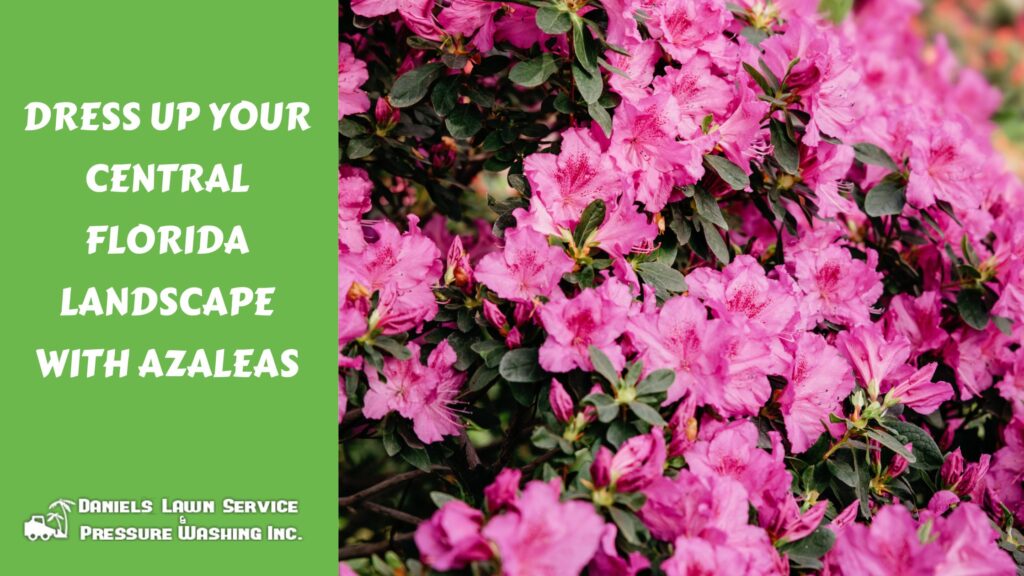
Azalea – Azaleas are widely planted in Florida yards because of the bright, colorful flowers they produce. Most of the evergreen azaleas found in home landscapes are hybrids, and came from Asia. Because evergreen azaleas hold their leaves year-round, they make great backdrop plants for seasonal flower beds. And of course in the spring, they put on their own show with flowers ranging in color from white, to pink, to red, depending on the cultivar.

One widely planted evergreen cultivar is ‘George Lindley Tabor’, a variety that produces countless soft pink flowers each spring and grows to about 10 feet tall and eight feet wide. It is classified as a Southern Indica hybrid, a type favored by gardeners for its vigor and tolerance of colder temperatures, typically down to 20°F without experiencing serious damage.

Bird of Paradise – Strelitzia reginae, or bird of paradise, is a stunning tropical plant that is famous for its eye-catching blue and orange flowers. The unique shape of the flowers makes it appear like a bird in flight. The banana-like evergreen leaves produce a lush backdrop. Look for a sunny or partly sunny location. It will need regular watering and fertilizing to grow and flower at its best. Over time, the plant can form a three- to five-foot tall clump. It is also available in a white-flowering form which can grow up to 15-30 feet tall. Cover when a hard freeze is forecast, or plant in a pot that can be moved indoors.

Bougainvillea – This is a tropical vining shrub that comes in a wide array of bright and fanciful colors. The “flowers” are actually modified leaves, called bracts, which are long-lasting and bright. The colorful bracts outshine the plant’s true (but tiny) flower, much like a poinsettia. Bougainvillea blooms in fuchsia, red, white, yellow, and orange. It can be pruned into a shrub-like form, but is more often trained to grow over fences and trellises to dramatic effect. It can grow up to a height of eight-to-20 feet, with a diameter spread of around 10-40 feet. Bougainvilleas require full sun and perform better when their soil is left a little dry, making this a perfect plant for the drought-tolerant landscape. Protect from frost and freeze.

Camellia – Camellias bloom in the fall and winter, when their stunning display of colorful flowers is most appreciated. During the rest of the year, their interesting textures and shape, evergreen foliage, and moderate growth make camellias an ideal landscape plant. Camellias can serve several functions in the landscape – including foundation plantings, screens, accent plants, background groupings and hedges. You can also enjoy continuous blooms by opting for a range of camellias that bloom at different times of the year. Plant in a sheltered location with partial shade to help them grow and bloom better. Try to prune before late summer.

Hibiscus – This lavish flowering shrub blooms in a rainbow of colors and creates a picture of a vivid tropical paradise. Tropical hibiscus (Hibiscus rosa-sinensis) is commonly seen in garden centers and landscapes. Flowers can be many colors, come in single or double forms, and often last for just a day. Individual flowers may be short-lived, but the plant will produce blooms over a long flowering season. Hibiscus attracts hummingbirds and butterflies. Tropical hibiscus are sensitive to cold weather; the slightest cold wave can cause lower leaves to yellow and drop off.

Hydrangea – Also known as French hydrangea, hydrangea is a large shrub with stunning masses of color. The two kinds of hydrangeas offer different looks to a garden. “Mop heads” have big round, dense balls of showy flowers that add a bold statement, whereas “lace caps” are more subtle and elegant. Hydrangeas need minimal care in well-drained, fertile soil, and are shade lovers. They’ll grow to several feet in height and can be three to five feet wide. The native oakleaf hydrangea has deeply lobed leaves that resemble large oak leaves.

Knock Out® Roses – A relatively recent shrub rose cultivar introduced in 2000, Knock Out roses can be planted throughout Florida and bloom year-round. They’re available in a variety of colors ranging from vibrant red to blush pink to yellow. Self-cleaning and drought-tolerant, they are resistant to black spot and powdery mildew. Knock Out roses are ideal for gardeners who love the appearance of roses, but don’t want the high maintenance requirements. These plants need at least six to eight hours of sunlight every day, and regular watering. It also helps to have a site with good air movement and well-drained soil that falls between pH 6.0 and pH 6.5.

Pentas – Also known as Egyptian star cluster, this is a slow-growing perennial plant that is native to Africa. Planting pentas in your yard will provide you with an all-year-round blooming garden and make it an attractive place for butterflies and hummingbirds. Pentas plants are available in a variety of colored flowers with each flower having five petals. You can choose from white, lavender, red, or pink blooms or bring a mix of different colored pentas into your yard. These plants can grow up to a height of six feet. However, as these plants can spread up to 15 inches, you must keep ample space around them.

Persian Shield – Also known as Bermuda conehead, Persian shield is a royal purple, evergreen perennial that can grow up to a height of three to four feet. This plant originates from Myanmar and is a tropical shrub that enchants gardeners with its deep purple, six-inch (15 cm) long foliage veined with green. It offers striking flowers in different shades of pink and white. In Florida, this beauty blooms throughout the year. This plant will thrive in full sun or shade equally, but keep in mind that the color will be less impressive under too much light.

Salvias – Salvias are herbaceous plants, usually with square stems. Flowers are borne in spikes which may be scarlet, purple, pink, blue, white, or yellow. They are great plants for attracting butterflies and hummingbirds to your garden, and have no serious pests. Salvias are at home in mass plantings, borders and even containers.

The height, spread, flower color, flowering season, and cold tolerance will vary depending on the specific salvia you choose. One particular species may have variable flower colors, as well. For example, the popular and native perennial salvia commonly called scarlet sage or scarlet salvia (Salvia coccinea) can have white, pink, or red flowers. Salvias bloom from spring to fall, and can reach a height of around three to four feet. They can grow under different conditions, and are drought-tolerant.

Want Beauty and Easier Maintenance? Try Florida Native Perennials!

Plants that thrive magnificently all on their own in Central Florida yards may sound too good to be true. However, Central Florida is a subtropical climate, and the state has many unique characteristics when it comes to soil, water and wildlife. The plants we see today have taken many thousands of years to adapt to our specific climate and geography. Because of this, Florida native plants can naturally endure the state’s heavy rainy season, very hot temperatures, periods of drought, humidity, occasional winter freezes, the harsh sun and more. 

The biggest benefit is that they’re simply easier to take care of! Florida native plants allow you to put in less effort for incredible results. Moreover, landscaping with Florida native plants will support your local ecosystem and curb the spread of intrusive, non-native species.

Some of the perennials mentioned in our “Top 10” list have native Florida species. For example, native azaleas – also known as bush honeysuckle – have smaller flowers and are more delicate-looking, but they’re also very fragrant, whereas non-natives have no fragrance. They usually bloom at the same time as other varieties, in the spring, with spectacular colors ranging from peach to pink to yellow. These fragrant native azaleas will reach up to a height of 10 feet and slowly lose their leaves during the winter. They prefer acidic, well-drained soil and are drought-tolerant. It requires little maintenance other than occasional pruning to have a healthy shape.

Another great example is Hibiscus coccineus, also known as the scarlet rosemallow, marsh hibiscus, or swamp mallow. This upright herbaceous perennial can reach a height of 4 to 8 feet. The long leaves of the marsh hibiscus have slender lobes with jagged teeth. Large, gorgeous deep-red flowers appear in mid- to late summer.

 Understand that we’ve just scratched the surface of perennials that can add beauty, enjoyment and distinction to your Central Florida yard! We hope we’ve provided inspiration for avid gardeners to incorporate more of these amazing plants into your landscape design. However, if you’re not the green thumb type but still want your property to be a source of pride and the neighborhood jewel, call Daniel’s Lawn Care & Pressure Washing to design, plant and even maintain the yard of your dreams!

Our full-service company provides landscape design, tree installation, tree trimming, yard maintenance, pressure washing and so much more. Contact us today so we can do the work, and you can do the enjoying! We proudly serve all of Central Florida – including Orlando, Sanford, Longwood and Lake Mary! We look forward to helping you achieve your goals and bring your vision to life!

Five Ways Landscaping Can Improve Your Home’s Value

So you’re putting your house up for sale! Of course, you want to be sure that it sells for top dollar. While there is plenty of advice from the experts about which interior and exterior improvements to make in order to appeal to homebuyers for a quick sale at (or maybe even above) list price, landscaping has a major impact on the first impression potential buyers get of your house. Our own lawn and garden experts at Daniel’s Lawn Service & Pressure Washing focus on five landscaping projects that will best enhance your property’s curb appeal and boost its market value.

Why is this important? A well-landscaped property not only greatly improves curb appeal, but sends a subliminal message to a potential buyer that the home requires little maintenance and is in good repair. A yard with overgrown vegetation and an overall look of neglect will not only put off buyers who don’t want to do the clearing, but will raise a red flag about what else may have been ignored in terms of the home’s physical maintenance. Neat, attractive landscaping will reinforce the impression that your house is turn-key ready for its new owner to move in, with no projects that need to be done!

  1. Maintain a Healthy, Trimmed Lawn

As SpaceWise points out, a major factor behind making your home look inviting and appealing is to keep your lawn looking great. A healthy expanse of green lawn pleases buyers as they imagine themselves, their family members and pets enjoying this outdoor space. Others may be thrilled to claim the neighborhood gem with its yard-of-the-month-worthy appearance! According to LawnStarter, a well-manicured exterior could increase a home’s overall value by as much as 15% to 20%.

On the other hand, overgrown grass, weeds and dead spots are a sign of neglect and can drive the value of your home down. If you have the time, inclination and ability to do it yourself, set up a fertilization schedule, mow regularly and keep your lawn watered. If not, a lawn care company is perfect to partner with!

  1. Remove Dead/Unhealthy Trees

The visual appeal of trees is undeniable. According to Better Homes & Gardens, mature trees add to the value of a home, increasing property prices in an area by 4% to 20%. This is only true of healthy trees, however. A common mistake that homeowners make is to leave dead or dying trees standing. Not only are such trees no longer an aesthetic asset, they’re hazards in Central Florida during hurricane season. Our blog post – “Why You Should Remove a Dead Tree From Your Property” – covers this issue in detail.

Trees that are dead or diseased to the point of instability can be uprooted by heavy winds (not only hurricane-force winds) and topple over onto roofs, vehicles, etc. Brittle dead branches can snap off and do likewise, and may also become projectiles, crashing through windows and screen enclosures. In addition, if you have a tree on your property that you know is dead, many insurance policies won’t cover damage to your home or car if the tree falls during a storm.

Assuming that your potential buyers will include fairly longtime Central Florida residents, they’ll be quick to recognize a dead tree standing, or one that’s in serious decline – and will be likely to continue their house hunt elsewhere, not wanting to take on the expense of removing it. Having a tree cut down by a professional isn’t cheap, but consider the potential return on investment!

  1. Add Color to Your Yard with a Diversity of Plants

A yard with full, leafy plants, thick growth and vibrant flowers will bring great texture, dimension and color to your landscape! Thick shrubbery, blooming plants and beautiful flowers will enhance your yard and deliver instant curb appeal. Look for a mix of bright seasonal annuals for pops of color, and hardy perennials to plant in key areas where they can be seen from the street, as well as wherever the exterior will be photographed for an online listing.

Our Blog page provides many ideas for incorporating warm season annuals and winter annuals into your garden, depending upon when you plan to list your house. Hopefully, you will have moved to your new residence before the season changes, but the lovely flowering plants will have done their job in helping to attract a buyer!

  1. Spread Fresh Mulch

One of the easiest landscape projects that homeowners can embark upon is spreading fresh mulch. This can give an eye-popping appeal to brighten a dull yard, dressing it up to get the right kind of attention. Adding fresh mulch around trees and shrubs has numerous other benefits – such as preventing weed growth, reducing evaporation, inhibiting erosion and regulating soil temperature.

A variety of mulch options are available at most home and garden stores. This is a partial list. Please click on this link for the complete list, which includes descriptions of each type.

  • Pine bark
  • Pine straw (needles)
  • Fallen leaves
  • Mixed hardwood mulch
  • Melaleuca mulch
  • Eucalyptus mulch
  1. Install an Irrigation System (Or Make Sure Your Existing System Works Properly)

Most homeowners love the benefits of an attractive yard, but few have the time to spend on watering. In Central Florida, an irrigation system is considered more of a necessity than an amenity. Today’s homebuyers don’t want to grapple with the hassle of moving sprinklers around the front, side and back yards every half hour or so until the entire property is watered. In summer months, temperatures are too high to water during the day (the water will quickly evaporate instead of soaking into the soil), making the prospect of performing this chore even more unappealing.

If you don’t have an irrigation system, give serious consideration to having one installed – especially if they’re common in your neighborhood. Expect it to be expensive, but the ROI should be worth the investment. An irrigation system could mean the difference between a quick sale and your house languishing on the market for months.

If you have an irrigation system, make sure it’s in proper working order. You may already have your installer perform an inspection on a regular basis, which puts you ahead of the game. If not, schedule an inspection from the company that installed your system, or another irrigation company with a good reputation. A typical inspection includes checking the system controller, inspecting the sprinkler heads, checking the backflow device and testing the watering zones. Making necessary adjustments will better direct water where it’s needed – which will result in a healthier lawn and plants – which, in turn, will result in improved curb appeal!

How the Right Kind of Improvements Can Add Up

As the adage goes, sometimes you have to spend money to make money. Giving your home every possible advantage to help it sell will pay off on closing day. If you’re planning to put your house on the market, you’re probably busy enough already. Why not leave getting your yard and landscape ready to our experienced team at Daniel’s Lawn Care & Pressure Washing? We’ll provide the landscaping plan, plants, care and maintenance so your house is ready to make that all-important great first impression – while you focus on other matters!

Our full-service company provides landscape design, tree installation, tree trimming, yard maintenance, pressure washing and so much more. Contact us today so we can do the work, and you can prepare for your big move! Of course, call us even if you plan to stay in your home-sweet-home! We proudly serve all of Central Florida – including Orlando, Sanford, Longwood and Lake Mary! We look forward to helping you achieve your goals and bring your vision to life!

Call Now Button