BLOG
Why Your Central Florida Lawn May Look Patchy in December
If you’ve noticed your Central Florida lawn looking a little patchy in December, you’re not alone. A common complaint among homeowners is that their grass looks thin and dull, with random bare spots. Even though winter is mild here, the change in temperature, shorter daylight hours and seasonal lawn challenges can all contribute to thin or uneven grass. The good news? Most December patchiness is completely fixable once you know what’s causing it!
Let’s break down the most common reasons — and what you can do to maintain your lawn and prepare it for spring growth.
Common Reasons for Patchy Winter Lawn Growth
- Cooler Temperatures Slow Down Warm-Season Grass Growth
Central Florida lawns rely on warm-season grasses like St. Augustine, Zoysia and Bahia. When temperatures drop into the 50s and 60s during December, these grasses naturally slow their growth. Thinning areas become more visible because the lawn isn’t actively filling in like it does in spring and summer.
What to Do
- Reduce mowing to every 2–3 weeks instead of weekly.
- Raise your mower height to leave grass about 3–4 inches tall to help insulate roots from potential cold snaps.
- Keep mower blades sharp to prevent stress.
- Resist the urge to fertilize — you could damage your lawn! The last recommended time to fertilize your lawn in Central Florida is October.
- Shade Patterns Change in Winter
The sun sits lower in the sky in December, which means areas of your yard that get full sun in summer may suddenly fall into shade. Grass in these newly shaded areas may thin out.
What to Do
- Trim tree limbs to allow more sunlight.
- Replace heavily shaded spots with shade-tolerant groundcover if needed.
- Avoid overwatering shaded areas, as they hold moisture longer.
- Lawn Pests Don’t Disappear Completely
While pests like chinch bugs slow down in cooler weather, others — like mole crickets, grubs and sod webworms — can remain active and continue damaging turf.
Signs of insect damage include the following:
- Soft, spongy soil.
- Small moths flying up when you disturb the grass.
- Grass that lifts up easily from the soil.
What to Do
- Have a professional perform a winter pest inspection.
- Spot-treat with eco-friendly products when possible.
- Repair damaged areas early to prevent spring infestations.
- Winter Lawn Diseases Can Create Brown Patches
Cool, moist winter weather creates the perfect environment for fungal diseases like brown patch fungus and dollar spot. These show up as circles or irregular patches of brown, dead, or thinning grass.
What to Do
- Run irrigation only in the early morning.
- Improve airflow by aerating to reduce heavy thatch. Our blog post — “How to Aerate Your Central Florida Lawn” — covers this topic in detail.
- Treat with a professional fungicide if necessary.
- Incorrect Water Scheduling
Many homeowners forget to adjust irrigation for winter. Overwatering is a major cause of December patchiness in Florida, especially with cooler nights. Our blog post — “What You Need to Know About Irrigating Your Central Florida Yard” — covers this topic in detail.
What to Do
- Set the irrigation system to water only once a week if it doesn’t rain. Overwatering during winter exposes the lawn to common Florida lawn pests and fungal diseases, such as brown patch. Follow county watering restrictions, which may change in winter.
- Ensure your irrigation system is delivering even coverage.
- Natural Dormancy in Bahia Grass
If you have a Bahia lawn, patchiness is normal in winter — it naturally goes dormant and loses color and density. Don’t worry. It will green back up in spring!
What to Do
- Avoid overwatering or fertilizing to “force” growth.
- Keep mower height high to reduce stress.
- Consider overseeding with ryegrass for temporary winter color.
The Take-Home Message
If your Central Florida lawn looks patchy in December, there’s typically no cause for concern, unless there is evidence of pest infestation, fungal growth or irrigation issues. However, in most cases, the uneven appearance of the grass is simply due to normal seasonal changes. Just a few small adjustments can help. This way, you can keep your lawn healthy and attractive throughout the season, and ready for a strong revival in spring!
To learn more about maintaining your Central Florida yard in winter, our blog post — “First Winter in Florida? We Answer Your Yard and Garden Questions!” — provides additional information.
Although we’re fortunate enough to not have to deal with blizzards, Central Florida yards need special attention this time of year. Our experienced team at Daniel’s Lawn Service & Pressure Washing Inc. knows the ins and outs of Central Florida’s climate, so your winter yard can be as beautiful as your spring and summer yard when it’s under our care! We will work with you to achieve your goals and bring your vision to life every season of the year! Our full-service company provides landscape design, tree installation, tree trimming, yard maintenance, bush hogging, pressure washing and so much more. Contact us today so we can do the work, and you can do the enjoying!
Get Your Property Ready for the Holidays with Pressure Washing
Everybody wants their home to be at its very best for the holidays! From decking the halls inside, to creating dazzling outdoor displays of colorful lights and festive decorations, getting ready for gatherings with family and friends is the focus – as well as perhaps winning an award for best neighborhood light display!
But one area that’s too often overlooked is the property’s hardscapes and wood decks. Dirt, grime and algae accumulate rapidly during Central Florida’s humid, rainy summers, making these surfaces a dingy contrast to the bright, welcoming exterior décor. Don’t neglect them this year! A professional pressure washing will make your driveway, carport, walkways, patio slab and deck spotless – perfectly setting off your home’s holiday finery to create a welcoming impression.
Aside from boosting your property’s beauty this time of year, there are some practical reasons for pressure washing its paved areas, which we’ll explore here.
Boosts curb appeal and property value
While you may not be thinking of putting your house on the market, curb appeal is always important. The exterior condition of your property is a direct representation of your pride of ownership and level of responsibility as a homeowner. It also has an impact on your neighborhood’s overall property values – as a neighborhood of well-maintained homes is perceived as a desirable place to live.
Other related benefits include the following:
Restores appearance — A driveway with oil stains and accumulated dirt and gunk doesn’t create a positive impression – nor does a walkway to your front door that sports a combination of black grime and green algae. Pressure washing restores these areas with a fresh, clean appearance.
Helps ensure HOA compliance — Many communities have homeowners’ associations (HOAs) that require residents to keep their exterior surfaces clean. Regular pressure washing can help you avoid fines for unsightly buildup.
Enhances safety and prevents health issues
Looking beyond the aesthetic aspect, pressure washing is an integral part of maintaining a safe, healthy environment for your family and guests – which include the following:
Prevents slip-and-fall accidents — Constant humidity and rainfall allow mold, mildew and algae to form a slick film on driveways, patios and sidewalks. This creates a dangerously slippery surface – especially when wet – posing a significant risk.
Improves air quality — When mold and mildew grow on outdoor surfaces, their spores can be released into the air and enter your home. These spores can cause allergies and respiratory issues, particularly for sensitive individuals.
Creates a healthier outdoor environment — Removing pollutants, allergens and other contaminants from surfaces can improve the air quality around your property. This is particularly important in Florida, where pollen and other allergens can be prevalent. The American College of Allergy, Asthma & Immunology (ACAAI) emphasizes that reducing exposure to outdoor allergens, such as mold and pollen, can help alleviate allergy symptoms.
Protects Your Investment and Extends Lifespan
A house is one of the biggest investments you’ll make, and its maintenance guarantees that it will always be beautiful and functional. Pressure washing prolongs the useful life of hardscapes in the following ways:
Eliminates stains — Pressure washing effectively removes stubborn oil and grease stains, tire marks and rust that can permanently discolor your paved surfaces if left untreated.
Prevents long-term damage from mold, mildew and algae — The growth of mold, mildew, and algae is not just a cosmetic issue. These organisms can break down and weaken porous surfaces like concrete and pavers over time, leading to cracks, erosion and pitting.
Prepares surfaces for sealing — For pavers and other masonry, pressure washing is a critical first step to ensure the surface is clean before applying a sealant. This allows the sealant to properly adhere, protecting the surface and extending its life.
Helps avoid costly repairs — Regular cleaning is a preventive measure that saves money in the long run by avoiding expensive and extensive repairs or replacement of pavers and other hardscapes..
Why You Shouldn’t DIY
It may be tempting to buy or rent a pressure washer and do the job yourself, but this approach is more likely to cause problems than achieve the desired result. Our blog post – “The Benefits of Pressure Washing Your Property’s Paved Areas” – lists the following drawbacks:
- Entry-level pressure washers for the consumer market typically don’t produce enough pressure to adequately clean. One disgruntled buyer of such a product wrote an online review describing it as an “Overpriced waterhose.”
- On the other hand, more powerful units can be too much for a homeowner to safely operate. Dangers include using too much pressure or the wrong nozzle – which can damage surfaces, break windows if you aim the nozzle in the wrong direction and even cause injury.
- The time factor is important to consider. Preparing the area to be cleaned, setting up the equipment, doing the work, taking the equipment apart, cleaning it and storing it can take the better part of a day, at least. Plan on spending additional time if you’re renting the equipment.
A professional pressure washing service provides the following advantages over taking the DIY approach:
- Pros use specialty surfactants that soak into all the pits and pores of hardscape surfaces to dissolve the most hardened, thickest dirt and grime.
- Pros can recognize stains on concrete and patio pavers – including motor oil, rust and paint droplets – and apply specialty detergents, then scrub the area as needed.
- Pros can recommend and apply soft wash systems for cleaning a concrete pool deck. Soft wash systems start with a surfactant that dissolves thick dirt and sand. A low-pressure rinse removes all that residue without damaging concrete paint or sealant – or cracking and chipping pavers and stone tiles.
- Pros use professional equipment and have the experience that allows them to do the job quickly, thoroughly and safely.
- Pros ensure that all dirt and grime are brushed and cleaned away from your home and lawn properly to avoid damage and an unsightly mess.
The Take-Home Message
The holiday season gives us the opportunity to celebrate with family and friends, and – yes – show off our house! Hiring a professional pressure washing service will make your property’s hardscapes – as well as your spirits – bright! Our pressure washing team at Daniel’s Lawn Service & Pressure Washing does all the work so you can relax and enjoy this special time of year!
By the way, our full-service company also provides landscape design, tree installation, tree trimming, yard maintenance, bush hogging and so much more. Contact us today! We proudly serve all of Central Florida – including Orlando, Sanford, Longwood and Lake Mary! We look forward to helping you achieve your goals and bring your vision to life!
Fantastic Ferns for Your Central Florida Yard
How often do you go to your local plant nursery or home improvement store’s garden department to select ferns for your yard? Probably not often! In most Central Florida landscapes, ferns tend to be an afterthought – a little greenery to fill in bare spots. But those familiar with the wide variety of fern species that thrive here can use them to create visual interest, drama and layered textures that enhance and elevate your garden.
Popular Central Florida Fern Species
Ferns have a prominent place in Florida’s ecosystem and economy. Native fern species – such as the native sword fern – help maintain soil health and prevent erosion. Moreover, the Volusia County town of Pierson is renowned as the “Fern Capital of the World” – a title it earned after the flourishing fern industry was established there in the early 1900s.
Since ferns are no stranger to Central Florida, here are six of the most popular fern species gracing area yards! We thank Gardenia and University of Florida IFAS Gardening Solutions for the following information. Click on the link in the name to learn more about each species!
Australian tree fern — For those who think of ferns as just a supporting player, the Australian tree fern (Sphaeropteris cooperi) lives up to its name, allowing it to be the center of attention. Looking like it would fit in perfectly at Jurassic Park, this tropical giant has a single trunk that can reach a height of 15-30 feet. The trunk has a brown, hairy appearance and grows up to a foot in diameter. Its long, large leaves form a handsome canopy that gives a tropical feel to the landscape. If this is your goal, our blog post – “How to Create a Tropical Look for Your Central Florida Yard” – provides many more ideas!
This low-maintenance fern grows best in areas with high humidity and very warm temperatures, making it an ideal choice for Central Florida yards. Plant in a shaded area that has well-drained soil. As with all ferns, this plant performs best when it is kept moist. One point to note: the soft fronds have hair-like structures that will cling to clothes and skin if you contact them. These can be quite itchy, so keep this in mind as you work around it!
Holly fern — Named for the pointy tips on its leathery leaves, this is a drought-resistant plant native to Africa and Asia. It forms loose two to three-foot tall clumps of deep green leaves that make a great background when used with more colorful plants. Holly fern (Cyrtomium falcatum) can be placed in partially sunny to fully shady spots as a border plant, groundcover, or in a woodland-inspired landscape. It can also be grown in containers on covered patios. Holly fern makes an excellent understory plant beneath plants like camellia, sweet olive and other large shrubs that have had their lower branches removed. This fern thrives in low light, so it’s perfect for shady areas under trees. As it can grow to about two feet tall and three feet wide, be sure to give your plant enough room to thrive.
Maidenhair fern — This species makes a delicate, airy addition to shady spots in your landscape, and also loves the indoors as a houseplant. The light gray-green foliage adds a soft feeling to the garden, especially around water features. This fern is best used in mass plantings, but can also be used as an edging or specimen plant. And it makes an excellent groundcover, never getting taller than a couple of feet. There are many kinds of maidenhair fern (Adiantum spp.), so pick a type with foliage that most appeals to you!
Native sword fern — Also known as Boston fern, this low-maintenance species has sword-shaped fronds and scales on the upper side of the rachis (main stem) that are one color. It can grow 2-3 feet tall and spreads rapidly, making it a good choice for ground cover in shady areas. The native sword fern (Nephrolepis exaltata) is often confused with the invasive tuberous sword fern or Asian sword fern, which can be identified by the presence of small, spherical tubers on the root system. To prevent too much of a good thing from native sword ferns in your landscape, it may be helpful to contain them with an edging to the area of the yard in which you want them.
Netted chain fern — Easy to grow in moist, shaded areas, netted chain fern (Nephrolepis exaltata) is a terrific choice for woodland gardens, bog gardens, water gardens, or along ponds and streams. Forming new growth constantly from its long creeping rhizome, this perennial fern can spread to form large colonies under ideal growing conditions. Generally pest- and disease-free, it performs best in partial to full shade in acidic, organically rich moist-to-wet well-drained soils. This graceful fern forms a dense carpet of arching fronds, its unique chain-like vein pattern adding subtle texture and interest to the landscape.
Staghorn fern — If you want your front yard to get attention, mounting a staghorn fern (Platycerium spp.) on a piece of driftwood or wood slab is a great way to make passing cars slow to a crawl so everyone can admire it! This plant is an epiphyte, meaning it gets moisture and nutrients from the air. A healthy staghorn fern has two types of fronds: green, arching, antler-like “fertile” fronds that look like leaves, and flat, shield-like “sterile” fronds at the base that start green and turn brown with age. The fertile fronds are a vibrant green, while the older, mature shield fronds are leathery and brown, providing protection for the plant’s roots. Being a tropical plant, staghorn ferns are vulnerable to freezing temperatures, and should be moved indoors if possible when they’re forecast.
How to Use Ferns to Enhance Your Landscaping
The various species of ferns available give you plenty of opportunities to express your creative side! The following options can help provide inspiration.
Groundcover — Use ferns to fill in shady, bare spots under trees or large shrubs, or to create a lush, naturalistic look in woodland gardens.
Accents — Plant them in clumps or swaths to add texture and soothing forms, or use taller varieties to create a sense of enclosure.
Around water — Ferns are a natural choice for edging streams or ponds, as many prefer moist soil. Netted chain fern and native sword fern are good choices for these areas.
Container plants — Place them in hanging baskets or pots on a covered porch to create a beautiful focal point.
Border plants — Use some varieties – such as holly fern – as a border plant to add a pop of color against more colorful perennials. Holly fern also works well with maidenhair fern in dry, shady areas.
Foundation plantings — Some ferns – such as the dramatic Australian tree fern – can be used as a substitute for traditional foundation plants.
Tips to Help Your Ferns Thrive
Although ferns are known for being low-maintenance, a little extra attention can make a big difference between merely surviving and thriving! For the basics, provide partial to full shade, keep soil consistently moist with rich organic matter and ensure high humidity. Protect them from freezes by moving tropical varieties indoors or covering them, and cut back any damaged fronds in the spring before new growth appears.
Other tips include the following:
Improve the soil — Ferns thrive in rich, slightly moist soil. Mix in a couple of inches of compost or other organic matter before planting.
Mulch the area — Use mulch to help retain soil moisture, suppress weeds and protect the roots from temperature extremes.
Water consistently — Keep the soil consistently moist, but not waterlogged. Check the soil moisture before watering to avoid overwatering, which can be harmful.
Water container ferns daily in hot weather — Potted ferns — especially in hanging baskets — dry out quickly. They may need watering as often as once a day during hot, dry, windy weather.
Fertilizing — Feed with slow-release fertilizer; use a slow-release granular fertilizer for best results.
Supplement during warmer months — Ferns can benefit from a monthly dose of a water-soluble, nitrogen-rich fertilizer during the growing season.
Protect from frost — Ferns are tropical plants and are sensitive to cold. In Central Florida, tropical ferns will need protection from cold snaps. If a hard freeze is expected, bring sensitive tropical ferns indoors to a sheltered location.
Trim damaged fronds — Before spring growth begins, cut back any fronds that were damaged by cold weather.
Watch for common insect pests — Keep an eye out for pests like scale, slugs, and snails. Insecticides can be damaging to ferns, so try to manage pests without them if possible.
The Take-Home Message
The variety and versatility of ferns can go a long way in making your Central Florida yard a showplace that’s a relaxing, uplifting retreat as well as the envy of the neighborhood! However, if you’re not the green thumb type – or lack an artistic eye for landscape design to incorporate ferns to their best aesthetic advantage – call Daniel’s Lawn Care & Pressure Washing to design, plant and even maintain the yard of your dreams!
Our full-service company provides landscape design, tree installation, tree trimming, yard maintenance, pressure washing and so much more. Contact us today so we can do the work, and you can do the enjoying! We proudly serve all of Central Florida – including Orlando, Sanford, Longwood and Lake Mary! We look forward to helping you achieve your goals and bring your vision to life!
How to Aerate Your Central Florida Lawn
Soil aeration is the unsung hero of lawn care tasks. Although many homeowners don’t perform it, this practice helps your irrigation and fertilization efforts achieve maximum effectiveness to result in healthy, green grass that’s better able to stand up to stress – as well as be the envy of the neighbors!
Why You Should Aerate Your Lawn
If you’re unfamiliar with the term, aeration involves perforating the soil with small holes to allow air, water and nutrients to penetrate the grass roots. This helps the roots grow deeply and produce a stronger, more vigorous lawn.
According to Briggs & Stratton, “The main reason for aerating is to alleviate soil compaction. Compacted soils have too many solid particles in a certain volume or space, which prevents proper circulation of air, water and nutrients within the soil. Excess lawn thatch or heavy organic debris buried under the grass surface can also starve the roots from these essential elements.”
How does that happen? As ASI Landscaping Management points out, “Throughout the year, your soil and grass go through a lot. It’s being trampled on by you and your family, rolled over by lawn equipment, and otherwise taking a lot of direct stress. By the time fall shows up, the grass and its roots can be compacted, which can affect how it grows going forward. Aeration involves using special equipment to perforate the ground with a series of shallow indentations.”
In addition to helping the roots, aeration also helps with the natural decomposition of the thatch layer in your lawn. Each time you mow, small pieces of cut grass stay in the lawn, creating a protective layer to shelter roots and young grass blades from the harsh sun. However, if the thatch becomes too thick, it can begin to suffocate your lawn. Aeration keeps thatch at the appropriate level. Even though Florida tends to have sandy loam soil – which is a collaboration of sand, clay, and silt and doesn’t get so easily compacted – aeration can still be necessary.
When You Should Aerate Your Lawn
In Central Florida, you should aerate your warm-season lawn twice a year – ideally in late spring and early fall – to allow the grass to recover quickly and take advantage of nutrient and water absorption during the peak growing periods.
To be more specific, early fall (September and October) is an optimal time because it’s after the peak of summer heat stress, allowing the grass to strengthen its root system and recover from the high temperatures.
Late spring to early summer (April to July) is good for warm-season grass – such as St. Augustine, Bermuda and Zoysia – which is actively growing. Aerating during this time gives the grass the best chance to benefit from the improved airflow and nutrient access.
If you’ve never aerated your lawn before, you may wonder if aeration is necessary. Take a good look around your property. You need to aerate if you see the following, which are signs of compacted soil:
- Thatch buildup on the soil surface.
- Pooling water: Water pools on the lawn surface after rain or irrigation, showing that the soil isn’t absorbing moisture efficiently.
- Spongy or hard soil: The soil feels hard, dry, or spongy underfoot, making it difficult for roots to grow.
- Thinning grass or bare patches: The lawn appears sparse, with areas of visible soil, as roots are unable to access essential water and nutrients.
- Discoloration or wilting: The grass loses its vibrant green color and may appear yellow or wilted due to stress.
Another good indication is if your lawn fails the “screwdriver test.” Find a spot where you see evidence of soil compaction, and push a standard screwdriver into the ground. If it’s hard to push, your soil needs to be aerated.
Aerating once a year is enough for most Central Florida lawns, but heavily used lawns – like those with kids, pets or frequent outdoor entertaining – may benefit from aeration twice a year.
Steps to Aerate Your Lawn for the Best Results
If you have a small lawn that only needs light aeration, you can go over it with a pitchfork, pressing the tines down into the soil at regular intervals. Also known as spike aeration, it will create holes where air, moisture, and nutrients can better reach the roots – but it won’t pull up plugs of soil to help the thatch decompose. Moreover, this method is tedious and time-consuming, which is why it’s better suited for a postage stamp-sized lawn if you intend to DIY.
It’s more practical to use a core aerator, which punches down into the ground with hollow tines, pulling up plugs of dirt, thatch and grass and leaving them on the surface of the lawn. You can find this type of equipment at a home improvement center or garden supply store.
There are two main types of core aerators: manual and gas-powered. Many stores offer rental services for gas-powered aerators, saving you from having to purchase it yourself.
The following general instructions for aeration are courtesy of Briggs & Stratton:
- Start with moist soil (wait 24 hours after a rainstorm or irrigation).
- Choose a tool or a machine that removes plugs of soil from the lawn, rather than making a hole in the ground. That causes the surrounding area of the hole to compact roots and grass even more, thus defeating the purpose of aerating your lawn.
- Since most machines and tools only cover a small percentage of soil surface, multiple passes might be necessary.
- Once the plugs have dried, they can be broken up and spread over your lawn for a clean appearance (the plugs can be broken up using your lawn mower or by pounding them with the back of a rake).
- After aeration, following up with the right care can ensure your lawn gets the full benefits to make it thrive.
Water your lawn thoroughly – Moist soil helps roots absorb nutrients more efficiently.
Avoid heavy foot traffic – Limit lawn activity for a few days to allow the plugs to break down naturally.
Mow as needed – Mowing helps break up the soil plugs faster, returning organic matter to the soil.
Fertilize as needed – Aeration boosts fertilizer uptake.
Overseed your lawn – Overseeding – as well as seeding – should be done in conjunction with aeration because it allows the seeds to reach closer to the existing root system. If you want your yard to look its best throughout winter, fall is the time to overseed. This refers to the practice of seeding a temporary cool-season grass – such as ryegrass – over the permanent warm-season lawn that goes dormant during late fall and early winter in many parts of Florida. This provides an attractive green lawn until it dies out in spring and growth of the warm-season grass resumes. Our blog post – “What to Do In Fall for Your Central Florida Yard” – covers this topic in detail.
The Take-Home Message
As with all aspects of lawn care, aerating isn’t glamorous, but can result in lush, vibrant grass that’s the basis of a yard with maximum curb appeal! But if the intense work it requires doesn’t appeal to you, call us! Our professionals at Daniel’s Lawn Service & Pressure Washing are true locals with a passion for keeping your Central Florida yard beautiful and healthy!
In addition to lawn care, our full-service company provides landscape design, yard maintenance, plant and tree installation, tree trimming, tree stump removal, land clearing, pressure washing and so much more. Contact us today so we can do the work, and you can do the enjoying! We proudly serve all of Central Florida – including Orlando, Sanford, Longwood and Lake Mary! We look forward to helping you achieve your goals and bring your vision to life!
Nine Reasons to Hire a Professional Lawn Care Service
Homeowners know that maintaining their house extends beyond the structure itself. The condition of the property on which it sits speaks volumes about the owner’s personal values – and can also greatly affect its property value. A well-manicured lawn, trimmed shrubs and trees, and attractive landscaping speak well about the homeowner, and elevates the neighborhood. An overgrown, neglected lawn has the opposite effect – and, if applicable – can get one in trouble with their HOA.
Although many people approach the yard maintenance aspect of homeownership with good intentions, it’s easy to get in over your head. Doing it yourself involves much more work, expense and time than you may be willing or able to commit. Add to that laboring in the conditions of Central Florida summers – that is, rising at the crack of dawn on a precious day off to mow and trim before the temperature hits triple digits, and/or a drenching afternoon thunderstorm. By this point, you may be wondering when you can enjoy relaxing in your yard!
Fortunately, no one says you have to perform any or all of the hard work yourself! If you’ve never considered hiring a professional lawn care service before, here are nine reasons to cut yourself a break and do so!
- Knowledge and expertise
Lawn care professionals have specialized knowledge of various grass types, soil conditions, and the specific needs of your lawn based on your local climate and other factors. They are also trained to identify and address common lawn diseases, pests, and weed issues efficiently and effectively. This allows them to create a customized care plan tailored to your lawn’s unique requirements.
- Time and convenience
Maintaining a healthy lawn demands consistent effort and dedication, involving tasks like mowing, weeding, fertilizing, aeration and more. By outsourcing these responsibilities, you free up your valuable time, allowing you to focus on other priorities or simply relax. Our motto at Daniel’s Lawn Service & Pressure Washing, Inc., is “We do the work so you can do the enjoying!”
- Consistent care and maintenance
Professional lawn care services provide consistent care on a regular schedule, ensuring your lawn receives the attention it needs to remain healthy and vibrant throughout the year. This consistency promotes robust grass growth and helps prevent issues like weed overgrowth and pest infestations.
- Eliminates the need for hard outdoor labor
Doing it yourself takes work. Mowing, edging and weeding in the hot Florida sun saps the energy right out of a person – even during non-summer months. Moreover, not everyone can perform such physically demanding work. You may not want to admit it out of pride or vanity, but yard work tends to become harder the more birthdays you celebrate. Also, those lacking a good amount of strength and stamina regardless of their age can have difficulty. Not to be alarming, but over-exertion could even lead to a medical emergency, depending upon your overall state of health.
- Professional-grade equipment and products
Lawn care companies utilize high-quality, commercial-grade equipment and products that may not be readily available to homeowners, leading to superior results in terms of mowing, trimming, fertilization and weed control. Getting back to the previous points we made about saving time and labor, a professional lawn care service can mow your front, back and side lawns much faster than you can with your consumer-size mower. Ditto for trimming hedges, edging, etc.
- Eliminates the expense of buying, maintaining and storing equipment, tools, lawn chemicals, etc.
Most homeowners don’t realize that in addition to being a big upfront expense, lawn equipment involves many ongoing expenses. Any equipment with an engine – such as mowers, hedge trimmers, edgers, weed-whackers and leaf blowers – needs mechanical maintenance to operate efficiently (or at all). If they break, they need to be repaired or replaced. Gas-powered equipment also, of course, needs gas – which needs to be purchased and stored safely in a sheltered location. Other materials can be hazardous to store, as well. Fertilizer, pesticides, etc., all require caution in storing. Did we also mention they cost money?
Now, on to non-mechanical yard tools. Shovels, hoes, rakes, spades and other implements are necessities if you take the DIY yard care route. While you may be tempted to buy the cheapest, you won’t save money in the long run. Poor-quality yard tools won’t be as easy or comfortable to use as well-made tools – plus they’ll break or wear out faster! Investing in quality equipment is worth it should you assume this responsibility, but is as expensive as it sounds.
And speaking of storing all this equipment and supplies, you may need to buy a shed if you don’t have a garage, or your garage doesn’t have enough room.
- Eliminates the risk of personal injury from operating equipment, trips and falls, etc.
Even hale-and-hardy individuals can have an accident while performing lawn maintenance tasks. The sharp blades of a lawn mower can cause deep cuts, lacerations, and damage to skin, muscles, ligaments, tendons and bones. So-called “missile injuries” are caused by objects like stones, sticks, or debris thrown from the mower’s blades at high speeds, causing injuries to nearby individuals. Keep in mind that the more exhausted you become as you work, the more likely you are to make a critical mistake – like not seeing that tree stump in the middle of your yard! Lawn care professionals are trained in the safe operation of all types of equipment, and recognize (and avoid) potentially hazardous conditions. Plus, a truly professional lawn care company – such as Daniel’s Lawn Service & Pressure Washing, Inc. – will be licensed and insured.
- Prevents DIY mistakes that could cost you more to repair or remedy
As Heroes Lawn Care points out, “DIY lawn projects often deliver subpar results because homeowners lack the same experience that professionals possess. Property owners also do not have access to most commercial-grade products, even if they own the right equipment for the job. Their lack of expertise and store-bought products result in patchy, uneven, or unhealthy lawns.”
But that’s only the tip of the proverbial iceberg – which admittedly is an odd analogy for a Central Florida yard. Our blog post – “Why Should You Hire Someone to Take Care of Your Yard?” – covers but a few of the common lawn problems that present major challenges to area homeowners. Not knowing how to effectively deal with brown spots in your grass, fungus and our state’s formidable insect pests can ruin your lawn and ultimately wind up costing you more to remedy the situation. A lawn service pro can recognize these issues – and many more – and head them off to prevent damage and keep your grass healthy.
- Enhanced curb appeal and property value
Finally, there’s the “ahhh” factor – the beauty of a professionally maintained yard that’s the pride of the neighborhood! While you might not be planning to put your house up for sale, that day may come – and your house will have an advantage by being a standout for all the right reasons. Improved curb appeal creates a great first impression that brings potential buyers to your door more quickly. If they like what they see on the outside, the odds improve that they will want to see what’s on the inside – and will also assume that the house itself is well-maintained and free of problems.
And because you’ve hired the services of a professional lawn care company over the long haul, you won’t have to add sprucing up your yard to the long list of things to do to prepare your house to sell quickly, and at the best possible price. According to the American Society of Landscape Architects, attractive landscaping can give you a 100% return on your investment (ROI), increasing your home’s value by as much as 20%.
The Take-Home Message
If you hadn’t considered hiring a professional lawn care company before, we hope we’ve given you something to consider today! Hiring a pro can save you exhausting work, time and money – as well as help improve your property value. Our full-service company provides landscape design, tree installation, tree trimming, yard maintenance, bush hogging, pressure washing and so much more. Contact us today so we can do the work, and you can do the enjoying! We proudly serve all of Central Florida – including Orlando, Sanford, Longwood and Lake Mary! Get your weekends back!
Beautifying Your Central Florida Yard With Bromeliads
When it comes to plants, bromeliads have a special place in the hearts of Floridians. Combining exotic flair with low-maintenance ease, their intriguing shapes and vivid colors bring a tropical look to any landscape. Unlike some plants that have a reputation for being temperamental and difficult to grow unless planted “just so,” bromeliads thrive in just about any spot in your yard. Depending upon the variety, however, some do better under certain conditions than others, but you don’t need a green thumb to keep them alive.
While bromeliads are readily available in garden centers and nurseries, knowing more about them can help you select the best variety(s), as well as how to incorporate them in your property’s landscaping to achieve the effect you want.
As Three Seasons Outdoor Living & Landscapes points out, “Bromeliads are a great option for a focal point or ground covering to your landscaping design. They come in multiple sizes that range from as small as six inches to as tall as a few feet. Because of the height difference within the species, they make perfect focal points and ground cover options for your existing landscaping, or you can create a dedicated landscaping bed that showcases a variety of your favorite bromeliads.”
Other landscaping uses include the following:
- Lining walkways.
- Around small palms along the property.
- Underneath trees.
- Accents in a mixed vegetation bed.
- In a planter box.
Our blog post – “How to Create a Tropical Look for Your Central Florida Yard” – includes information about other tropical plants that play well with bromeliads to establish the look of an island resort.
Why Bromeliads are Especially Suited for Central Florida
Low maintenance – Bromeliads are incredibly easy to care for and don’t require frequent watering due to their ability to collect moisture in their rosettes – which forms the plant’s central “cup” – also known as a “tank” or “vase.” Once established, they can tolerate moderate drought conditions, requiring watering only once every one to two weeks during hot, dry months.
Climate suitability – Most bromeliads are tropical or subtropical and thrive in Florida’s warm, humid conditions. Even though they prefer moisture and humidity, they are extremely tolerant of low-moisture conditions. They are adaptable to a wide range of light conditions, from bright, filtered light to partial shade, depending on the variety.
Variety of species – There are thousands of different bromeliads, offering a diverse array of shapes, sizes, and colors. Florida also has 16 native species, including the well-known Spanish moss and ball moss. Contrary to somewhat-popular belief, neither is a parasite that harms the trees in which they live. They are epiphytes, surviving on moisture and nutrients in the atmosphere. This wide range of varieties makes it possible to find bromeliads suitable for almost any location or landscaping design.
Aesthetics – Their bold foliage and vibrant colors add a striking tropical element to gardens and landscapes. Bromeliads can serve as colorful accents, focal points, or even ground cover. They also make excellent houseplants and can be grown in containers, both indoors and outdoors.
Pest and disease resistance – Bromeliads are relatively pest-resistant. When problems do arise, scale and mealy bugs are the most common issues, and they can typically be managed with insecticidal soap or neem oil.
Common Bromeliad Varieties
Bromeliads are a common sight in residential yards and commercial properties throughout Central Florida – although in this case, “common” is far from synonymous with “ordinary.” Here are some of the colorful bromeliad varieties you may be familiar with by sight, but not by name – until now!
Aechmea — This is often referred to as an urn plant because of its vase-like, upright shape. The leaves are typically colorful and have small spines along the edges. The plants can produce vibrantly hued flower spikes lasting from a few weeks to six months.

Billbergia — These bromeliads are tall and narrow, vase-shaped and have sharp-edged leaves, and are much sought after among gardeners. Under certain conditions, they spread readily across garden beds. They can be grown in trees, which is how they’re found in nature.

Cryptanthus — Generally referred to as Earth stars due to their flat growth and wavy-edged leaves. They are quite popular with many bromeliad enthusiasts, with more than a thousand hybrids. One of the most widely grown is Cryptanthus bivittatus.

Dyckia — Known for their hardiness, members of the Dyckia genus are more tolerant of harsh environments and drought than many other bromeliads. They tend to form clumps and can produce yellow or orange flower stalks that are up to five feet tall. The sharp spines on the leaf edges can be very decorative.

Guzmania — Popular as houseplants, Guzmania bromeliads are known by smooth, green foliage, accompanied by conspicuously showy flower spikes. They also can be grown outdoors in Central Florida, which consists of plant hardiness zones 9b and 10a.

Neoregelia — These bromeliads are cultivated mainly for their brilliant colors and interesting patterns of showy foliage, and are therefore some of the most hybridized forms of bromeliads. Tiny flowers appear inconspicuously within the leaf cup when these plants flower. They are sometimes known as ‘painted fingernail” for the pink markings on their leaves.

Tillandsia — Nearly 500 species are contained within this genus, making it the largest, most varied and widely distributed genus in the bromeliad family. Most plants in this genus are epiphytes, so they can extract moisture from the air and often grow on other plants. Tillandsia contains Florida native bromeliads such as Spanish moss (Tillandsia usneoides). One species of this genus that is fairly common is T. cyanea; it produces exquisite flower spikes and is often sold as a gift plant.

Vriesia — Some of these bromeliads can become downright huge. The leaf rosettes of Vriesea hieroglyphica can measure up to five feet across individually. It has glossy foliage banded with irregular stripes of light and dark green. This species grows well indoors, or outdoors in light shade.

Tips for Growing Healthy Bromeliads
As mentioned earlier, bromeliads are hardy, low-maintenance plants. However, giving them the proper care will help them thrive, rather than merely survive. University of Florida IFAS Gardening Solutions provides the following tips:
Consider the amount of light your spot receives – The amount of light can affect a bromeliad’s leaf color, leaf shape and growth rate. Light levels that are too low for the variety will lead to leaves that are long, thin and greener in color. Light levels that are too high will make leaves grow shorter, thicker and lighter in color.
Plant properly – Compared with other garden plants, bromeliads have limited root systems that serve mainly as anchors for the plant. It is best to provide them with a loose, well-drained potting mix – for example, one part peat, one part bark and one part coarse sand. Since bromeliads grow and produce offshoots frequently, leave enough space for their mature sizes to grow. When planting, space bromeliads about one to three feet apart in your landscaping beds or around your property. Moreover, be sure to plant in an area with good drainage, as a wet area will promote root rot.
Avoid overwatering – Bromeliads absorb water and nutrients mainly through their leaves and through the cups at the base of their leaves. As just mentioned, they don’t like “wet feet,” so avoid drenching the ground.
Flush out cups to prevent mosquito breeding – Taking this step is more to help humans and pets than to help the bromeliads. Once a week during the summer and fall rainy season, use a garden hose to flush out mosquito larvae and decaying leaves and twigs, which are a food source to the larvae. A biological mosquito control product (Bacillus thuringiensis subspecies israelensis) is available from garden centers, home supply stores and online. The product should be sprinkled into bromeliad cups every two to three weeks in summer and fall; it will kill some species of mosquito larvae in 24 hours.
By the way, if you’re a true bromeliad enthusiast and want more of a good thing, you can propagate bromeliads yourself! Young plants known as “pups” develop at the base of the “mother” plant. Separate the pups from the mother plant when they are half the size of the parent plant. To start new plants, cut the pup off where it attaches to the mother plant and place it in potting soil. The time from the formation of a pup to maturity is approximately one year, but some species take much longer.
If your outdoor space is limited, adaptable bromeliads can be successfully grown in containers. Kala Hamel of Pinder’s Nursery provides the following tips:
- Use a chunky, well-draining mix—think orchid bark or pine fines.
- Don’t bury the base; it should sit just at soil level.
- Combine with ferns, trailing vines, or seasonal annuals for a lush look.
Bonus tip: Keep the bromeliad in its pot even when planting in a larger container to make future repotting and pup removal easier.
The Take-Home Message
Fascinating exotic bromeliads are a great way to add a touch of the tropics to your property without a lot of fuss. But if you want an expert’s touch to incorporate them into your landscape to create focal points or areas of interest, call us! Our team at Daniel’s Lawn Service & Pressure Washing is ready to help with a wide range of services – from landscape design to plant selection, installation and maintenance.
In addition, our full-service company provides tree trimming, yard maintenance, pressure washing and so much more. Contact us today so we can do the work, and you can do the enjoying! We proudly serve all of Central Florida – including Orlando, Sanford, Longwood and Lake Mary! We look forward to helping you achieve your goals and bring your vision to life!
How to Prepare Your Central Florida Yard for Hurricane Season
Hurricane season is upon us once again! Beginning on June 1 and running through November 30, this time of year is when apprehension runs high about Central Florida taking a hit. This year, the National Oceanic and Atmospheric Administration (NOAA) and other weather experts predict an above-normal 2025 hurricane season in Florida. NOAA is forecasting a range of 13 to 19 total named storms (winds of 39 mph or higher), six to 10 of which are forecast to become hurricanes (winds of 74 mph or higher) – including three to five major hurricanes (category 3, 4 or 5; with winds of 111 mph or higher).
While we can hope these foreboding forecasts don’t come to pass, it’s better to be proactive! As the peak of hurricane season is typically August through mid-October, you still have an opportunity to prepare your yard to prevent or minimize damage should nature unleash its fury. Keep in mind that tropical storms – which have sustained wind speeds from 39 to 73 mph – are capable of inflicting a good deal of property damage, as well!
Pay Attention to Your Trees to Prevent Severe Property Damage
Neglected trees can pose a number of serious hazards. Dead branches can snap off during a storm and crash through windows, as well as fall on houses, vehicles and people. Dead and unhealthy trees can be uprooted, causing the same types of property damage as fallen branches – but even more extensive. In addition, fallen branches and trees can bring down overhead utility lines, which is the main reason for prolonged post-hurricane power outages.
A dramatic case in point was Hurricane Charley – which made landfall on August 9, 2004 as a category 4 storm (130-156 mph sustained winds), uprooting an estimated total of 28,000 trees throughout Orlando and Winter Park. Since then, Central Florida communities encourage homeowners to prune old or overhanging branches and remove dead and declining trees to prevent a similar situation.
According to the University of Florida, Institute of Food and Agricultural Sciences (IFAS) Extension, a tree that is vulnerable during a hurricane is one with a high center of gravity, a dense canopy, a decayed trunk, two or more trunks, or shallow roots. Shallow roots result from shallow soil or a high water table.
Overly long branches should be shortened and branches with cracks removed or shortened. Branches with the same diameter as the trunk should be shortened and the outer edges (not the interior) of the canopy should be thinned, making the tree less likely to be blown over. Low branches that are close to the roof should be removed or shortened, as well. It is recommended to have your trees evaluated by a professional about every two years.
Young trees will need support to increase their chance of survival during heavy winds. Canterbury Farms Nursery & Garden Center recommends staking them carefully to avoid causing damage to the roots. Make sure the ties aren’t too tight, as you still want the tree to be able to have some natural sway so that it doesn’t snap off in high winds.
Cutting down heavy limbs or a tree are not DIY jobs, as most homeowners don’t have the tools, equipment or ability to do so safely. And don’t rely on YouTube or TikTok videos to educate you. Call a full-service yard service company or arborist to trim or remove trees.
The University of Florida, Institute of Food and Agricultural Sciences (IFAS) Extension offers the following recommendations:
- Prune weak, rotting, or dead tree branches and remove low-hanging ones near the house.
- Check tree roots for signs of rotting and remove any rotten or diseased trees or shrubs.
- Keep the tree canopy maintained and thinned to increase air circulation.
If your property is graced by palm trees, you may be wondering if they need special attention to weather a severe storm. Fortunately, they are naturally able to withstand the high winds that hurricanes bring. Contrary to what you might have been told, palm trees don’t need the so-called “hurricane cut” or “hurricane pruning” that removes all but the youngest fronds with the goal of making the tree more wind-resistant. Not only is removing fronds unnecessary, it can seriously damage the palm tree. When pruning palms, only remove fronds that are completely brown and that hang below the 9 o’clock or 3 o’clock position.
Check Drainage Areas and the Irrigation System
The prolonged, torrential rainfall a hurricane produces can overwhelm a property that has poor drainage, causing flooding. Check drainage areas and clear any debris. A blocked storm drain or drainage area can create worse flooding problems. If water backs up onto your property and creates loose soil, the root systems of nearby trees may not be able to keep the tree properly anchored – leading to falling trees.
Also check roof gutters and downspouts, and clear them of debris if necessary. Secure parts of your gutters that may be weak. When your rain gutters are blocked, it causes excess amounts of water to pool, which can potentially damage your roof.
In the event a hurricane warning is issued for your area (hurricane force winds are expected in 36 hours), shut off your irrigation system. You won’t need it anyway! Also be sure to shut off the main water line should you be ordered to evacuate. If a tree falls on your property, the roots could break the water lines and cause flooding or make an existing flood even worse. This will also prevent contaminated water from entering your plumbing system.
Make Plans for Patio Furniture, Other Outdoor Items and Container Plants
Now is the time to walk around your property and take note of items that will need to be moved indoors or secured in place should a hurricane approach – such as patio furniture, grills, container plants and garden statuary. Look for any object that could be picked up by high winds and become a projectile that crashes through windows, your screen pool enclosure, etc.
As our blog post – “Hurricane Season Is Here! Is Your Yard Ready?” – notes, you don’t want to wait until a hurricane is imminent before deciding where such objects should be moved to protect them! If you won’t be able to bring potted plants indoors, cluster them next to an exterior wall and tie them together. If you have an outdoor grill, bring the grill indoors, but leave the propane tank outside, chained in an upright position to a solid object or structure.
Some items – such as garden statuary – may be too heavy to pick up, yet could still become a projectile in hurricane-force winds. If an object requires being put on a hand truck or dolly and needs two people to move it, consider locating it to a protected area now. The help you’ll need to do the heavy lifting may not be available when the hurricane warning comes.
Also realize that a screen pool enclosure is not a protected area. A category 1 hurricane packs sustained winds of 74 to 95 mph, which means a screen enclosure offers little or no protection to anything inside. The screen panels and frames themselves can be damaged by large, heavy objects – such as patio furniture – thrown against them. To help protect the screen enclosure itself, provide a “vent” for wind to flow through. You also can remove screen panels on opposite sides of the enclosure by pulling out the vinyl spine that holds the panels.
If you find that making such preparations takes a lot of time and effort, you may want to pare down the number of container plants and yard ornaments that decorate your yard. They’re lovely to look at, but it could be worth your while to – as the stylish people say – curate your collection!
Hope for the Best, but Prepare for the Worst! Stay Safe This Hurricane Season!
The anxiety that many Floridians experience during hurricane season is understandable, but being prepared can alleviate a lot of worry. Daniel’s Lawn Service & Pressure Washing specializes in tree services, lawn care services, landscape design, pressure washing and bush hogging. We are licensed and insured, so you can hire us with confidence for all of your yard maintenance needs. We’re located in Lake Mary, serving Longwood, Sanford, Orlando, and the entire Central Florida area. Contact us to help you get ready for hurricane season, and take one more worry off your plate!
What You Need to Know About Irrigating Your Central Florida Lawn
Achieving and maintaining a healthy green lawn in Central Florida involves many challenges – not the least of which is watering it. Learning irrigation best practices can mean the difference between a lawn that’s susceptible to weeds, fungi, diseases and pest activity, and one that’s thriving and attractive. Here are the three key things to know – and practice!
Avoid Overwatering Your Lawn
Overwatering your lawn is as detrimental to its health as underwatering. Overwatering grass leads to a shallow root system, as the roots don’t need to extend deep in the soil to find water. This reduces its ability to tolerate stress – such as drought and foot traffic. In addition, as Natural Green Lawn Spraying points out, overwatering can promote fungus and weed growth.
Often, homeowners are unaware that an irrigation system should be adjusted seasonally, and failure to adjust for seasonal changes will usually lead to overwatering. This can easily happen during Florida’s rainy season, which generally runs from late May through mid-October – although the almost daily mid-afternoon thunderstorms we associate with summer tend to occur June through August. Pay attention to weather reports, and avoid watering 24 hours before a predicted rain.
However, even with daily rain, thunderstorms usually pass after a half hour. Given Central Florida’s sandy soil and afternoon summer temperatures hitting triple digits, water can be absorbed quickly – which makes trying to determine whether your lawn needs watering trickier. Instead of following a strict watering schedule that may be counterproductive, the University of Florida Institute of Food and Agricultural Sciences (UF/IFAS) Gardening Solutions recommends “listening” to your lawn to tell you when it’s thirsty. Look for at least one of these three signs:
- Folded leaf blades.
- Blue-gray color.
- Footprints are visible in the grass (which indicates the grass isn’t springing back).
A good rule of thumb for watering is once or twice a week during the summer months, and once every two to three weeks over the winter. According to Duda Sod, an average Florida lawn requires about three-fourths of an inch of water per watering session.
Also according to Duda Sod, overwatering can lead to several issues, including the following:
Dry patches – Although you might think of this as a symptom of underwatering, dry, brown patches can also be a sign of overwatering. Because it can be difficult to distinguish the culprit, don’t let this be your only criteria for determining watering needs.
High weed growth – When your lawn is getting too much water, weeds can proliferate rapidly. If you notice that you are having to pull up more weeds than usual, this could be a sign of overwatering.
Fungus growth – Fungus remains dormant in the soil until activated by an abundance of water. When active, fungus takes its nourishment from the grass and can cause your lawn to turn yellow with stunted growth. Large patches of the lawn can die off and will need to be replaced. Lawn fungus is very hard to get rid of once it has become established, so prevention is the key.
Irrigation runoff – Take a look at the areas around the edges of your lawn immediately after watering. Runoff coming from your lawn is a sure sign that it is getting too much water. Your lawn should be able to absorb all of the water you provide at each session, so shorten your watering periods to minimize runoff.
Soil compaction – In lawns that get too much water, the underlying soil often becomes compacted due to the excess moisture. To grow strong, healthy roots and gain access to air and sunlight, you’ll need to aerate the soil, loosening it up so the roots can spread. Our blog post – “Why You Should Aerate Your Lawn” – covers this topic in detail.
In addition, be aware of watering restrictions your county or municipality may have. Restrictions are common during summer, and may limit residential watering to certain days of the week and times of day. Check your community’s website if you aren’t sure, as you may be subject to a fine if you don’t follow restriction rules.
Know Your Landscape’s Irrigation Needs
Your turfgrass variety, soil composition and location of landscape plants all affect your yard’s irrigation needs. As our blog post – “How to Water Your Central Florida Lawn” – points out, Central Florida’s soil is primarily sandy. For this reason, our region’s soil doesn’t hold water for long, and dries out faster – therefore requiring more frequent watering. However, soils in urban areas are compacted, which does not allow water to penetrate, and may result in waterlogged conditions or standing water. City dwellers should keep this in mind.
Your turfgrass variety will also affect the frequency of watering. Popular St. Augustine grass typically requires irrigation every four to five days without rain during summer. Zoysia grass performs best when it receives approximately 1″ of water per week. If one or more inches of rainfall occurs in a week, additional irrigation isn’t necessary.
Moreover, UF/IFAS Gardening Solutions notes it’s important to remember that a sprinkler zone may be irrigating not only turf but landscape plants, as well. These plants may have different irrigation requirements and could be over- or under-watered if your irrigation strategy is based solely on the needs of your turfgrass. A properly designed irrigation system will zone turf and landscape plants separately.
Choose the Right Type of Irrigation System for Your Lawn
In-ground irrigation systems with a central controller are the most common for Central Florida residential yards. Although DIY kits are available, this is best done by a licensed professional. A professional installer can establish zones for different areas of your yard, as well as prevent runoff that wastes water and money. An irrigation company will also perform maintenance and check the system to ensure it’s operating efficiently.
Those who don’t want the expense of a professionally installed system – or those with small yards – can choose from the following types of sprinklers:
Hose-end sprinkler – As its name implies, this sprinkler type connects to the end of a garden hose, and can be moved to any area of the lawn. However, it requires moving at regular intervals to ensure the lawn receives an adequate amount of water.
Oscillating sprinkler – This sprinkler type delivers water in a back-and-forth, fan-shaped pattern, typically using a narrow tube with nozzles. This motion allows it to water a rectangular or square area evenly. The sprinkler’s arm oscillates (moves back and forth) to distribute water across the designated area.
The Take-Home Message
Irrigating your Central Florida lawn to keep it at its lush, green best isn’t complicated when you know what to do. Neither is lawn maintenance, when you call us! Our experienced team of professionals at Daniel’s Lawn Service & Pressure Washing specializes in lawn maintenance – as well as landscaping, landscape design, pressure washing, and more. Visit our website to learn about our services and contact us so we can do the work and you can do the enjoying!
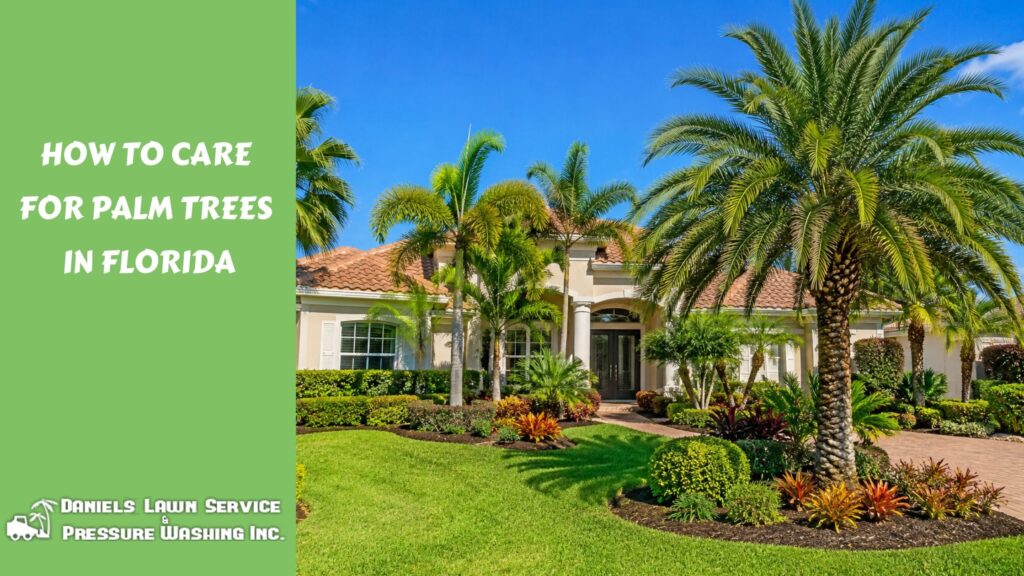
Landscaping Your Central Florida Yard With Palms
Nothing says “Florida” quite like a palm tree! In fact, the sabal palm is Florida’s state tree. To head off the smarty-pants out there, we know – botanically speaking, palms aren’t really trees. They’re monocots – grass-like plants that include celery and corn. But for the purposes of common use, we’ll refer to them as trees. They have what appears to be a trunk, grow from the ground, and have greenery on top. Good enough!
If you’re a recent transplant from a snowy climate, your vision of the ideal Central Florida yard probably had a palm tree or two in it! Now that you’re here – or if you’re a native or longtime Floridian – your property may already be graced by at least one palm. But planning a landscape with palms as focal points and/or accents takes a little doing. Whether you want to go big with the tropical vibe, or mix them in among scrub oaks, ligustrums and other popular plants, palms can be a great asset to your property when selected properly!
Advantages of Palms in the Landscape
In addition to their ability to evoke feelings of living in an island paradise, the first big advantage of palm trees becomes apparent after a hurricane rages through Central Florida. The morning after reveals mighty oaks uprooted – too often crashed through roofs and vehicles – while palms that bent and swayed with the winds are still standing. Their ability to weather storms by being flexible could serve as an example to us!
Moreover, without heavy branches that can grow dangerously over roofs, palm trees are fairly contained in their vertical growth – also making them far less likely to cause property damage during a hurricane or tropical storm.
According to Johnsons Farms FL Inc., other advantages of palms include the following:
Palm trees provide natural shade – Although it isn’t the same type of shade as a spreading oak, the wide, leafy fronds of strategically placed palm trees can offer welcome shade in outdoor seating areas, or by patios and decks. They also can shade specific areas of your home, like windows and walls – thereby naturally regulating temperatures. Another plus: The slim trunks of palm trees don’t interfere with scenic views!
Palm trees increase curb appeal – However long you’ve lived in The Sunshine State, palms help establish the quintessential Florida look. Planting tall palms along your property can draw eyes toward your home. Shorter palms in tree planters by an entryway make an attractive focal point.
Palm trees help clean the air – Like all plants, palm trees purify air naturally by taking in carbon dioxide and emitting oxygen. Carbon monoxide, sulfur dioxide, nitrogen oxides and other pollutants are absorbed by palm trees and are converted into less harmful compounds, which is great for the environment!
Palm trees provide privacy – Low-hanging dense palm fronds can act as natural privacy screens when planted in strategic spots along property lines or patios. They conceal without completely obscuring their surroundings. The multi-trunked European fan palm (also known as the Mediterranean fan palm) can be clustered for a lush tropical look that secludes at the same time. You can even place some palm species – such as the pygmy date palm (Phoenix roebelenii) – in decorative planters to create a stylish privacy wall.
Choosing the Right Palm for the Location
Fortunately, there are many species of palm to choose from, depending upon the effect you want to create in your landscape! From tall – such as the afore-mentioned sabal palm, which reaches a height of up to 40 feet – to the also-afore mentioned petite pigmy date palm (also commonly known as a robellini palm).
According to JMC Landscaping, “Selecting the right palm trees should first and foremost be based on a location’s intended use and attributes. There are various palms available for landscaping homes, commercial buildings, parks, and streets. They can be used as patio trees, border plants, specimens, or street plants.
“Consider the overall appearance of the property you’ll be putting the palms on. Large, towering palm trees lend a stately feeling to the area with their feathery canopies, while shorter palms with cute, fan-shaped leaves make great accent pieces.
“To make sure you have healthy palm trees, you need to choose the right palm species. Moreover, find out if your chosen palm species prefer the shade or sunlight so you’d have an idea of where to plant them. As much as possible, avoid planting palm trees in areas with direct sunlight. Too much sun can burn the fronds, eventually killing them.”
Common palm species include the following, with thanks to Central Florida Tree and Landscape, Lake Wales:
Sabal palm – Also known as the cabbage palm, the sabal palm (Sabal palmetto) has a full, round canopy atop a trunk 10–16 inches in diameter and reaches up to 40 feet in height. This palm is highly adaptive, tough, tolerant of a wide range of soils, and is hurricane-resistant. When planted six to 10 feet on center, sabal palms provide desirable shade.
Pygmy date palm – A small-sized palm with graceful arching fronds, suitable for smaller landscapes. It’s also ideal for landscaping a pool area – especially a screen-enclosed pool. Our blog post – “Landscaping Ideas for Your Central Florida Pool Area” – offers suggestions for creating a variety of moods using different low-maintenance plant species.
Windmill palm (Trachycarpus fortunei) – Cold-hardy and pest-resistant, this graceful palm adds a touch of elegance to Central Florida landscapes.
Majesty palm (Ravenea rivularis) – With feathery fronds, this is a popular choice for its tropical appearance.
Foxtail palm (Wodyetia bifurcata) – Recognized for its unique foxtail-like fronds, this palm adds a distinctive flair to landscapes.
Pindo palm (Butia capitata) – Drought-tolerant and versatile, the pindo palm features arching fronds and edible fruit. The fruits can be messy on sidewalks and walkways, so plant at least 10 feet away from paved surfaces.
Christmas palm (Adonidia merrillii) – Named for its festive appearance, the Christmas palm is compact and suitable for smaller spaces.
Fundamental Palm Care
As our blog post – “Palm Tree Care and Feeding” – notes, while palm trees are usually hardy, they do require a certain amount of maintenance in order for them to achieve full growth and be healthy. Here is what you need to know!
Fertilizing your palm correctly is a crucial part of ensuring successful growth. This is because Florida’s sandy soil doesn’t hold on to nutrients as well — especially during periods of heavy rain — leading to nutrient deficiencies, which can lead to defoliation and eventually death. The best way to make sure your palm tree has enough nutrients is to use a slow-releasing fertilizer that is specially formulated for palm trees.
These slow-release fertilizers are available in granules, pellets and spikes that deliver small doses over time directly to the palm’s roots. Over-fertilizing your palm tree can be just as harmful as not fertilizing, so it’s important to follow label directions. Fertilize in spring, summer and fall. Spread granular fertilizer evenly underneath the canopy (leaf spread) starting one foot away from the trunk and spreading it out to and around the leaf spread. Do not pile fertilizer up against the trunk, as this will damage new roots. Water after application.
Signs of distress due to poor nutrition include the following:
- Older foliage that turns yellow-to-orange indicates a magnesium deficiency.
- Yellow-to-orange spots on all of the palm’s foliage is evidence of potassium deficiency.
- Symptoms of nitrogen deficiency include the yellowing and dropping of leaves and poor growth. This is most likely to occur in soil that is low in organic content, although nitrogen loss can also be caused by erosion, runoff and leaching of nitrate.
Moreover, sensitive palm species need protection from freezing temperatures, on the rare occasions a freeze alert is issued. Covering them with cloth frost is recommended. Speaking of covering, our blog post – “It’s Winter in Central Florida! How to Bundle Up Your Plants to Protect Them From Freezing!” – covers this topic in detail!
Should palms be pruned like other trees? You’ll probably like the answer! As the University of Florida’s Institute of Food and Agricultural Sciences (UF/IFAS) points out, some palm trees — such as the sabal palm — are “self-cleaning,” and shed old fronds on their own. For those that aren’t, you may choose to prune them periodically. Use a pole saw to remove any brown fronds, or hire a lawn care professional to do the job.
One thing to not do is prune tall palm trees to prevent damage from a hurricane, which is unnecessary and can harm the tree. Remember, palm trees are designed to be resilient to high winds! Only prune to remove dead growth.
The Take-Home Message
Whichever species — or variety of species — of palm tree you choose to lend a tropical feel to your slice of Central Florida paradise, our team at Daniel’s Lawn Service & Pressure Washing is ready to help with a wide range of services, from landscape design to plant selection, installation and maintenance. We have experience planting trees of all types, and can also recommend the optimal location to plant in terms of soil, light, and aesthetic appeal. Call us today to learn how we can give you the lawn and garden of your dreams!