BLOG

Five Spring Lawn Care Tips for Central Florida
Now that we’ve sprung ahead to Daylight Saving Time, it’s time to think about spring and your Central Florida lawn!
How to Create a Florida-Friendly Yard
There are a variety of reasons why homeowners choose certain plants for their landscape. Some want colorful flowering annuals or
It’s Winter in Central Florida! How to Bundle Up Your Plants to Protect Them From Freezing!
During the months of January and February, native and long-time Floridians bundle up in coats and jackets to keep warm
Busting Seven More Common Yard and Garden Myths
A love for gardening and yard care is often handed down from generation to generation. Your mom may have patiently
Poinsettias – The Gift That Can Keep on Giving All Year ‘Round
Pity the poor poinsettia! The star of holiday decorating both outdoors and indoors, it’s typically tossed in the trash soon
Fascinating Cycads for Your Central Florida Yard
Back when dinosaurs ruled the Earth, those that lived in subtropical and tropical climates trod among prehistoric plants now known
What to Do In Fall for Your Central Florida Yard
Fall is a subtle season in Central Florida. Afternoon temperatures ease from triple to double digits, and the sun sets
How to Create a Tropical Look for Your Central Florida Yard
Does the idea of living in Central Florida bring to mind a beautiful tropical landscape? If you’re a recent transplant
Invasive Plant Species That Might Be in Your Landscape
You’ve doubtlessly seen movies about space aliens that set out to invade Earth. They assume human form, then settle into

Five Spring Lawn Care Tips for Central Florida

Now that we’ve sprung ahead to Daylight Saving Time, it’s time to think about spring and your Central Florida lawn! Although we’re fortunate to have relatively mild winter temperatures that don’t kill turfgrasses, don’t think you have nothing to do just because your lawn will green up on its own in the coming weeks! Practicing conscientious lawn care now will pay off in a healthy, verdant blanket of grass guaranteed to make your property the envy of your neighbors!

Our Daniel’s Lawn Service & Pressure Washing Inc. experts offer the following five steps to get your lawn ready for the growing season.

  1. Resume a regular mowing schedule

There wasn’t much to do during your lawn’s winter dormancy. But now that those green shoots are emerging, mow once a week. First, however, make sure your lawn mower is up for the job! Check the mower’s fuel system, air filter, spark plug and sharpen blades. LawnWorx recommends attaching a mulch spreader to your mower (if possible) to help provide nutrients to your lawn.

According to University of Florida IFSA Extension, mowing is actually one of the most important home lawn management practices. To maintain the optimum health of your grass, regularly mow throughout the summer months.

The general rule of thumb is to never mow lower than ⅓ inch tall, as it weakens the root system, and can badly stress your turf, leaving it vulnerable to disease, drought and insect or weed invasion. However, University of Florida IFSA Extension provides recommended mowing heights for your lawn’s specific turfgrass species, which are as follows:

  • Bahiagrass: 3.5 – 4″
  • Centipedegrass: 1 – 2″
  • St. Augustinegrass: standard cultivars, 3.5 – 4″; semidwarf cultivars, 2 – 2.5″
  • Zoysiagrass: The majority of these cultivars should be mowed at 1.5-2″

Other lawn mowing tips include:

  • Leave grass clippings on the ground. They act as compost, returning valuable nutrients to the lawn.
  • Keep mower blades sharp. Dull mower blades tear leaf blades, stressing the grass and making it more vulnerable to pests and disease.
  • Do not mow when your lawn is wet. Wet grass clippings keep your mower blades from making the cleanest possible cut.

If you do miss a weekly mowing, bring the height of the grass back down to the recommended level slowly. Raise the mower height so you don’t remove too much leaf tissue at once.

  1. Water less frequently for longer periods of time

Florida newcomers make the common mistake of watering too frequently. Afternoon temperatures are hot – especially during summer – so your turfgrass must get thirsty, right? Not so! Overwatering encourages shallow root growth, which reduces your lawn’s ability to tolerate stress. A healthy lawn has deep roots. How often to water depends on the season, your soil type, the amount of shade in your yard and other factors.

During times of active growth – now through autumn – lawns generally need watering once or twice a week. To encourage deep root growth, however, depend more upon observing your lawn than looking at the calendar, and only water when it “tells” you.

Signs that your lawn is ready to irrigate include the following:

  • Folded leaf blades.
  • Blue-gray color.
  • Footprints visible in grass (the grass doesn’t spring back).

When you do give your lawn a drink, be sure not to saturate it – especially to the point of runoff, which wastes water. A simple watering schedule is to apply ½ to ¾ inch of water when the grass begins to show the signs listed above. Once you’ve applied this amount, don’t irrigate until your grass looks “thirsty” again. Moreover, don’t irrigate if rain is forecast within the next 24 hours.

Also observe your county’s lawn watering restrictions. Each Florida county has different restrictions on days of the week, hours of the day and length of time you can water, so check your county’s website or call your county government’s office.

  1. Aerate your lawn

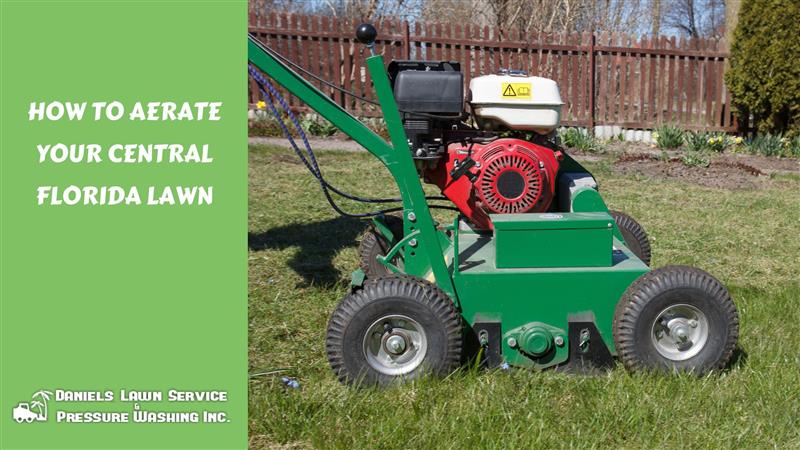
Although many homeowners skip this step, aerating the soil keeps it from getting compact, and supplies roots with water, oxygen and nutrients. There are three types of aeration methods: core, spike and liquid. Lawn care professionals prefer the core method, as it removes plugs of dirt from the lawn, relieving pressure in compacted soil and providing more breathing room for air and water to travel through to reach your grass’s roots. 

The best time of year to aerate in Central Florida is late spring or early summer, when the grass is growing most rapidly and will be able to recover quickly from the stress of aeration. Our blog post – “Why You Should Aerate Your Lawn” – covers this topic in detail.

  1. Apply the first round of fertilizer

Fertilizing your grass should follow aeration. Wait to apply the first round of fertilizer until the grass comes out of dormancy. Applying fertilizer now can help prepare your grass for the heat of summer months ahead. 

Start with a soil test to determine nutrient requirements as well as your soil’s pH level. Fertilizers are composed of three main elements – nitrogen, phosphorus, and potassium – as well as a variety of other ingredients. Opt for a balanced blend of granular, slow-release fertilizer to adjust the acidity/alkalinity and nutrient content of your soil accordingly. When applying granular fertilizer, a drop spreader is suitable for small lawns, while larger areas of turf require a rotary spreader for even coverage.

Applying the proper amount of fertilizer will help your lawn resist weeds. However, applying fertilizer at the wrong time or applying too much can damage your lawn. If you’ve installed a new lawn, wait at least one or two months before fertilizing so it doesn’t run off because the root system isn’t developed. Be sure to read the label carefully before applying. Never apply more than one pound of nitrogen per application.

  1. Monitor for weeds, insect pests and diseases, and treat accordingly

Weeds, destructive insects and diseases all spell trouble for your slice of Central Florida paradise! This is the time of year to prevent them from gaining a foothold. While a healthy lawn is the best defense, here’s what you need to know to get the most from your efforts.

Weeds are first on our list. There are three traditional ways to control them:

Removal by hand – This method is practical only for small yards or flower beds. The obvious drawback is that it’s labor-intensive and time-consuming, should you decide to do it yourself. The best time to hand-pull weeds is when the soil is moist. For this method to be effective, you should make sure you remove the whole plant with its roots.

Proper lawn care – Fertilize your lawn frequently every six to eight weeks during growing season. This helps your lawn stay thick, leaving little space for the unwanted weeds. As mentioned earlier, mowing your lawn at a taller height shades the soil, making it harder for the weed seeds to sprout, since their growth relies heavily on sunlight. Proper irrigation is another important component. Watering heavily and infrequently is the key to a thick grass and deeper roots, giving weeds tough competition.

Herbicide application – Usually, two types of chemical treatments are used to control the spread and growth of weeds: post-emergent and pre-emergent herbicides. Post-emergent chemical treatments kill a weed that is already growing, while pre-emergent herbicides are formulated to prevent germination.

Post-emergent herbicides can be selective – only targeting weeds – or non-selective, killing everything they come in contact with. As for pre-emergent herbicides, be aware that they will also prevent grass seeds from growing, if you plan to reseed any area of your lawn. To know when to apply a pre-emergent, learn the growing season for specific weed species, and apply 14 to 21 days prior to expected growth. Our blog post – “Common Weeds in Central Florida Lawns” – covers this topic in detail.

Central Florida’s subtropical climate is conducive to a long growing season and beautiful variety of plant life. Unfortunately, it’s also conducive to destructive insects that thrive on devouring your lawn! Common culprits include chinch bugs, cutworms, fall army worms (which are also active in spring), mole crickets and sod webworms. Our blog post – “Insect Pests to Look Out for in Your Central Florida Yard” – covers this topic in greater detail.

Again, a healthy lawn will go a long way in preventing these pests from gaining a foothold. When possible, it’s best to avoid applying pesticide, as this will also kill beneficial insects. If necessary, use a pesticide formulated to target a specific insect. Putting the following practices in place can help.

Encourage natural enemies – Introduce beneficial insects such as ladybugs, parasitic wasps and predatory beetles, which naturally minimize pest populations. Birds are also helpful – set up feeders to attract them.

Add nematodes to the soil – These microscopic roundworms are effective at controlling a wide range of harmful soil-dwelling pests – especially insect larvae and grubs – by releasing bacteria that kill them, and are a natural, eco-friendly alternative to chemical pesticides. Introduce nematodes to your lawn when the soil is moist.

As for lawn diseases, they can be tricky to identify because the damage they cause in the form of discolored or patchy turf is sometimes mistaken for insect infestation. The two main symptoms of turfgrass diseases are a circular patch that is no longer uniformly green and/or spots on the foliage. If you spot these signs, further examine the leaves and roots of your turf for more symptoms.

Fairy ring, dollar spot, leaf spot, rust and root rot are among common lawn diseases in Central Florida. University of Florida IFSA Extension provides a helpful flow chart to help identify turfgrass diseases. Click here to access it.

Many diseases can be avoided through good lawn management, especially through avoiding over-watering. Keep these tips in mind:

  •       Avoid mowing down that affected grass and don’t compost it, because that can
        further spread the spores.
  •       Enhance lawn drainage so that water doesn’t pool on the lawn.
  •       Follow best mowing practices.
  •       Don’t allow thatch to build up, as it can become a breeding ground for fungi.
  •       Apply the appropriate fertilizer.

The Take-Home Message

Even here in Central Florida where there isn’t much differentiation among the seasons, spring is a special time that’s crucial in establishing a healthy lawn that will be a great asset to your property throughout the year! Taking these steps now can save you a lot of the frustration, work and – yes, money – that correcting the consequences of an unhealthy lawn would entail.

However, we know that you may not be willing or able to put in the time and effort necessary. That’s what we’re here for! Our professionals at Daniel’s Lawn Service & Pressure Washing are true locals with a passion for keeping your Central Florida yard beautiful and healthy!

In addition to lawn care, our full-service company provides landscape design, plant and tree installation, tree trimming, yard maintenance, land clearing, pressure washing and so much more. Contact us today so we can do the work, and you can do the enjoying! We proudly serve all of Central Florida – including Orlando, Sanford, Longwood and Lake Mary! We look forward to helping you achieve your goals and bring your vision to life!

How to Create a Florida-Friendly Yard

There are a variety of reasons why homeowners choose certain plants for their landscape. Some want colorful flowering annuals or perennials, others want ornamental shrubs, tall-growing shrubs for a privacy hedge, etc. But in Central Florida, creating a Florida-Friendly yard allows you to have it all – and much more!

According to University of Florida IFAS Gardening Solutions, “You don’t have to be an expert gardener or landscaper to create a Florida-Friendly yard. All it takes is a willingness to learn and a desire to build a beautiful yard that helps protect Florida’s environment. Landscaping the Florida-Friendly way means having a beautiful landscape that could save you time, energy, and money while protecting Florida’s future.”

University of Florida IFAS Gardening Solutions developed the Florida-Friendly Landscaping™ Program. It consists of nine principles that work together to promote sustainable landscaping practices that use less water, reduce pollution and protect natural resources. Should you think that planting according to the program will result in a boring yard, our list of Florida-Friendly plants names only a very few of those available – which will provide the color and beauty you want!

The Florida-Friendly Landscaping Program is a comprehensive approach, but you don’t have to pull out all of your existing plants and start over. You can take small steps, and gradually work your way up to the full program. Your yard probably already has at least a few Florida-Friendly plants!

Advantages of a Florida-Friendly Yard

No matter where in your yard you begin, converting to the Florida-Friendly Landscaping Program has significant short-term and long-term advantages. Rockaway Sustainable Landscaping provides the following examples:

Improved aesthetics – Florida-Friendly landscapes can be just as beautiful as traditional landscapes, with diverse, colorful plant selections suited to the Florida climate. The focus on healthy soil and proper care leads to vibrant and thriving plants.

Water conservation – Florida-Friendly practices can reduce outdoor water use by up to 50%, saving money and precious resources. Deep watering less frequently encourages deeper root growth, making plants more drought-tolerant.

Pollution reduction – By using fewer fertilizers and pesticides, Florida-Friendly landscaping helps protect waterways from harmful runoff that can damage ecosystems and contaminate drinking water. Slow-release fertilizers and organic options minimize nutrient leaching.

Wildlife habitat creation – Choosing native plants attracts butterflies, birds and other beneficial creatures, promoting biodiversity and a healthy ecosystem. Native plants provide food and shelter for wildlife, creating a balanced environment.

Cost savings – Implementing Florida-Friendly landscaping practices often reduce long-term costs by requiring less water, fertilizer and pest control. Efficient irrigation systems and organic pest management strategies offer potential financial benefits.

The Nine Principles of a Florida-Friendly Yard

Of course, planting any type of foliage that’s a Florida native or suited to the state’s climate is beneficial in terms of low-maintenance. But to have a yard that follows the Florida-Friendly Landscaping Program, there are nine principles to follow in order to achieve its optimum benefits:

  1. Right Plant, Right Place

How well your plants perform depends in great part on whether you choose the right plants for the right place. Look for low-maintenance plants that are suited to your site and that’ll require minimal irrigation, fertilization, or pest control once they’re established – thereby conserving water and protecting natural resources. Think about how much sun your site receives and choose plants that will work with your property’s conditions. Take into account wet or dry spots in your yard, and group plants based on their irrigation needs. And always take into account the mature size of plants before you purchase and install them.

  1. Water Efficiency

Plants have a specific water requirement to survive and sometimes even drought-tolerant plants in the right place will need supplemental watering. Unfortunately, many homeowners overwater. This does more than deplete the water supply. It also makes plants prone to pests and disease, as well as adds to stormwater runoff, which pollutes our water resources.

Don’t water according to a schedule – look to your plants for telltale signs of water need. Water your lawn only when at least half of it shows wilt. For landscape beds, consider using micro-irrigation systems to put water only where you need it. If you have an irrigation system, make sure it’s working properly and not watering paved areas.

  1. Fertilize Appropriately

Plants need nutrients to grow, and typically get them from the soil. But we sometimes apply organic or synthetic fertilizers to help plants along. Different nutrients encourage growth in different ways, so do your research before you apply fertilizer. That way you’ll apply the right type of nutrients at the right time. Plants also benefit from the right amount of fertilizer. Overfertilizing can aggravate pest problems, stimulate excessive growth, and cause pollution of waterways and groundwater.

Always keep fertilizers off hard surfaces, never fertilize within 10 feet of any water body, and do not fertilize before a heavy rain. Read and follow all label instructions before applying any fertilizer.

  1. Mulch

Mulch is an attractive way to help control weeds, retain soil moisture and moderate soil temperatures. It gives your landscape a neat, uniform appearance and is a Florida-Friendly choice for hard-to-mow slopes and shady spots. Organic mulches can also help improve soil as they decompose.

Many different materials can be used for mulch. Choose environmentally friendly mulch made from melaleuca, eucalyptus, or pine straw or bark. Avoid using cypress mulch, which is often harvested from delicate wetlands. Let fallen leaves stay under your trees to create self-mulching areas. Cut down on mowing by replacing grass with mulch in shady areas where grass won’t grow.

  1. Attract Wildlife

Unfortunately, natural wildlife habitats are diminishing in Florida as more areas develop. Wildlife need food, water, cover and space. Add trees and plants that bear fruit and seed in your landscape. Plant foliage and flowers for butterflies, birds and bees. Native plants can be a good source of food for animals and beneficial insects.

If you don’t have a natural water source, consider building a small pond or placing a birdbath in your yard. Research what kinds of birds nest in your area, and buy or build them a home. Protect your wildlife visitors by limiting pesticide use, or using the least toxic products available.

  1. Manage Yard Pests Responsibly

Pesticides are not always as necessary as people believe. Healthy plants can often tolerate pest attacks, and beneficial insects, birds, and other natural controls can help suppress insect pests. To minimize problems, choose healthy, pest-resistant plants for your landscape, and use them in the right place. Scout your landscape often to detect pest problems early. Pick off insects by hand and remove infected areas of the plant. If you must use a pesticide, use insecticidal soaps, horticultural oils and other low-toxicity products like bacillus thuringiensis (Bt). Treat only the affected plants, and follow all label instructions.

  1. Recycle Yard Waste

It’s easy to recycle the yard waste left over from mowing, pruning, raking and other yard work. Plus, it helps return valuable nutrients to the soil. Leave grass clippings on the lawn when you mow. Never dump grass clippings or other yard waste into storm drains or waterways. It’s illegal, and pollutes the environment.

Use raked leaves and pine needles in beds as mulch, or add them to the compost pile to create a nutrient-rich soil amendment. You can toss small cuttings from trees and shrubs behind other plantings to recycle their nutrients. Many communities provide free yard waste pick-up, and some will turn the waste into free or cheap mulch or compost available to homeowners. Contact your local municipality to see if it offers this service.

  1. Reduce Stormwater Runoff

Rainwater can run off your landscape onto asphalt and other hard surfaces where it can’t penetrate into the ground. But in Florida-Friendly yards, rainwater soaks into the ground and stays on site, helping protect Florida’s waterways. Reduce the amount of rainfall that leaves your landscape by using porous materials like mulch and pavers for your sidewalks and driveways. Densely growing turfgrasses and groundcovers help capture rainwater, and can also filter pollutants and reduce erosion. Moreover, you can keep water on site by directing downspouts into landscape beds, planting rain gardens, and using rain barrels and cisterns.

  1. Protect the Waterfront

Many homeowners have property adjacent to water, and enjoy the beautiful scenery and fun water-based activities. Because everything you put in your landscape can wash into the water, waterfront property requires special care. To protect water bodies from nutrient and pesticide runoff, create a “maintenance-free zone” between the lawn or landscape and the water body. Don’t mow, fertilize, or use pesticides in this area, which should be at least 10 feet wide.

Add Florida-Friendly, low-maintenance plants in this zone. They won’t require much care, and can filter out pesticides and fertilizer runoff from adjacent lawns and landscaped areas.

A Note About Homeowner’s Association Rules:

Homeowner’s Associations (HOAs) govern the appearance of their community’s homes. Some are stricter than others, but Florida statute 720.3075 states that HOA rules cannot prohibit a property owner from planting Florida-Friendly landscaping. This Florida law supersedes any HOA bylaws or covenants stating otherwise. Just a little knowledge to have handy in case you need to do battle with your HOA!

Great Florida-Friendly Plants for Your Yard

Fortunately, following the Florida-Friendly Landscaping Program doesn’t relegate your yard to dull, drab plants. The following list provides plenty of stunning options that allow you to create numerous looks for your landscaping – from tropical to traditional! University of Florida IFAS Gardening Solutions provides the Florida-Friendly Landscaping™ Guide to Plant Selection & Landscape Design, which includes a comprehensive list of plants. Download the free guide here!

Also, our blog post – “Advantages of Landscaping with Florida Native Plants” – features a few more of our favorites!

Azaleas Azaleas are a classic Southern plant, both for the structure they provide year-round and for the magnificent floral displays they produce in spring. There are numerous cultivars to choose from – including exotic-looking native azaleas, which can flourish in any well-draining soil, and enjoy partial shade. Our blog post – “Dress Up Your Central Florida Yard with Azaleas” – covers this great shrub in detail!

Bougainvillea This vining shrub is available in a wide range of bright, fanciful colors, adding charm and drama. Its “flowers” are actually modified leaves, called bracts. They appear periodically throughout most of the year, but are especially plentiful in winter. Bougainvillea can be trained to grow over fences and trellises, or pruned into a shrub-like form. It requires full sun, and performs better when soil is a little dry, making this a perfect plant for the drought-tolerant landscape. However, it does need to be protected from frost and freeze.

Crotons Known for their boldly-marked leaves, crotons are available in a wide variety of leaf shapes and colors that will please any gardener. Prized for their tropical look, crotons are evergreen perennial shrubs that can grow up to 10 feet tall, but there are both dwarf and larger varieties. Crotons grow best in full sun, but many cultivars can tolerate – and even prefer – light or partial shade. Crotons are also popular houseplants.

Hibiscus Hibiscus flowers can be many colors, come in single or double forms, and often last for just a day. Individual flowers may be short-lived, but the plant will produce blooms over a long flowering season. Hummingbirds and many types of butterflies are attracted by hibiscus, as well. Hibiscus range in size from low spreading shrubs to upright tree forms that can reach 20 feet in height. Some are compact and dense, while others are open and thin. They are used in the landscape as informal hedges or screens, foundation plants, specimens, or background for other plants. Check regularly for pests such as aphids, mealybugs and whiteflies.

IxoraThis sun-loving shrub bears clusters of four-petaled flowers and is also known as flame of the woods. It flowers throughout the year, with each flower cluster lasting between six and eight weeks, giving your landscape long-lasting and lovely color. Compact and densely branched, it’s great for planting as a border and screen hedge, as well as a featured specimen.

Pentas Pentas produce red, pink, or white flowers throughout the warm months and attract hummingbirds and butterflies. In many areas of Florida, pentas grow as perennials, though they’ll die back after freezes if not protected. Plant in the late spring in a site with full sun and well-drained soil. Most pentas will reach over a foot in width and two to three feet tall, so make sure to leave them plenty of room. Pinch back early growth to encourage bushier plants.

Society garlic This groundcover produces delicate, star-shaped purple flowers. These perennial plants grow to about a foot tall and are wonderful in borders or mass plantings. Easy to grow, it’s great for a sunny, water-wise garden. Society garlic prefers sandy soil, and flowers best in full sun. It can be grown in partial shade, but will not flower well. Plants thrive with regular watering during the growing season, less frequent watering when flowering, and reduced watering during the winter dormant period.

The Take-Home Message

Planting and caring for your yard according to the Florida-Friendly Landscaping Program requires planning, but the process need not be daunting. Working toward your goals gradually will begin paying off in a beautiful low-maintenance yard in harmony with Florida’s climate and growing conditions that helps protect our state’s valuable natural resources. 

If you need help, our landscaping experts at Daniel’s Lawn Service & Pressure Washing can advise you on the best types of Florida-Friendly plants for your property – and provide a landscaping design that allows you to incorporate and showcase them to give you a yard that will truly be your slice of Central Florida paradise!

In addition to landscaping design, our full-service company provides plant and tree installation, tree trimming, yard maintenance, pressure washing and so much more. Contact us today so we can do the work, and you can do the enjoying! We proudly serve all of Central Florida – including Orlando, Sanford, Longwood and Lake Mary! We look forward to helping you achieve your goals and bring your vision to life!

It’s Winter in Central Florida! How to Bundle Up Your Plants to Protect Them From Freezing!

During the months of January and February, native and long-time Floridians bundle up in coats and jackets to keep warm when facing what we consider cold temperatures — and ignore the laughs from our northern family and friends accustomed to snowplows clearing paths after yet another blizzard.

But we’re not the only ones who need to stay warm as the thermometer reading drops. Our outdoor plants require extra care and attention to survive Central Florida’s coldest nights of the year. However, doing so isn’t quite as simple as covering shrubs and bedding plants with old sheets and towels and hoping for the best. Knowing how to protect your plants from freezing is easier — and less expensive — than replacing them!

Advice for Florida Newcomers: You DO Need to Protect Your Plants in Winter

If you were waiting for a snowplow to come to the rescue not long ago (just before deciding you’d had enough), Central Florida’s version of winter may seem mild to you. Your plants might not agree. Many shrubs, perennials, annuals and even some trees are susceptible to temperatures that are considered a light freeze (29° to 32° F) back home.

Tropical plants are especially vulnerable — which is important to keep in mind if they were already on your property when you bought your house, or you planted hibiscus, bird of paradise, etc., because you wanted a Florida look for your landscaping. This is because while South Florida has a true tropical climate, Central Florida’s climate is actually subtropical. Tropical plants thrive here as long as the temperature cooperates. Once a freeze warning is issued, they’re at high risk for damage or loss — even from one night of exposure. In fact, sudden freezing temperatures after prolonged warm weather can do more harm to your plants than long-lasting freezing weather, as they haven’t had adequate time to acclimate.

Which Plants to Cover — and How to Cover Them

Now that we’ve hopefully convinced you that being prepared for a freeze is essential to saving your plants, those that should be covered include citrus, fuchsia, bougainvillea, succulents, salvia, hibiscus, jasmine, tree ferns and penstemon. Canterbury Farms Nursery & Garden Center provides an extensive list of subtropical and tropical plants that need extra protection. Click here to read in full.

In addition, the staff of Cypress Creek Landscape Supply recommends covering any recently installed plant when a freeze is forecast — even if it’s cold-hardy — as it takes time for a plant to become well-established enough to survive a freeze.

To be ready with the right protection, buy frost cloth. This is an insulating material of woven fabric created specifically to protect plants from freeze damage. The cloths are reusable, and can last for several years. Frost cloth is available at plant nurseries and home improvement centers, as well as major online retailers.

The good people at Green Acres Nursery & Supplies provide the following instructions for correctly placing frost cloth:

  • Completely drape the plant from the top all the way to the ground.
  • Apply the cloth right before sundown to make sure the cloth gathers the heat produced in the ground during the day.
  • Don’t leave any openings in the cloth for the warm air to escape or cold air to enter at night.
  • It is crucial that the frost cloth touches the ground, to the drip line of the plant.

Placing heavy objects like bricks or securing the fabric into the ground with frost fabric staples will ensure that the cloth forms a seal with the ground and traps the warm air that radiates from the soil that is captured during the day. The bricks or staples will also secure the cloth in the case of heavy winds and/or rain, reducing the chances of it blowing away.

A quilt or blanket can be used as a last resort, but only for hardy, well-established plants that won’t be damaged by their weight. Burlap can be used, but shouldn’t touch the plants, which necessitates creating a tent-like structure with wooden stakes. This prevents wet burlap from freezing and damaging foliage, and ensures the cover doesn’t blow away in the wind.

General freeze protection measures include the following:

  • Add extra mulch around sensitive plants when a freeze is forecast. This helps trap the soil’s heat.
  • Water your sensitive plants early in the day before a forecasted freeze. This allows the soil to absorb warmth from the sun and warmer daytime air, thereby helping plants survive the cold. Also, cold winds are drying, taking a toll on plants that are already too dry.
  • Bring potted or container plants indoors, or at least bring them closer to each other. Add mulch around the plants to trap heat at the surface if they need to stay outdoors.

What NOT to Do to Protect Your Plants

Being unprepared is the first big mistake, from which all other mistakes follow. When a cold front approaches, the panic reaction is to grab whatever old sheets, beach towels, etc., are available and cover vulnerable plants. Such items not only do nothing to protect against the cold, their weight can break branches, they are difficult to secure on the plant, and will also transmit cold to the plants if they become wet. Moreover, blankets and sheets do not allow for light penetration or airflow, and can cook the plant if they get too hot.

Worse yet is improvising with a sheet of plastic, or large plastic garbage bags. Landscaping professionals agree that plastic should never be used to cover plants because it doesn’t “breathe,” and can actually create an even colder temperature underneath. Plastic also tends to allow moisture to form on plant leaves, causing them to burn.

Moreover, you may have heard about using overhead irrigation during a freeze. According to UF/IFAS Gardening Solutions, running irrigation like this works on farms where the irrigation systems are designed for this purpose. The water has to run continuously from before the freeze to several hours after temperatures rise for this method to protect plants. With home irrigation systems, you’re just wasting water. Additionally, the amount of water that home irrigation puts out can turn into heavy ice, which can damage plants.

Also, don’t fertilize cold-sensitive plants in the late fall or winter. Fertilizer application will encourage new growth, which is especially susceptible to cold injury. Newly pruned plants are more susceptible to cold damage as well, so postpone pruning until spring. 

The Take-Home Message

While your Central Florida plants need protection against the freezing temperatures that occur in January and February, being proactive with proper care throughout the year will give them an extra advantage in the hardiness department. Plants tolerate cold temperatures better and recover from injury faster when they’re healthy.

Our blog posts — “How to Protect Your Plants From Freeze” — and “First Winter in Florida? We Answer Your Yard and Garden Care Questions!” — provide additional tips on winter plant care.

So even though we’re privileged to live in The Sunshine State, the plants that beautify our property require special attention this time of year. Our experienced team at Daniel’s Lawn Service & Pressure Washing Inc. knows the ins and outs of Central Florida’s climate, so your winter yard can be as beautiful as your spring and summer yard when it’s under our care! We will work with you to achieve your goals and bring your vision to life every season of the year! Our full-service company provides landscape design, tree installation, tree trimming, yard maintenance, bush hogging, pressure washing and so much more. Contact us today so we can do the work, and you can do the enjoying!

Busting Seven More Common Yard and Garden Myths

A love for gardening and yard care is often handed down from generation to generation. Your mom may have patiently taught you how to plant a flower, or enlisted your help in pulling weeds – while your dad might have taught you how to mow the lawn. Unless you majored in horticulture, however, your knowledge beyond what you learned from your family is most likely self-acquired. Although you’ve probably learned a lot of valuable information, you may still believe certain myths that are generally accepted as fact.

In the interest of broadening your education and improving your slice of Central Florida paradise, we offer this follow-up to our blog post –“Busting Seven Common Yard and Garden Myths” – with seven more mythbusters. Read and learn!

  1. Putting Gravel in the Bottom of a Container Helps Drainage

Adding gravel, small rocks or pot shards to the bottom of pots for drainage was once a recommended practice, but it has been found to actually have the opposite effect, preventing water from draining out as easily.

According to Leanne Potts of Better Homes & Gardens, a pot with drainage holes at the bottom is all you need to let the excess water drain out so roots stay aerated. You do not need to add a layer of gravel or pot shards to help it out.

“Putting anything at the bottom of the pot is bad for plants,” gardening expert C.L. Fornari writes in her book, Coffee for Roses…and 70 Other Misleading Myths About Backyard Gardening. Studies have shown the movement of water through a potting medium is hindered, not helped, by a layer of coarse material in the bottom of a pot. That so-called drainage layer of rocks can also block the drainage hole and keep it from doing its job.

  1. Drought-tolerant Plants Don’t Need Watering

Even the most drought-resistant plants need watering for the first year after planting. According to Florida Native Plants Nursery & Landscaping, with Florida’s heat and very nutrient-poor and quick draining soils, it’s important that you provide ample watering to your new plants in the beginning so that root hairs will grow into the surrounding soil. A layer of mulch can help retain moisture. Our blog post – “Why You Should Mulch Your Central Florida Landscape in the Fall” – provides tips for mulching that apply throughout the year.

Watering requirements depend upon the plant species, soil, sun and time of year, so refer to the tag that accompanies the plant if you buy it. For established drought-tolerant plants, keep an eye out for signs of water stress – such as curling, drooping, browning or dropping leaves – then water to revive.

  1. Pine Needle Mulch Makes Soil Too Acidic for Plants

False! Pine needles (also known as pine straw) make an excellent mulch. Although pine needles have a low pH of 3.2 to 3.8 when they fall off the tree (neutral pH is 7.0), the needles begin to decompose once they hit the ground and soil microbes neutralize the acidity. If you use fresh needles as mulch, there may be a slight drop in soil pH until they decompose, but not enough to damage plants. Pine needles are a good mulch material that will suppress weeds, hold in moisture and slowly add nutrients to the soil as they break down.

Moreover, according to UF/IFAS Gardening Solutions, they give a very natural look to landscapes. And, unlike some mulches, pine straw is not likely to wash away because the needles knit together. Pine straw is among the least expensive mulches, but it breaks down and settles quickly. You will have to re-mulch the area often.

Although it’s a great overall mulch, don’t rely on pine needle mulch if your goal is to lower the soil pH around such acid-loving plants as azaleas, camellias and blueberries.

  1. Houseplants Purify Indoor Air

That would be nice if it were true, but alas, it isn’t! This myth originated from an experiment conducted by NASA in the 1980s, which tested whether certain houseplants would purify toxins from the air in a closed environment like a space station. Some did clean volatile organic compounds (VOCs) like formaldehyde out of the air when they were placed in small, air-tight containers.

However, a 2019 study covering a decade’s worth of research assessed the air-purifying ability of indoor plants and concluded that houseplants are ineffective at improving indoor air quality. The problem with the NASA experiments was that the small, densely gaseous chambers used in the laboratory were nothing like your house. The study showed that plants do metabolize VOCs, but the amounts were extremely small and the rates by which they metabolize them were extremely slow. To have an appreciable amount of VOCs that could be lowered to affect air quality in your home, the study found that there would be a need for about 10 plants per square foot of living area. Basically, a 1,200-square-foot home would need 12,000 plants!

Bottom line: If you want to improve your indoor air quality, buy a mechanical air purifier instead of a philodendron. But if you want an attractive, low-maintenance houseplant, a philodendron is a great choice!

  1. Deer-resistant Plants on the Edge of a Yard will Repel Deer

Everyone loves graceful deer – unless they’re dining on your azaleas! While planting shrubs that deer don’t find palatable would seem to be an easy remedy, it just doesn’t work. Although they may initially be put off by a barrier of such greenery as cast iron plants, rosemary and ferns, deer aren’t deterred for long, and will soon make their way to your yard’s delectable offerings. The most effective way to keep deer out of your yard and garden is an 8-foot-tall fence. If the expense of a fence is too daunting – or your HOA doesn’t allow it – try a deer repellent and put it on the plants they like to eat. Reapply the repellent after every rain.

  1. Snakes are Aggressive

Snakes have had a bad reputation since time immemorial. Although we know that non-venomous species are helpful in the yard because they regulate rodent populations, they still strike fear when we encounter them on our home turf. Fortunately, there’s no reason to panic. As UF/IFAS Gardening Solutions observes, even surprised snakes are rarely aggressive.

“Most snakes will actively avoid interactions with people and only strike out when cornered, approached, or attacked. So going after a snake with a shovel is probably the least-safe option that might cross your mind. A snake is not going to come after you if it does not feel threatened.

“The best way to protect yourself while gardening is to wear thick boots and gloves. Take care when working in areas that may serve as a hiding place for a snake. And while it’s best to never approach any snake, approaching a venomous snake can be dangerous, even deadly. If you think a snake may be venomous, call a professional.”

  1. Grits Control Fire Ants

Fire ants are a painful nuisance in Florida yards, so eradicating their nests is necessary to the safe enjoyment of your property. This is no easy task, however, as most of us have learned from frustrating experience. For this reason, numerous home remedies continue to circulate, but none are effective – including grits, soap, soda water, diesel, or citrus peels. According to UF/IFAS Gardening Solutions, some treatments may encourage the ants to move, but they rarely move far.

“Club soda is another common home remedy for fire ants. As the reasoning goes, the carbon dioxide from the bubbles suffocates the ants in their tunnels. While the logic is appealing, in actual practice this treatment has little to no effect.”

Unfortunately, there is no known way to permanently eliminate fire ants from an area. To control fire ants, UF/IFAS Gardening Solutions recommends boiling water, protecting the native competitor ant species, and using garden-specific baits and contact pesticides only as needed.

The Take-Home Message

As a homeowner, taking care of your Central Florida yard and garden requires a good deal of knowledge. Being able to separate misinformation from facts will help you achieve a beautiful outdoor environment that’s a source of pride and enjoyment for you and your family!

Of course, our experienced professionals at Daniel’s Lawn Service & Pressure Washing can lend a hand! We provide landscape design, tree installation, tree trimming, yard maintenance, pressure washing and so much more. Contact us today so we can do the work, and you can do the enjoying! We proudly serve all of Central Florida – including Orlando, Sanford, Longwood and Lake Mary! We look forward to helping you achieve your goals and bring your vision to life!

Poinsettias – The Gift That Can Keep on Giving All Year ‘Round

Pity the poor poinsettia! The star of holiday decorating both outdoors and indoors, it’s typically tossed in the trash soon after January 1 and forgotten until around mid-November, when new poinsettias are purchased to start the cycle again. This season, we ask you to consider the poinsettia in a different way – as an intriguing perennial that adds long-term interest to your Central Florida yard. With proper care, you’ll be rewarded with a thriving foliage plant that can last for many years.

“The Central Florida area is one of the best places in the country to keep this low-maintenance plant alive and thriving,” writes Theresa Johnston in About Orlando. “After a few months, the colorful leaf-like bracts will begin to fade out, leaving a beautiful, full, green bushy plant with just hints of its holiday red.”

The same applies to potted poinsettias used as interior decorations. These hardy plants can likewise flourish indoors, and – with the proper care – even “rebloom” with colorful, showy bracts in December.

If you’re catching on that there’s much more to poinsettias than a few weeks of festive red or white foliage that dresses up your front porch and foyer, keep reading!

Poinsettias – A Brief History

Although poinsettias are usually associated with snowy climates – thanks to all of those Christmas movies and greeting cards – the plant originated in Mexico. According to University of Florida IFSA Extension, the ancient Aztecs called the plant “cuetlaxóchit,” using it in their fall celebrations, as well as for the production of red and purple dyes, and for medicines derived from its milky white sap.

The poinsettia’s long identification with Christmas began in the 17th century, when Franciscan friars used it to decorate altars and Nativity scenes. They named the plant “flor de Nochebuena” (“Holy Night flower”) because it blooms around Christmas. The festive plant’s good timing also boosted its popularity throughout Latin American countries, where it goes by such names as “pastora” and “flor de Pascuas,” which mean “Christmas flower.”

It earned its English name in honor of Joel Roberts Poinsett, the botanist and U.S. ambassador to Mexico, who introduced it to the United States in 1825. Poinsett sent one of these exotic specimens to his friend, Robert Buist, a renowned Philadelphia botanist with the Pennsylvania Horticultural Society, who exhibited the plant for the first time at a flower show in 1829. A successful floral import-export executive, Buist introduced the plant in Europe in the 1830s and christened it “Euphorbia Poinsettia.” Demand for poinsettias quickly spread, and the rest is holiday history.

Currently, there are more than 150 poinsettia varieties. However, those with red, white and marbled bracts are the most popular in Florida. For those who want to make a fashion statement, other available colors include pink, fuchsia, burgundy, yellow and even purple. 

Where do all these poinsettias come from? Ecke Ranch, which is based in Encinitas, California, produces over 70% of the purchased poinsettias in the U.S. The ranch accounts for almost half the market of the plant in the world!

Planting Poinsettias Outdoors

Here’s one more interesting fact. In the six weeks prior to Christmas, approximately 35 million poinsettias are sold, representing about $250 million worth of sales. That’s a lot of money – not to mention a lot of fine, healthy plants – that get tossed out right after Christmas. This time, consider your holiday poinsettias as an investment in your landscaping instead of disposable décor! Removing them from their pot and planting them in your yard isn’t that difficult – nor is their care and maintenance.

To plant and grow poinsettias outdoors, Sydney Park Brown of University of Florida IFSA Extension provides the following instructions.

‘The best potted plants for establishing in the landscape are ones that have been in good light while indoors and have retained some green and healthy leaves. Choose a sunny spot that will not receive any artificial light at night. Plant your potted poinsettia(s) as soon as danger of frost is past. Cut off the fading bracts, leaving 4–6 inches of the stem on each branch and as many green leaves as possible.

“Poinsettias prefer moist, well-drained soils with a soil pH between 5.5 and 6.5. Place the plant in the soil at the same depth it was growing in the container. Gently firm the soil around the plant and water well. Keep the plant mulched and well-watered until established. Fertilize monthly, from March to October in central and south Florida and from May to September in north Florida. Use a fertilizer with balanced amounts of nitrogen and potassium (the first and third numbers of the analysis) and low phosphorus (the middle number). Follow the application directions on the product label.

“Prune in early spring when the floral display is finished and the danger of frost has passed. Cut back to within 12 to 18 inches of the ground or to living tissue if the plant was damaged by cold. Poinsettias may become “leggy” and unattractive if not pruned regularly during the growing season. Cut back once a month, if needed, leaving four leaves on each shoot. Discontinue pruning after September 10. Flower buds will begin to develop in October. Delay or disruption of flowering will occur if fall temperatures are too warm or too cold or if the required dark period is interrupted.”

Did You Know? Once out of the pot and planted in the ground, a healthy poinsettia can reach a height of 10’! 

Growing Healthy Poinsettias Indoors

If you want your potted poinsettias to remain a container plant – whether indoors or out – University of Florida IFSA Extension provides the following tips:

  • Set on a porch or in a window with indirect sunlight for at least 6 hours per day.
  • If kept indoors, room temperatures of 65°F to 70°F are best; keep them away from cold drafts and excessive heat.
  • Water thoroughly only when the surface of the soil is dry to the touch; do not water too frequently.
  • Indoors, fertilize lightly only every 4-6 weeks.
  • In April, when the leaves and bracts begin to deteriorate and fall off, cut the plant back and give it sun, water and fertilizer regularly.

A big challenge is to get your potted poinsettias to “reflower” the next year. For those who know your poinsettia basics, the brightly colored bracts aren’t flowers – rather, they’re a cluster of modified leaves. The actual flowers are small, and clustered in the center of the bracts. To encourage them to put on their holiday show, start in October by keeping them in complete darkness for at least 13-14 hours each day, and in bright light the rest of the day. After about two months – just in time for Christmas – your potted poinsettias should give you the gift of a colorful display of blooms!

By the way, the persistent myth that poinsettias are poisonous is just that – a myth!  Like most plants, they contain toxins, but not in dangerously high concentrations. While some individuals are mildly allergic to their milky sap, opportunities for it to make enough contact with skin to cause a reaction are pretty slim. Our blog post – “Busting Seven Common Yard and Garden Myths” – covers this topic in greater detail.

The Take-Home Message

Decorating with poinsettias is a favorite Christmas tradition that brightens homes and helps to make the season merry. With a little care and attention, they can truly be the gift that keeps on giving to your landscape or home throughout the year, for years to come!

Of course, once those poinsettias are growing in your yard, we can take care of them – along with all of your other plants! Daniel’s Lawn Care & Pressure Washing is a full-service company that provides yard maintenance, landscape design, tree installation, tree trimming, pressure washing and so much more. Contact us today so we can do the work, and you can do the enjoying! We proudly serve all of Central Florida – including Orlando, Sanford, Longwood and Lake Mary! We look forward to helping you achieve your goals and bring your vision to life!

Fascinating Cycads for Your Central Florida Yard

Back when dinosaurs ruled the Earth, those that lived in subtropical and tropical climates trod among prehistoric plants now known as cycads. Although the dinosaurs died out, cycads survive to the present day.  With their fringy fronds, some cycad species are mistaken for palms, with the misnamed sago palm being the most well-known example.

Unlike palms, however, cycads are dioecious, meaning they have separate male and female plants. When mature, the male plants produce pollen-filled cones, while the females produce larger cones that contain seeds. Botanical distinctions aside, cycads can be an intriguing low-maintenance addition to your landscape that bring a lush touch of the tropics and a living glimpse of a long-bygone era. Our blog post – “How to Create a Tropical Look for Your Central Florida Yard” – provides plant recommendations that cycads will visually complement.

Bring a Bit of Jurassic Park to Your Yard with These Prehistoric Cycads

If you want to introduce a bit of wild, primordial beauty to your 21st century yard, cycads will set the scene, harkening back to when the world was young. Cycads have thrived for millions of years, so they’ll readily find growing conditions on your property agreeable.

University of Florida IFAS Gardening Solutions provides the following list of cycads you can incorporate into your landscaping. Click on the name to learn more about each!

Bamboo Cycad Despite all we just said about cycads resembling palms, the bamboo cycad looks more like the plant it’s named for. Ceratozamia hildae has an upright, delicate appearance that makes it one of the most unique among all 200 cycad species.

It forms thin, stem-like petioles that grow up to 5-7 feet long depending on how much sunlight they receive. Pairs of thin, lime-green “leaflets” are arranged along the petiole in a “bow tie” pattern. These thin, papery leaflets distinguish the bamboo cycad from other cycads, which typically have thick, leathery leaflets. 

Easy to grow, bamboo cycads tolerate a wide range of climate and light conditions, and can mature in 2-4 years with proper care. They grow best in partial shade, but also can be grown in moderate sun or deep shade. Bamboo cycads require a little moisture compared to other cycads, but should never be overwatered or allowed to sit in saturated soil, as they’re sensitive to root rot. Avoid planting in low spots or places that become saturated easily. If you have a small yard with limited space, they make attractive container plants.

Cardboard Plant Known scientifically as Zamia furfuracea, the cardboard plant is a Florida landscape favorite that easily passes for a palm. In fact, it’s commonly referred to as a cardboard palm, so if you hear this designation, know that it’s one and the same! The cardboard plant provides a year-round display of striking foliage and, once established, requires little water or maintenance. Fun fact: The cardboard plant was named a 2007 Florida Plant of the Year by the Florida Nursery Growers & Landscape Association (FNGLA).

The fronds of the cardboard plant can grow to 3 feet long with up to 12 pairs of stiff, leathery, dark green leaflets. Its evergreen foliage provides a great backdrop for colorful flowers in landscape beds. Select a site that will leave the plant ample room to grow, as it can reach up to 6 feet in diameter. This hardy, eye-catching plant grows in full sun or shade, and tolerates a variety of well-drained soils.

The leaves grow out of a thick, fleshy trunk that serves as a reservoir in times of drought. The trunk is also where the distinctive-looking reproductive structures arise. Male and female plants each produce their own cones. After the female cones are fertilized, they ripen and break open to reveal a number of tightly packed, bright red seeds.

Coontie Looking like a combination of a palm and a fern, the coontie (Zamia integrifolia) has the distinction of being the only cycad native to the United States. Typically one to three feet tall, it has stiff, glossy, featherlike leaves attached to a thick, short, underground stem.

Because of its high drought tolerance and moderate salt tolerance, the coontie is an excellent choice for coastal yards – and it’s cold-hardy, as well. Coonties can be planted in sun or shade, and can be used as a specimen plant or in foundation and massed plantings.

The coontie is also the preferred food source for larvae of the rare atala butterfly, which makes it an ideal addition to any butterfly garden. But don’t worry – the coontie survives the larvae’s appetite and grows new leaves!

Dioon This is a genus of plants native to Central America. These cycads are easy to grow and can make a strong statement in any landscape. They’ve been discovered by professional landscapers and gardeners alike as replacements for sago plants, which are susceptible to the destructive cycad aulacaspis scale.

Chestnut dioon (Dioon edule) and giant dioon (D. spinulosum) are the two species most commonly grown in Florida. Although the palm-like leaves of both plants have a feathery look, the leaf tips are quite spiny.

Chestnut dioon is the more cold-hardy of the two and is suitable for USDA zones 8-11. It resembles the king sago, but the foliage is typically more blue-green and can even be pale blue or pale red as it emerges. Though quite slow growing, the plant can develop multiple trunks and can reach up to 8 feet in height. Giant dioon is best suited for the southern parts of Florida since it is rated for USDA zones 9B-11. It produces stiff, upright leaves that are light green in color. Giant dioon is a suitable alternative for the queen sago and grows up to 5 to 12 feet tall and 6 feet across.

Chestnut dioon prefers full sun to partial shade, while giant dioon should be planted in partial or full shade. Both species will perform best when planted in a well-drained soil that receives irrigation, but they are also drought-tolerant. They can be grown in poor soils, though fertilizing the plants will improve growth. Look for a balanced fertilizer that also provides trace elements.

Chestnut dioon also has a high tolerance to salt, making it a Florida-friendly choice for coastal gardens. Both species can work well as specimen plants or as an architectural backdrop to other plants in a mulched bed.

Sago Alternatives As mentioned, the cycad aulacaspis scale has had a devastating effect on king and queen sago plants, with the majority of those having some degree of infestation. This pest is very common in Central Florida. Compared to other scale insects that attack plants, this scale is much more aggressive. It multiplies rapidly and leads to leaf yellowing. For this reason, home gardeners are looking for alternatives that can provide a similar dramatic, tropical look, but are resistant to this scale and other insect pests.

In addition to the chestnut dioon described earlier, Ceratozamia kuesteriana is another good alternative to the king sago, as both can be grown throughout Florida. Both of these cycads have evergreen, palm-like fronds and resemble the king sago, but they aren’t as prone to the cycad aulacaspis scale. In case you’re wondering, Ceratozamia kuesteriana doesn’t have a more user-friendly common name.

Other alternatives to sagos include actual palms – such as the slow-growing windmill and radicalis palms. Some of these plants prefer full sun, while others like a little shade.

Tips for Growing Healthy Cycads

Although most cycads are low-maintenance – after all, there was no one around to take care of them eons ago – home gardeners can unknowingly cause harm. Sara Edelman – Palm and Cycad Manager at Fairchild Tropical Botanic Garden – provides the following tips to ensure healthy cycads.

Take care when using mulch – Mulch increases organic matter and nutrients around plants and decreases the growth of weeds. However, mulch is a major deterrent of cycad growth. The base of the cycad is usually characterized by a nice round bud that is somewhat soft. When mulch gets too close to the base, the soft part begins to rot and spreads infection through the cycad. After a few months of heavy mulching around cycads, the newest leaves will start to wilt.

Pay attention to planting depth – In many gardens, the base of the cycad is buried underground, much like a ground orchid bulb. The result is severe decay, similar to what heavy mulching causes. Burying the base underground suffocates the cycad, increases chance of rot and stops the plant from producing new leaves. The correct depth is directly below the base of the cycad and above where the roots start.

Don’t remove the pup – For many cycads, strength and health are measured by the ability to grow pups. This is a form of asexual reproduction in which the individual is able to grow a new center of growth off of the current base. Many people who want to keep their cycad small will remove the pup. However, doing so could damage the cycad beyond repair, and there is a risk of losing the parent and the pup to infection, rot and disease. If the goal is to keep the cycad manageable, trim back the leaves. Cycads respond very well to trimming in the fall months as long as no damage is done to the base of the plant.

Now, here’s a word of caution: All cycads are toxic to humans and animals. No part of any cycad should be eaten. Touching the leaves is generally not considered dangerous, but it’s a good idea to wash your hands afterward. To stay on the safe side, don’t plant a cycad if you own a dog that’s allowed the run of your yard. If you have small children – or visiting grandchildren – make sure they don’t try to eat the seeds, to which they may be attracted.

The Take-Home Message

Cycads can be an ideal plant to complement your existing landscaping, or used to establish a tropical look with Florida flair. Although low-maintenance, care should be taken to avoid inadvertently harming them through improper gardening methods.

If you need advice on where to plant these fascinating prehistoric “living fossils” – as well as someone to provide and plant them – call us! Our landscaping experts at Daniel’s Lawn Service & Pressure Washing can advise you on the best types of cycads (or any plant or tree) for your property – and provide a landscaping design that allows you to incorporate and showcase them to give you a yard that will truly be your slice of Central Florida paradise!

In addition to landscaping design, our full-service company provides plant and tree installation, tree trimming, yard maintenance, pressure washing and so much more. Contact us today so we can do the work, and you can do the enjoying! We proudly serve all of Central Florida – including Orlando, Sanford, Longwood and Lake Mary! We look forward to helping you achieve your goals and bring your vision to life!

What to Do In Fall for Your Central Florida Yard

Fall is a subtle season in Central Florida. Afternoon temperatures ease from triple to double digits, and the sun sets a little earlier. The most obvious change is announced by the arrival of PSL (pumpkin spice latte) season. But although September isn’t the start of sweater weather here, your yard still needs special attention to keep it healthy now, as well to make sure it’s ready to thrive again in spring! We at Daniel’s Lawn Service & Pressure Washing offer this guide to fall lawn care – as well as some garden favorites to brighten your yard!

Time to Aerate, Seed/Overseed and Fertilize Your Lawn

If you’ve never aerated your lawn, you’re not alone. However, you might be missing a step that could greatly benefit your lawn’s health. ASI Landscaping Management makes the case for aeration as follows:

“Throughout the year, your soil and grass go through a lot. It’s being trampled on by you and your family, rolled over by lawn equipment, and otherwise taking a lot of direct stress. By the time fall shows up, the grass and its roots can be compacted, which can affect how it grows going forward. Aeration involves using special equipment to perforate the ground with a series of shallow indentations.

“Aeration does two things; it helps loosen those compacted grassroots and opens up the ground so it is more receptive to things like moisture, fertilizer, and seed. Having the soil in your yard aerated during your fall landscaping is giving it a healthier start for the following spring. Even though Florida tends to have sandy loam soil, which is a collaboration of sand, clay, and silt and doesn’t get compacted so easily, aeration can still be necessary.”

If you’re a lawn care enthusiast who likes to DIY, Briggs & Stratton offers the following instructions for aeration:

  • Start with moist soil (wait 24 hours after a rainstorm or irrigation).
  • Choose a tool or a machine that actually removes “plugs” of soil from the lawn, rather than making a hole in the ground. That causes the surrounding area of the hole to compact roots and grass even more, thus defeating the purpose of aerating your lawn. 
  • Since most machines and tools only cover a small percentage of soil surface, multiple passes might be necessary. 
  • Once the plugs have dried, they can be broken up and spread over your lawn for a clean appearance (the plugs can be broken up using your lawn mower or by pounding them with the back of a rake).

Fall is the ideal time to take a good look at your lawn and seed areas of bare soil. Seeding works great to rejuvenate such areas with a vibrant cover of grass. A good rule of thumb is that the less seeds you use, the longer it will take to knit in and the longer it takes to knit in, the more susceptible to weeds your lawn will be. As our blog post – “How to Prepare Your Central Florida Lawn for Fall” – notes, this is the best time of year to seed, since the cooler temperatures make better conditions for new growth.

If you want your yard to look its best throughout winter, fall is also the time to overseed. This refers to the practice of seeding a temporary cool-season grass – such as ryegrass – over the permanent warm-season lawn that goes dormant during late fall and early winter in many parts of Florida. This provides an attractive green lawn until it dies out in spring and growth of the warm-season grass resumes – with no additional work on your part required. Additional benefits of overseeding include better retention of the soil’s moisture, return of nutrients to the grass and weed prevention.

Overseeding – as well as seeding – should be done in conjunction with aeration because it allows the seeds to reach closer to the already existing root system, providing the seed-to-soil contact that allows seeds to germinate and sprout.

And don’t forget to fertilize! October is the last recommended month to fertilize prior to winter. Depending on your plants, you might need to fertilize more often than once a year, so make sure to research the care that your plants need. It’s also important to follow the manufacturer’s directions for use for the best results. Look for a brand that contains a slow release of nitrogen and potassium, and has a nitrogen, phosphorus and potassium ratio of 16-4-8.

If you really want to fertilize your lawn like a pro, have your soil tested to determine the kind of nutrients it needs and the balance of the pH level. Having the soil professionally tested yields valuable insight into what nutrients are missing, if the pH balance is appropriate to support growth, and more. These particular factors are critical to know. For example, if the pH level is too high, turfgrass and plants can suffer major deficiencies because vital nutrients in the soil are burned up before the plant can utilize anything. This will help you to select the proper fertilizer that will best support the growth of your turfgrass and plants. Fertilize after aerating your lawn to achieve optimum benefits.

Time to Treat Your Yard for Weeds and Pests

In Central Florida, numerous types of weeds and insect pests can pop up all year long. However, they are easier to get rid of in the fall. Choosing a pre-emergent and/or herbicide and applying it to your soil after aeration is the best way to prevent rapid weed growth.

According to Duda Sod, weeds such as chickweed, henbit, burweed, and wild geranium find it too hot during the rest of the year to grow, but can spread quickly over a dormant winter lawn. Lawn Care Extraordinaire provides an extensive list of common Florida weeds, with photographs to make identification easy.

After applying your pre-emergent, you may have to pull out a couple of stragglers after the initial application, but if rampant weed growth continues, you will need the help of a lawn service professional. The best time to apply an herbicide or pre-emergent is when the weather reaches 60 degrees Fahrenheit or lower for four consecutive nights, around late September and into October. Our blog post – “Weeding and Feeding Your Florida Lawn” – provides additional advice and recommendations.

When it comes to recognizing if you have an insect infestation, look for brown patches or any discoloration in your yard. Some of the insects to watch out for during the cooler months include:

  • Fall armyworms
  • Mole crickets
  • Sod webworms
  • Southern chinch bugs

As Gaston Mulch & Soil notes, “These pests should be treated and prevented before they cause lasting damage to your lawn. If your lawn has discoloration or brown patches, these are good indicators that you have an issue. Make sure you use specially formulated pesticides for these particular pests because the incorrect pesticide can be ineffective against our native pests and also damage your soil. Call a professional pest control company if you don’t feel comfortable handling pesticides yourself or think you have an infestation.”

If you are looking for eco-friendly pesticides that are non-toxic to humans and animals, our blog post – “Earth Friendly Pesticides” – offers instructions for mixing and applying your own homemade natural ingredient pesticides.

Time to Plant Annuals and Perennials to Enjoy Now

This being Central Florida, flowering plants can grow and bloom throughout fall and winter. University of Florida IFAS Gardening Solutions provides this list of plants that will brighten up your yard. Click on the plant name for more information.

Chrysanthemums Often shortened to mums, these easy-to-grow, herbaceous perennials can live for years and continue to bloom. Generally these plants grow to be about 6 inches tall although they can reach 2 feet in height when flowering.

Mums form rounded mounds that, when in bloom, burst with the autumnal colors that our transplanted residents from up north may be missing this time of year! Not only do mums come in an array of colors, they also come in a variety of flower forms. The single flower form looks much like a daisy, while the pompon form has more of a globular shape. There is even a spoon flower form where the flower petals are tubular and flatten out at the tips, resembling many little spoons. Mums are ideal for mass plantings and cut flowers. As a bonus, the flowers attract butterflies.

Firespike – This ornamental adds a big pop of red to the garden. Known botanically as Odontonema cuspidatum, firespike grows 4 to 6 feet tall and produces clusters of 3-inch-long, tubular red flowers. Its foot-long spikes of showy flowers appear fall through winter in Central Florida. They attract hummingbirds and several species of butterflies that feed on the nectar. Because of its overall height and large, glossy foliage, firespike makes a great anchor when massed at the back of a garden bed. It also works well in cutting gardens.

MarigoldsAvailable in mainly a range of yellows and oranges, these hardy, reliable annuals are often used for color massing, edging, borders, cut flowers and container plantings. French marigolds excel year-round while the large-flowered African types are best for spring. The marigold will grow one to two feet tall, and needs full sun. The brightly colored flowers can be single or double. They make great cut flowers and are most effective in mass plantings; place them at least a foot apart. They’ll fill in to create a groundcover in an open bed or beneath a small tree.

Pansies and Violas Pansies and violas are charming cold-tolerant annuals that you can plant in winter and enjoy through spring. Viola flowers are small—typically less than an inch across—while pansy flowers can be two to three inches wide. Pansies and violas come in a range of colors, including red, white, purple, yellow, and apricot. Some pansy flowers are a single bright color, while others have a dark center. Some also produce a sweet scent at dawn and dusk. They’re ideal for borders, containers, and window boxes. Plant in a well-drained, rich soil where they’ll receive plenty of sun, and irrigate only as needed.

Snapdragons This is an easy-to-grow ornamental annual that can be planted in October. Snapdragons range in size from six inches to three feet tall and come in a rainbow of colors, so you can select a variety that fits your landscape. Snapdragons make great borders and they’re beautiful when planted in groups. They are a long-lasting cut flower, and can even thrive in containers. They do best in soil amended with organic matter and prefer full sun.

The Take-Home Message

Although it may seem that our Central Florida fall and winter temperatures don’t plunge as low as they do up north, our lawns can tell the difference! Performing the necessary care and maintenance now will keep your yard beautiful even when the only people still wearing shorts outdoors are the tourists – and will give it a big advantage when spring comes back around.

However, we know that you may not be willing or able to put in the time and effort necessary. That’s what we’re here for! Our professionals at Daniel’s Lawn Service & Pressure Washing are true locals with a passion for keeping your Central Florida yard beautiful and healthy!

In addition to lawn care, our full-service company provides landscape design, plant and tree installation, tree trimming, yard maintenance, land clearing, pressure washing and so much more. Contact us today so we can do the work, and you can do the enjoying! We proudly serve all of Central Florida – including Orlando, Sanford, Longwood and Lake Mary! We look forward to helping you achieve your goals and bring your vision to life!

How to Create a Tropical Look for Your Central Florida Yard

Does the idea of living in Central Florida bring to mind a beautiful tropical landscape? If you’re a recent transplant to The Sunshine State from a region that has four distinct seasons – including that freezing one called “winter” – you may be looking forward to transforming your yard into a lush tropical paradise where you can enjoy resort-like vibes throughout the year (or most of it)!

Even if you’re a Florida native or semi-native whose yard is in a bit of a visual rut, uplifting your landscaping with a touch of the tropics can add exotic notes that engage the eyes and refresh the spirit. If you’re a fortunate pool owner, tropical plants are the ideal way to set off your pool and patio as the place to relax and entertain! Our blog post – “Landscaping Ideas for Your Central Florida Pool Area” – provides information on plant selection and landscaping design.

Tropical plants can take your yard from dull to dazzling, so we’ll look at what you’ll need to do to get started – and, of course, recommend some eye-catching, yet easy-to-care-for plants that will add the right textures and vivid colors that will transport you to your exclusive island-like retreat!

Why a Tropical-style Landscape Requires Planning

It’s important to know that Florida has two distinctive climate zones: subtropical and tropical. North and Central Florida are subtropical, while South Florida is tropical. So what’s the difference? Some of those exotic plants you envision might not be as tolerant of our relatively few cold days! This is why coconut palms thrive in Miami, but not here.

If you’re new to gardening, the USDA Plant Hardiness Zone Map is the standard by which gardeners and growers can determine which perennial plants are most likely to succeed at a specific location. Central Florida encompasses mostly zone 9b, with South Florida classified as zones 11a and 11b. Miami-Dade County and the Florida Keys are entirely in zone 11b.

Fortunately, this doesn’t significantly limit your selection – unless you really had your heart set on gathering coconuts from your very own tree! But creating an attractive tropical-inspired landscape requires planning to achieve the right visual harmony.

Keep in mind that any tropical plants you select will need to be incorporated into your existing landscaping. A common mistake is to fall in love with a hibiscus shrub or bougainvillea vine at your garden center or nursery, and bring it home only to plant it wherever there’s a bare spot. Instead, take photos of plants you like, then tour your yard and determine where they can best be planted to achieve the effect you want. Of course, getting inspiration from Pinterest and other sources can provide ideas for grouping plants and using them to define specific areas of your yard – such as a porch, patio, pool, walkways and corners. As will all other plants, check for sun/shade tolerance, soil and watering requirements, and height/width at maturity.

Colorful Plants and Graceful Palms for a Tropical Paradise

Even though tropical plants give an upscale look to your landscape, they’re relatively inexpensive to purchase and easy to care for. University of Florida IFAS Gardening Solutions kindly provides the following list of plants that can make your yard a standout! Click on the name to learn more about each.

Bird of ParadiseThis distinctive plant adds exotic flair with its vivid orange and blue blooms that resemble birds taking flight. Its blue or blue-green leaves are oblong, 12 to 18 inches long, and held on long, stiff leafstalks. Technically, the “bloom” is comprised of sepals and bracts, but like poinsettias, these bracts are typically called flowers. Mature plants can produce up to three dozen flower spikes annually. It can be planted year-round in mass plantings, as a specimen, in a container, or as an accent plant. Bird of paradise reaches a maximum height of 3 to 5 feet with a spread of 2 to 4 feet. Mature plants will grow into clumps, which can be an attractive focal point in the landscape.

Bougainvillea This tropical vining shrub is available in a wide array of bright, fanciful colors. As with the bird of paradise, its “flowers” are actually bracts. They appear periodically throughout most of the year, but are especially plentiful in the winter, when the splashes of color are a welcome sight. Bougainvillea blooms in fuchsia, red, white, yellow, and orange. It can be trained to grow over fences and trellises, or pruned into a shrub-like form. Bougainvilleas require full sun and perform better when soil is a little dry, making this a perfect plant for the drought-tolerant landscape. However, it does need to be protected from frost and freeze.

BromeliadsThese distinctive plants make a statement with their bold, often colorful leaves and the exotic flower spikes that many varieties produce. There are thousands of different bromeliads that come in an array of shapes and sizes and thrive in many light conditions, so you’re bound to find a variety that can work for you. Keep in mind that a bromeliad’s leaf hue, form and pace of development can be influenced by the amount of sunlight it receives.

Tip for gardeners: Periodically flush the natural cups that collect water at the base of the leaf rosettes, as these can be a breeding ground for mosquitoes.

CrotonsThese perennial evergreen shrubs are popular for their large, showy leaves in bright colors that include reds, oranges, yellows, pinks, purple, greens, and white. This shrub can grow up to 10 feet tall, but there are both dwarf and larger varieties. Crotons are easy to propagate, and are reasonably priced. Many crotons grow best in full sun, but many cultivars can tolerate – and even prefer – light or partial shade. Frosts or freezes will damage them, but they quickly recover. When grown outdoors, this plant looks most appealing when planted in groups. Use them to accent green shrubbery and add a splash of color to any yard or container. Crotons are also attractive and hardy indoor plants.

HibiscusNothing says tropical paradise better than the large bright, vibrant flowers of the hibiscus shrub! Hibiscus flowers can be many colors, come in single or double forms, and often last for just a day. Individual flowers may be short-lived, but the plant will produce blooms over a long flowering season. Hummingbirds and many types of butterflies are attracted by hibiscus, as well. Hibiscus range in size from low spreading shrubs to upright tree forms that can reach 20 feet in height. Some are compact and dense, while others are open and thin. They are used in the landscape as informal hedges or screens, foundation plants, specimens, or background for other plants. Check regularly for pests such as aphids, mealybugs and whiteflies.

Ixora One of the best qualities about this tropical perennial is that it flowers throughout the year! Each flower cluster can last between 6 and 8 weeks, giving your landscape long-lasting and lovely color. Ixora varieties offer a nice selection of colors – including bright red, orange, yellow, pink, and white. A compact, densely-branching shrub, ixora is ideal for planting as a hedge, border, screen, or featured specimen – depending on which variety you select. Some ixora types grow to 10-15 feet tall and 4-10 feet wide when unpruned, but they can handle shearing to maintain them as a smaller hedge. However, constant shearing will reduce their flower display. Smaller forms that only reach 4-6 feet are available, as well as petite cultivars.

European Fan PalmAlso known as the Mediterranean fan palm, this slow-growing, clumping palm grows 8 to 15 feet tall and spreads 6 to 10 feet wide. The fine-textured fronds make this palm stand out from other plants in the landscape. Leaf color ranges from lovely light green to stunning silver. The fronds are held on curved, short trunks. Small clusters of yellow flowers form in the spring and are followed by inconspicuous fruits. Young or mature, this palm makes a stunning sculptural element in a garden or in a patio container.

Pygmy Date PalmGraceful and – by palm tree standards – petite, the pygmy date palm is a popular choice for tropical, Florida-style landscaping, especially for homes on standard-size suburban or city lots. True to their name, pygmy date palms only reach a maximum height of about 12 feet. They are single-stemmed but often planted in clumps. This gives the look of a multi-trunked palm as the group reaches maturity.

Enjoy Instant Gratification with a Tropical Landscape

Although your tropical plants will grow to become even more full and spectacular over time, a big advantage is that they’re beautiful and engaging even right home from the garden center. You don’t have to wait to start enjoying the exotic charm they’ll bring to your yard! Once you have your very own Central Florida tropical oasis, you can indulge in a little getaway any time!

Don’t have the time or inclination to go select, plant and maintain tropical plants? Or not sure about where to plant them? Call Daniel’s Lawn Care & Pressure Washing to design, plant and even maintain the yard of your dreams! In addition to landscaping design, our full-service company provides plant and tree installation, tree trimming, yard maintenance, pressure washing and so much more. Contact us today so we can do the work, and you can do the enjoying! We proudly serve all of Central Florida – including Orlando, Sanford, Longwood and Lake Mary! We look forward to helping you achieve your goals and bring your vision to life!

Invasive Plant Species That Might Be in Your Landscape

You’ve doubtlessly seen movies about space aliens that set out to invade Earth. They assume human form, then settle into a town with the intention of spreading out and replacing the real people. But did you realize that leafy invaders with their own nefarious motives may be growing in your very own yard? And that you may have planted some of them yourself?

While a weed is simply a plant in the wrong place, invasive plant species are harmful to Florida’s ecosystem. Such plants grow and spread rapidly, crowding native and non-invasive plants out of yards and plant communities. If you’re not familiar with that term, plant communities are groups of plants sharing a common environment that interact with each other, animal populations and the physical environment. Certain plant communities often occur together on the landscape due to shared environmental requirements. Invasive plants take space, nutrients, water and light from other plants. This, in turn, deprives native wildlife – such as birds, bees and butterflies – of food and shelter.

Are Any of These Invasive Plants in Your Central Florida Yard?

To complicate matters, many invasive species began as landscape favorites, and are still sold in home improvement centers and plant nurseries. At the risk of sounding like a clickbait article, our following list will likely include some plants that will surprise you! We thank University of Florida IFAS Gardening Solutions for their helpful information. 

  1. Camphor Tree

Native to China and Japan, Cinnamomum camphora is easily recognizable by the smell of camphor its shiny green leaves give when crushed. Camphor trees have a fast growth rate and produce large amounts of shiny black berries – which are eaten by birds, thus spreading the seed. The Florida jujube, Ziziphus celata, is an endangered native species found in Central Florida that is being pushed out by the camphor tree. This large, round-canopied, evergreen tree has broad, unusually strong branches, and can reach 70 feet in height. The UF/IFAS Assessment of Non-native Plants in Florida’s Natural Areas has identified the camphor tree as invasive in North and Central Florida, and does not recommend planting.

  1. Chinaberry Tree

A round, deciduous shade tree with fragrant lilac flowers, Chinaberry trees are common throughout Florida. Native to India, China, and the Himalayas, Chinaberry was brought to the United States as an ornamental. This species can reach up to 40 feet in height, and grows rapidly when young. Its aggressive growth rate and lack of natural enemies has caused it to crowd out native plants. Moreover, its fruits and seeds are poisonous to humans – not to mention messy. If you’re looking for an ornamental tree that will provide graceful blooms, consider a crape myrtle or redbud.

  1. Creeping Fig

Owing to its rapid growth and beauty, creeping fig (Ficus pumila) is often used for softening the look of exterior walls and fences. This vine’s wandering stems and small leaves create an interesting lacy pattern as it grows across the wall. It is also used as a groundcover, as well as for topiaries. Its ability to thrive in both sun and shade has made the creeping fig a landscaping favorite.

However, it’s a high invasion risk and needs vigilant pruning to keep in check. If you use as a groundcover near a wall or building, be aware that it will grow onto the wall very quickly. Plus, the vine’s adhesive pads make it hard to remove. For this reason, it can damage exterior walls that have wood siding if allowed to get a foothold. To prevent this, clip the edge of the groundcover regularly – or replace it with an attractive non-invasive groundcover, such as Asiatic jasmine. Our blog post – Great Groundcovers for Central Florida Yards – offers additional options that are ideal for every landscape. 

  1. Sword Fern

The invasive sword fern is especially insidious, as it’s almost identical to two native sword fern species: Nephrolepis exaltata (also known as wild Boston fern) and Nephrolepis biserrata (giant sword fern). This imposter species is sometimes called tuberous sword fern (Nephrolepis cordifolia), and can take over and displace all other ferns, groundcovers and low-growing plants by forming impenetrable dense stands. To make matters worse, there’s Asian sword fern (Nephrolepis brownii) – also not native, but widespread. University of Florida IFAS Extension provides additional information, as well as photos that will help you identify the invasive and native sword fern species.

  1. Liriope

This may be one of the entries that will surprise you! Liriope is a large, clumping grasslike perennial that’s traditionally been popular as a carpeting groundcover, thanks to its ability to quickly cover an open area, and spikes of light purple blooms. It’s also known as big blue lilyturf, border grass, or lilyturf. After several years, an individual plant can reach 24 inches in width by suckering at the base.

Ironically, it’s that spreading growth habit that’s moved the UF/IFAS Assessment of Non-Native Plants in Florida’s Natural Areas to list Liriope muscari (and the related Liriope spicata) as a high invasion risk. UF/IFAS no longer recommends using liriope in the landscape. For those who want an attractive edging grass, mondo grass is a great, non-invasive option.

  1. Nandina

Also called heavenly bamboo, nandina was originally introduced as an ornamental shrub for its red berries and foliage, but this invasive plant has spread into natural areas of the Southeast, displacing native plant populations. Nandina is distinguished by a spreading form with bamboo-like stalks and delicate, ferny foliage in shades of green and red. It is difficult to control, as even a piece of root left behind can grow into a new plant. Its berries are eaten by birds and other animals, spreading the plant many miles from where it originated. Nandina also spreads via underground stems. Growing to a height of 10 feet, nandina can be aggressive in the landscape and difficult to remove. If you really love the look of nandina, sterile cultivars that are either berry-free or produce berries that don’t germinate are available. Easier yet, choose a native holly that produces cheerful red berries.

  1. Pampas Grass

Stately, fast-growing pampas grass has long been a favorite for adding a dramatic accent to both residential and commercial landscapes. Unfortunately, pampas grass has been found by the UF/IFAS Assessment of Non-Native Plants in Florida’s Natural Areas to be invasive and is not recommended for any use. Instead, consider a native grass like muhly grass, or Fakahatchee.

How to Remove Invasive Plants

As our blog post – “Battling Invasive Plants” – points out, “Because invasive species do not have natural predators or competition, they won’t go away on their own. Methods for removing invasive plants include pulling out the entire plant (mechanical control) or chemical control. Of course, it is better to attempt manually pulling invasive plants before using chemical methods in order to protect the environment and other plants you do not wish to harm.”

Should you remove plants by hand, bag all plant debris, tie bags off tightly and dispose of them in the regular, landfill trash. This prevents cuttings and seeds from establishing themselves elsewhere.

Before you pull out, share, or purchase a plant, however, always do your research. The University of Florida IFAS Assessment of Non-Native Plants in Florida’s Natural Areas is an excellent resource for checking a plant’s invasive status. The assessment includes pictures to help you identify the plant in question. If you have a questionable plant you didn’t plant yourself and can’t find in the assessment, contact your county Extension office for help identifying it.

Once you’ve identified the offender, removing it may be a challenge. University of Florida IFAS Gardening Solutions provides the following steps:

  • Many tough ground-cover species can be difficult to remove by hand. In these cases, a process called soil solarization can be the best option – especially during summer. Cover the area with a sheet of clear plastic; bury the edges and wait. After six weeks the plants underneath should be dead. Prolonged periods of cloudy weather may mean extending the treatment period, however.
  • In extreme cases, a targeted application of herbicide may be necessary. Before applying, it is important to educate yourself. Irreversible damage to your landscape is possible. Some herbicides are also toxic to humans. Reading and following all label instructions is required by law. Consult the Florida Homeowner Herbicide Guide for more information.

The Take-Home Message

No matter how lovely they are in your yard or garden, invasive plant species are ultimately detrimental to Florida’s ecosystem. Removing them requires time, labor and care to ensure that seeds, berries or clippings are properly bagged up and tied off so they can’t scatter and produce new plants. Also, using herbicides powerful enough to kill these plants carry their own risks regarding toxicity to humans, animals and the environment.

Instead of doing this tough job yourself, call our professionals at Daniel’s Lawn Service & Pressure Washing! We are true locals with a passion for keeping your Central Florida yard beautiful and healthy! We have the experience and equipment to remove any invasive plant completely and safely.

Our full-service company provides plant and tree installation, landscaping design, tree trimming, yard maintenance, pressure washing and so much more. Contact us today so we can do the work, and you can do the enjoying! We proudly serve all of Central Florida – including Orlando, Sanford, Longwood and Lake Mary! We look forward to helping you achieve your goals and bring your vision to life!

Call Now Button