

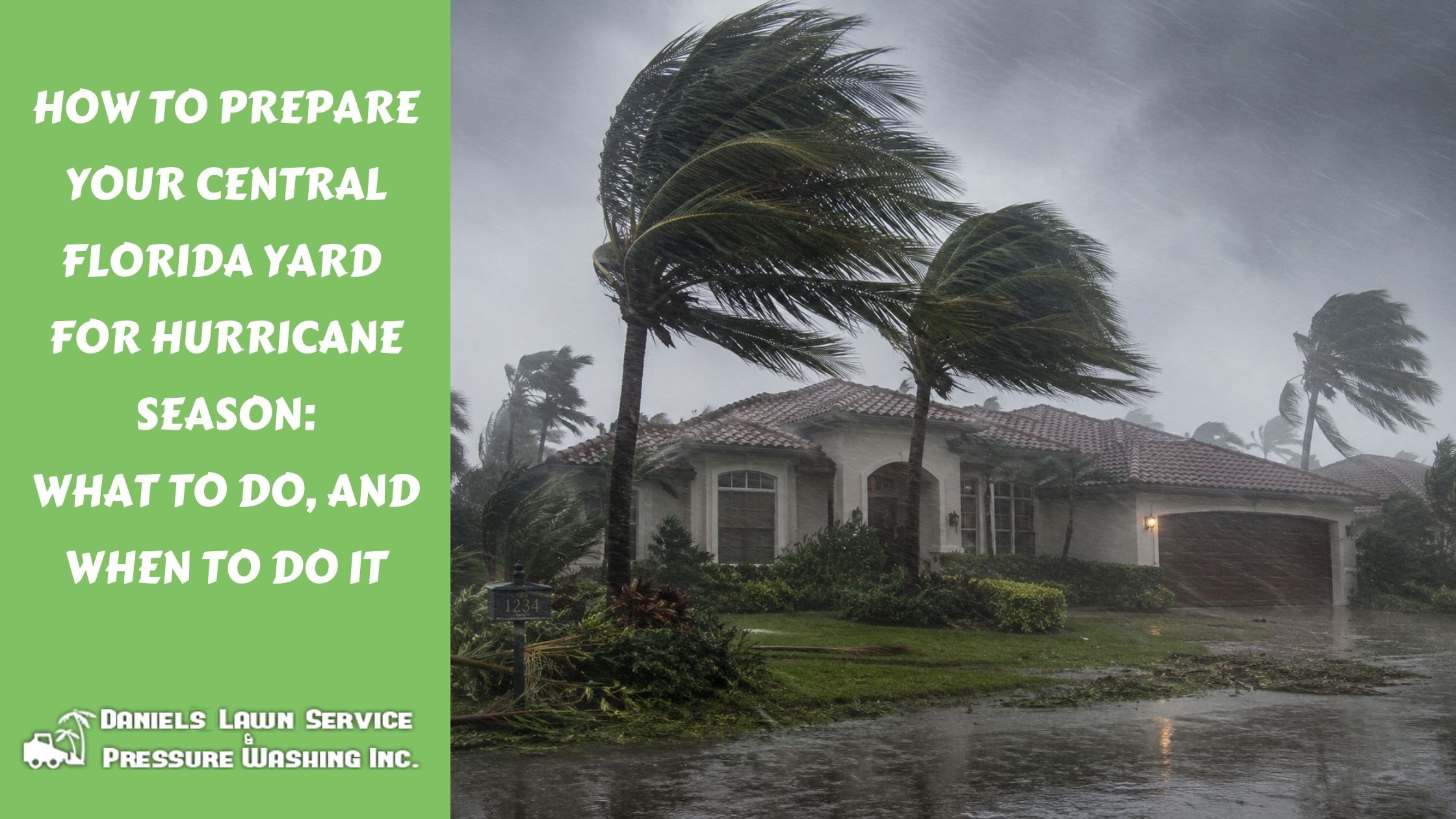
The time is fast approaching for hurricane season, which runs from June 1 through November 30. Native and long-time Floridians are now taking inventory of their stockpile of batteries, non-perishable food and other essentials to help tide them over should a hurricane hit and a prolonged power outage occurs. Truly experienced Central Floridians are also taking the time to look around their property to see how to best prevent damage from high winds, sustained torrential rains and flooding.
Hurricane season preparations for your yard shouldn’t be left for when a hurricane warning is issued — which is when sustained winds of 74 mph or higher are expected in 36 hours or less. At that point, you’ll be too busy scrambling to finalize all your other preparations to batten down the hatches and/or prepare to evacuate. The best time to take stock of your property and plan for the worst is now! Although the peak of hurricane season is typically August through mid-October, it doesn’t pay to take chances.
We at Daniel’s Lawn Service & Pressure Washing provide this general timeline to preparing your property.
What to Do Now
Take a good look at your trees. You may not typically be observant of their overall condition, but trees are especially vulnerable in a hurricane. Dead branches can snap off during a storm and crash through windows, as well as fall on houses, cars and people. Dead and unhealthy trees can be uprooted, causing the same types of property damage as fallen branches — but even more extensive. Moreover, fallen branches and trees can bring down overhead utility lines (the main reason for those prolonged post-hurricane power outages).
According to the University of Florida, Institute of Food and Agricultural Sciences (IFAS) Extension, a tree that is vulnerable during a hurricane is one with a high center of gravity, a dense canopy, a decayed trunk, two or more trunks, or shallow roots. Shallow roots result from shallow soil or a high water table.
Call a professional tree service to remove dead or declining trees, as well as cut branches overhanging the roof, carport or power lines. A tree service professional will also be able to determine the health of your trees, if you’re not sure.
CAUTION: Just in case you’re tempted to do so, cutting down heavy limbs or a tree are not DIY jobs, as most homeowners don’t have the tools, equipment or ability to do so safely. And don’t rely on YouTube or TikTok videos to educate you. Again, call a full-service yard service company or arborist to trim or remove trees.
With healthy trees, have the tree canopy maintained and thinned to increase air circulation. Palm trees are the exception, as they are naturally wind-resistant. The so-called “hurricane cut” for palms — in which all but the youngest fronds are removed — is unnecessary, and can undermine the health of the tree. When pruning palms, only remove fronds that are completely brown and that hang below the 9 o’clock or 3 o’clock position.
Also keep in mind that trees planted in the last five years don’t have an extensive root system to anchor them against strong winds. Reinforce the trunks with 2×4 stakes now, so you aren’t rushing to do so when a hurricane warning is issued.
Clean roof gutters of leaves, twigs and other debris — Tropical storms (maximum sustained wind speeds between 39 and 73 mph) and hurricanes produce torrential rains over a prolonged period. Roof gutters and downspouts clogged with debris can’t allow the water to run off. Wendy Wilber of Florida Farm & Family advises checking your yard’s drainage areas to make sure they’re free and clear of debris.
“Water cannot flow well through blocked drainage areas and can flood the yard if it has nowhere else to go. Standing water can cause trees to fall over and kill tree roots, even weeks after the storm.”
Make a plan to move your patio furniture, container plants and other items — As our blog post — “Hurricane Season Is Here! Is Your Yard Ready?” — notes, you don’t want to wait until a hurricane is imminent before deciding where such objects should be moved to protect them, as well as to prevent them from becoming projectiles that can crash through your windows in high winds! Decide the best place(s) to store your outdoor furniture, grill, garden ornaments and statuary, hanging and potted plants, etc. If you don’t already have them, buy the supplies needed to secure outdoor items that can’t be moved indoors.
Some items may be too heavy to pick up, yet could still become a projectile in hurricane-force winds. If an object requires being put on a hand truck or dolly and needs two people to move it, consider locating it to a protected area now. Once a hurricane threatens Central Florida, the help you’ll need to do the lifting may not be available!
Consider the need to secure large, relatively lightweight objects. Trampolines, in particular, need to be anchored well to prevent them from becoming airborne. Use heavy-duty straps, bungee cords, or sandbags to secure them to the ground.
By the way, a pool screen enclosure is not a protected area. Considering that a category 1 hurricane packs sustained winds of 74 to 95 mph, a screen enclosure offers little or no protection to anything inside. The screen panels and even frames themselves can be damaged by large, heavy objects — such as patio furniture — thrown against them.
Document your yard with photographs — Take wide-angle and close-up photos of all four sides of your home, roof, fencing, and landscaping in case you need to file an insurance claim should your property sustain hurricane damage.
What to Do During a Hurricane Watch
A hurricane watch is somewhat less urgent than a hurricane warning, but should be your call to put your plans into action — rather than waiting to see if your area is fully expected to be in the storm’s path. This is the time to do the following:
Secure outdoor furniture — Anchor items using sandbags, straps, or ground anchors, and use heavy-duty covers for protection. For maximum security, stack chairs, and move furniture into corners. Do not put furniture in the pool, thinking it will be protected. Its sharp edges can damage the pool’s surface, and pool chemicals can damage the furniture.
Bring outdoor objects indoors or secure them if they can’t be moved — You’ve already decided which potted plants and objects can be brought indoors, so do it now. For larger planters you’re unable to bring indoors, cluster them next to an exterior wall and tie them together, or lay them on their sides and group them together against your home’s foundation. If you have an outdoor grill, bring the grill indoors, but leave the propane tank outside, chained in an upright position to a solid object or structure.
Do a final check for anything you may have overlooked before going inside to ride out the storm. Grab those wind chimes!
Shut off your irrigation system — You won’t need it!
Do not drain the pool — If you do, it can pop out of the ground due to the excessive groundwater pressure caused by heavy rains. Swimming pool maintenance professionals also advise against covering the pool. Although it may seem a logical way to prevent debris from being dumped in, it’s easier to remove branches and other items afterward than replacing an expensive pool cover that’s been damaged by the same.
Be Prepared and Stay Safe This Hurricane Season!
The anxiety that many Floridians experience during hurricane season is understandable, but being prepared can alleviate a lot of worry. Daniel’s Lawn Service & Pressure Washing specializes in tree services, lawn care services, landscape design, pressure washing and bush hogging. We are licensed and insured, so you can hire us with confidence for all of your yard maintenance needs. We’re located in Lake Mary, serving Longwood, Sanford, Orlando, and the entire Central Florida area. Contact us to help you get ready for hurricane season, and take one more worry off your plate!
