

Florida’s warm climate, frequent rain and sandy soil create ideal conditions for lush lawns – but unfortunately, they also make the perfect environment for invasive weeds. These aggressive plants spread quickly, crowd out healthy grass and can be difficult to control without the right approach.
Knowing what you’re dealing with is the first step to protecting your lawn. Our blog post looks at some of the most invasive weeds commonly found in Florida lawns – as well as reasons why they’re so persistent, and tips on combating them before they conquer your yard!
Why Weeds Thrive in Florida
Florida is considered one of the most difficult states for weed management. The same conditions supporting turfgrass growth also enable weeds to flourish – usually faster and more aggressively than in other areas of the United States.
The main contributing factors are as follows:
Warm weather throughout the year – Florida’s subtropical climate means that even during rare hard freezes, temperatures never drop low enough, long enough to kill weeds. Our practically year-round growing season allows many weed species to grow and spread continually – not just spring and summer. This gives weeds far more time to establish and reproduce than in colder states.
Predominately sunny days – Closely related to warm weather, Florida has an abundance of sunlight throughout the year. Unlike other climates that have a true winter with weeks – or months – of gloomy, overcast skies – Florida truly lives up to its official nickname, The Sunshine State. Unfortunately, while people and turfgrasses love it, so do weeds!
High humidity and frequent rainfall – Florida receives heavy rainfall, especially during the summer rainy season. Combined with high humidity, this creates ideal conditions for weed seeds to germinate and grow quickly, as weed seeds sprout faster in moist soil and roots spread easily. Some weeds – such as dollarweed and sedges – actually thrive in wet conditions, and therefore spread rapidly in areas with poor drainage.
Sandy, low-nutrient soil – Florida is characterized by sandy soil that drains rapidly and is deficient in nutrients. Weeds are often better adapted to poor soil conditions than turfgrasses, allowing them to thrive where grass struggles.
Seven Common Central Florida Weed Species
Trust us, there are more than just seven weed species to exasperate Central Florida homeowners, but we had to narrow it down to a manageable list. To learn more about each, click on the link in the name.
Crabgrass is one of the most common and fast-spreading weeds in Florida. It thrives in thin or stressed lawns and grows low to the ground, making it difficult to eliminate once established. Spreading rapidly in late spring and summer, crabgrass produces thousands of seeds and grows in large clumps that choke out healthy turfgrass.
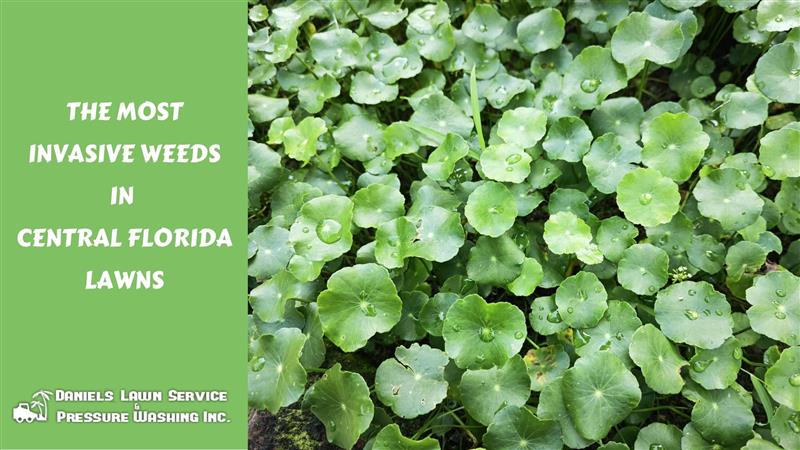
Dollarweed is easily recognizable by its round, coin-shaped leaves. As mentioned earlier, it thrives in moist areas and often signals overwatering or poor drainage, and returns quickly if conditions remain wet. Dollarweed spreads through underground stems, competing aggressively with turfgrass.
One of the most aggressive and invasive weeds in Florida, torpedograss is listed as a Category I invasive by the Florida Invasive Species Council (FISC). It spreads through an extensive underground rhizome system. If torpedograss is manually removed, any remaining rhizome or stem fragments will form new plants. It is difficult to control without professional treatment.
Sometimes mistaken for grass, nutsedge grows faster and taller than surrounding turf. It is easily identified by its tall, flower-bearing triangular stems. It is part of the sedge (Cyperaceae) family of grass-like flowering plants, and considered one of the world’s most pernicious weeds. In Florida, the most common species are yellow and purple nutsedge. Spreading through underground tubers, nutsedge thrives in wet soil – making it a common cause of drainage problems in lawns – and grows back quickly after mowing.
Goosegrass is a summer annual weed that flourishes in compacted soil areas – such as near driveways, walkways and spots subject to heavy foot traffic. Plants form low-growing matted, grass-like clumps that fan out from a central point. Its vigorous growth and abundant seed production make it an aggressively intrusive weed that competes successfully with warm- and cool-season turfgrasses.
This small, low-growing weed has a creeping growth pattern and tiny leaves. It exudes a milky sap that can irritate skin. In landscapes, it is frequently found growing in turfgrass or in mulched planting beds, but it is also commonly found growing in sidewalk cracks and between patio pavers. Garden spurge prefers warm and sunny locations but can also grow in dense shade. Spreading by means of seeds, it often occupies weak lawns and bare spots where the grass has died out.
A warm-season weed, Chamberbitter often goes unnoticed until it’s already spread throughout the lawn. Leaves are compound, with rounded leaflets growing on a long, stem-like part of the plant called an axil. The flowers are small and inconspicuous, distributed evenly along the axil. It produces seeds under its leaves, which scatter far and wide. Chamberbitter thrives in shady areas, and is difficult to control once mature.
Weed Prevention and Control Methods
Preventing weeds is easier than trying to eradicate them once they’ve gained a foothold in your lawn. Proper lawn care is fundamental to creating an environment that helps turfgrass thrive and is inhospitable to weeds. Fertilize your lawn frequently every six to eight weeks during growing season. This helps your lawn stay thick, leaving little space for weeds. Also, mowing your lawn at a taller height shades the soil, making it harder for the weed seeds to sprout, since their growth relies heavily on sunlight. Proper irrigation is another important component. Watering heavily and infrequently is the key to a thick grass and deeper roots, giving weeds tough competition. Improving drainage if necessary will eliminate wet areas in which some weed species thrive.
Apply pre-emergent herbicides – Pre-emergent herbicides prevent the germination of weed seeds. The herbicide creates a barrier in the soil, preventing weeds from growing in the first place. Lawn care professionals recommend two applications – one in the early spring and another in the fall. This captures these two critical windows and provides maximum protection for the lawn.
Use a post-emergent herbicide to treat existing weeds – For weed control, post-emergent weed killers are best applied in late spring and early fall – when the weeds are actively growing. You’ll have a better chance of controlling weeds if you spot, identify and treat them as early as possible. Our blog post – “Common Weeds in Central Florida Lawns” – covers this topic in detail.
Remove by hand – This method is only practical for small yards and flower beds. The obvious drawback is that it’s labor-intensive and time-consuming, should you decide to do it yourself. The best time to hand-pull weeds is when the soil is moist. For this method to be effective, make sure you remove the whole plant with its roots. Removing pervasive weeds may require you to dig them out of the ground using a trowel.
The Take-Home Message
Weeds will always be an issue with Central Florida lawns, but they need not be invincible! Successfully combating the numerous weed species that spread and take root requires knowledge, the right products and equipment, time, diligence, hard work and expense – which often is compounded by trial-and-error efforts for those who take the do-it-yourself approach.
Save yourself the toil and frustration of DIY weed control! Our experts at Daniel’s Lawn Service & Pressure Washing have the local experience and knowledge to understand weed growth cycles, seasonal variations and efficient weed control methods to keep your lawn at its best throughout the year. Moreover, our full-service company provides the expert lawn care that prevents the conditions which typically make a yard vulnerable to weed growth!
Our other services include landscape design, yard maintenance, pressure washing, tree installation, tree trimming, tree stump removal, land clearing and so much more. Contact us today so we can do the work, and you can do the enjoying! We proudly serve all of Central Florida – including Orlando, Sanford, Longwood and Lake Mary! We look forward to helping you achieve your goals and bring your vision to life!
