

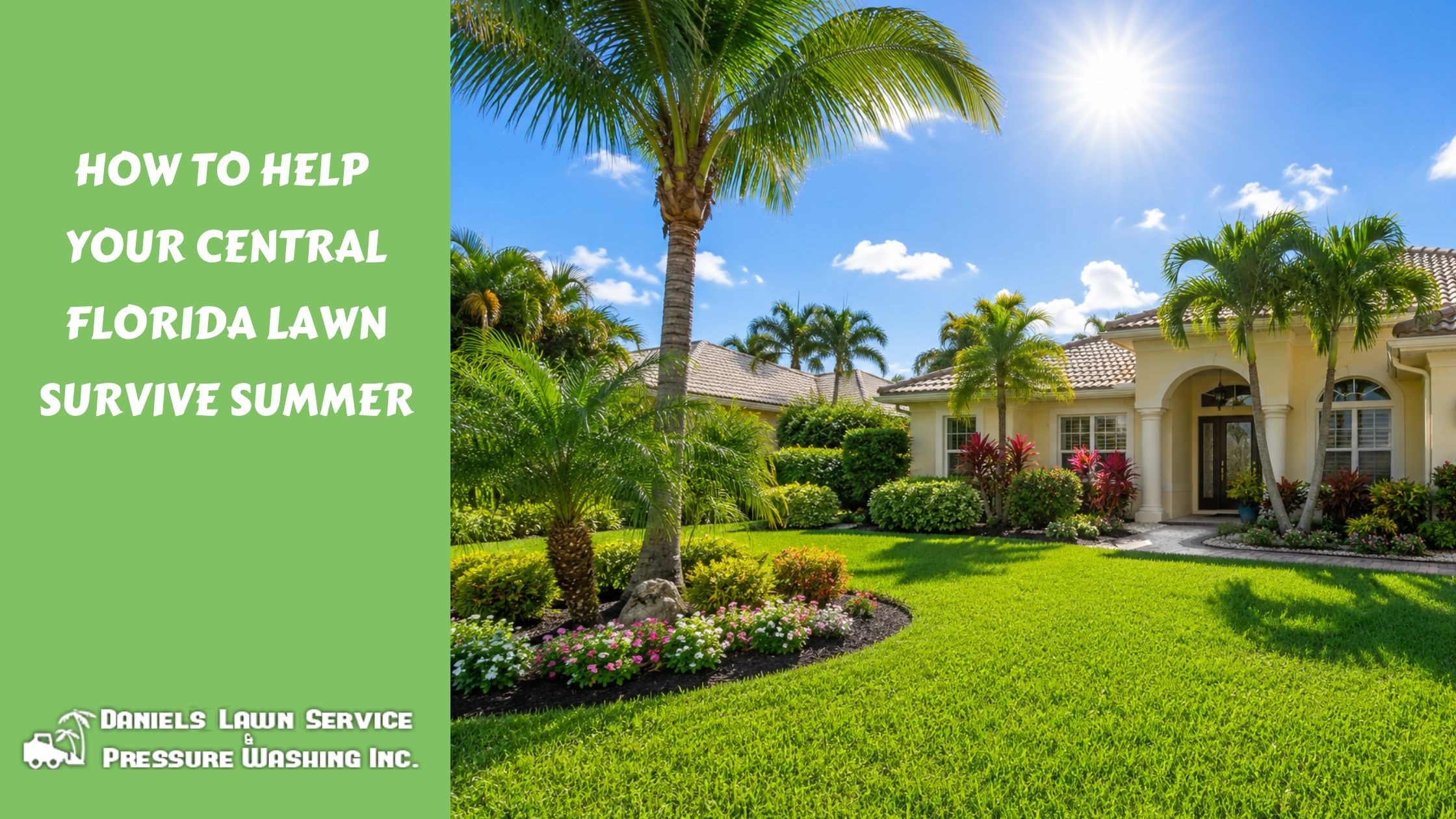
Summer in Central Florida can be brutal on lawns! Between intense heat, heavy humidity, afternoon thunderstorms, and aggressive pests, even healthy grass can struggle during the hottest months of the year. The good news? With the right maintenance strategy, your lawn can stay greener, healthier, and more resilient all summer long. Here’s how to help your Central Florida lawn survive summer stress!
Water Deeply — But Don’t Overwater
One of the biggest mistakes Florida homeowners make in summer is watering too often. While Central Florida receives frequent rainfall, lawns still need proper irrigation during dry periods. However, too much water can create fungal disease, shallow roots, and pest problems. Best watering practices include the following:
- Water deeply but infrequently
- Water early in the morning
- Avoid evening watering, which can encourage fungus
- Adjust irrigation based on rainfall
According to the University of Florida IFAS Extension (UF/IFAS), lawns typically only need supplemental irrigation when grass blades fold, dry spots appear, or footprints remain visible after walking on the lawn.
Raise Your Mowing Height
During summer, slightly taller grass helps protect your lawn from heat stress. While it may be tempting to do so, “scalping” (mowing too low) can badly stress your turf, leaving it vulnerable to disease, drought, and insect or weed invasion.
Longer grass blades provide the following benefits:
- Shade the soil
- Reduce moisture evaporation
- Encourage deeper roots
- Improve drought tolerance
UF/IFAS recommends mowing at the highest recommended height for your grass species.
- Bahia grass: 3.5 – 4″
- Centipede grass: 1 – 2″
- St. Augustine grass: standard cultivars, 3.5 – 4″; semi-dwarf cultivars, 2 – 2.5″
- Zoysia grass: The majority of these cultivars should be mowed at 1.5-2″
Summer mowing tips:
- Never remove more than one-third of the blade
- Keep mower blades sharp
- Avoid mowing during peak afternoon heat — this is also a health risk
- Never mow wet grass
Our blog post — “How to Care for Your Central Florida Yard in Summer” — covers this topic in greater detail.
Watch for Lawn Fungus and Disease
Florida’s heat and humidity create ideal conditions for lawn disease. Common summer lawn diseases include:
Brown patch fungus — This often appears as circular patches of brown or yellow grass that thrives in warm and humid conditions. It is known to spread rapidly when lawns remain wet for extended periods.
Grey leaf spot — Commonly affects St. Augustine grass and appears as small lesions on grass blades. Large sections of turf can thin out or die if the infection is major.
Take-all root rot — This is a disease that attacks the root system in the grass itself. Grass may appear yellow or weak, often looking drought-stressed even when adequate water is available.
Shady or poorly drained areas are especially vulnerable. Early detection is key.
Monitor for Summer Lawn Pests
Summer is peak season for pests like:
Chinch bugs — This deceptively harmless-looking insect feeds by draining the sap from grass while injecting a toxin until it withers. As described by University of Florida IFAS Gardening Solutions, “Young chinch bugs are orange with a white stripe across their back. As they grow older, they emerge as black, winged adults. The final stage of the lifecycle is an adult with black and white wings and orange legs. Even at this stage they are only a fifth of an inch long, about the length of a grain of rice. At this size they can be hard to spot.”
Look for chinch bugs between the sheaths of the leaf blades and in the thatch layer in the turf. Damaged areas appear as yellow to brown patches. The center of these areas may be dead and bare.
Mole crickets —This lawn pest looks like a cross between a mole and a cricket. They are uniformly brown, and adults are about 1 ½ inches long. They have large front legs for digging, which look similar to mole paws. They’re a serious pest notorious for tunneling through lawns and causing major damage to grass. Signs of infestation include:
- Brown spots of dead or dying grass.
- Small mounds of brown soil.
- Armadillos and birds on your lawn hunting for food.
Sod webworms — Highly destructive to lawns, sod webworm caterpillars are cream-colored with brown spots on each segment and a dark, yellowish brown head. They grow to a full length of slightly less than a half-inch. Sod webworms emerge as brown moths with splotchy triangular-shaped wings and are about ¾-inch wide. Signs of infestation include:
- Piles of bright green droppings.
- Thinning grass and brown patches.
- Ragged grass blades, shorter than the nearby grass.
All of these pests can quickly damage stressed lawns. Our blog post —“Insect Pests to Look Out for in Your Central Florida Yard” — covers this topic in detail.
What to do:
- Inspect your lawn regularly
- Look for yellowing or thinning areas
- Treat infestations early before they spread
UF/IFAS recommends routinely scouting your lawn during summer months to catch pest issues before major damage occurs.
Fertilize Carefully
More fertilizer does not always mean a greener lawn in summer. Over-fertilizing during extreme heat can:
- Burn grass
- Increase disease pressure
- Stimulate weak growth
Summer fertilization tips:
- Use slow-release fertilizers
- Follow local fertilizer ordinances
- Never fertilize immediately before heavy rain
Proper timing and application are critical for lawn health in Central Florida.
Reduce Stress on Your Lawn
Lawns under heat stress are more vulnerable to damage. Avoid the following:
- Heavy foot traffic during extreme heat
- Scalping the lawn
- Excessive herbicide use during high temperatures
Instead, leave grass slightly taller, limit unnecessary stress, and allow grass to recover after storms or drought conditions.
Improve Soil Health
Much of Central Florida has sandy soil that drains quickly and struggles to retain nutrients. Improving soil health helps lawns:
- Retain moisture
- Develop deeper roots
- Better tolerate summer heat
Helpful practices include the following:
- Aeration
- Topdressing with compost
- Mulching landscape beds
- Proper fertilization
Although many homeowners don’t perform it, aeration helps your irrigation and fertilization efforts achieve maximum effectiveness to result in healthy, green grass that’s better able to stand up to stress. Our blog post — “How to Aerate Your Central Florida Lawn” — provides step-by-step instructions.
The Take-Home Message
Keeping your Central Florida lawn healthy and green during the summer is possible, but takes dedication. You may not have the time it requires, and would probably prefer not to labor in triple-digit temperatures! That’s what we’re here for! Our dedicated Daniel’s Lawn Service & Pressure Washing team has been providing top-quality lawn care to Central Florida homes for more than 20 years.
In addition to lawn care, our full-service company provides landscape design, yard maintenance, plant and tree installation, tree trimming, tree stump removal, land clearing, pressure washing and so much more. Contact us today so we can do the work, and you can do the enjoying! We proudly serve all of Central Florida – including Orlando, Sanford, Longwood and Lake Mary! We look forward to helping you achieve your goals and bring your vision to life!
