

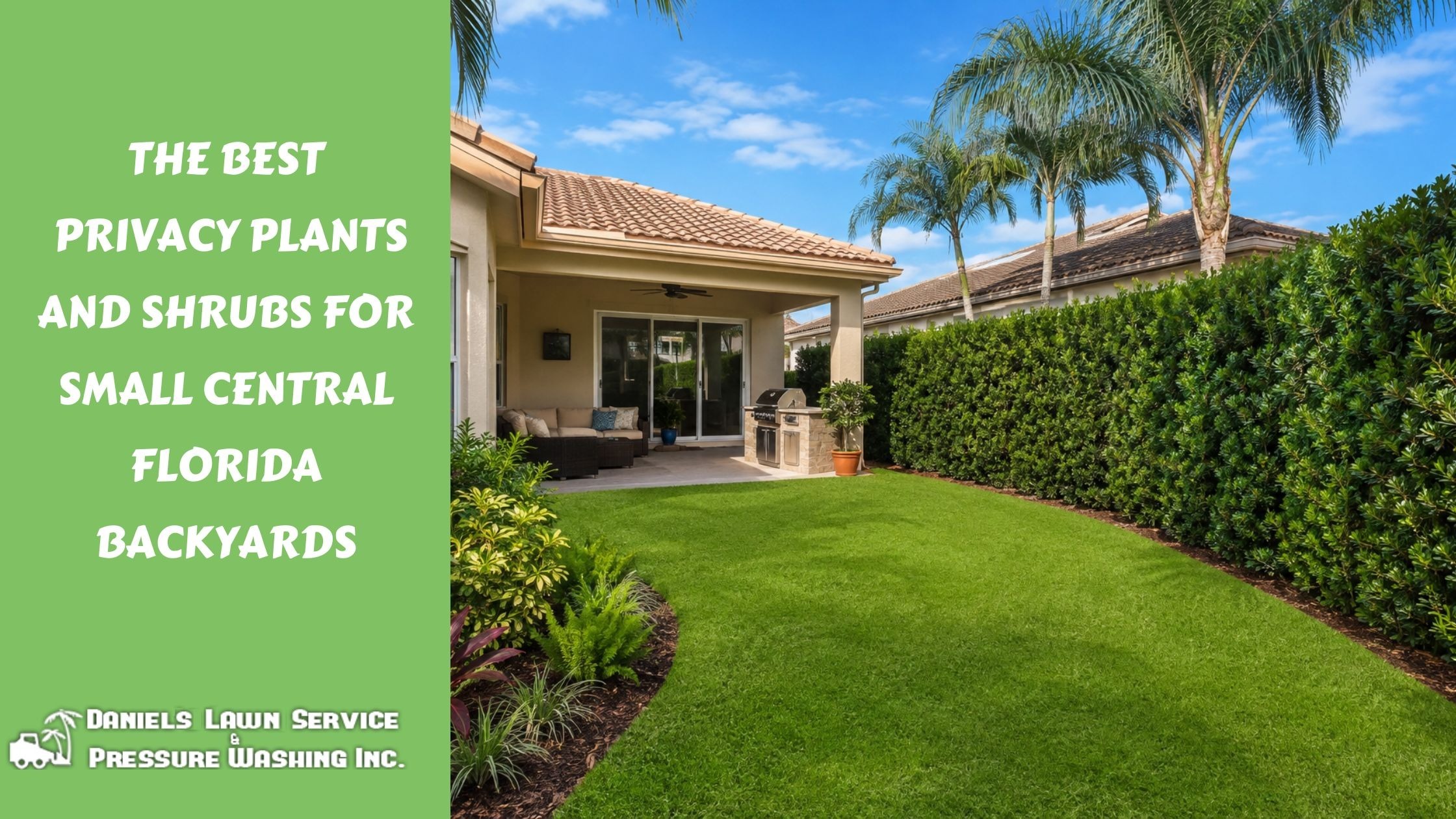
A backyard should be a place to relax, entertain, and enjoy the outdoors — not feel like you’re on display for the neighbors. Fortunately, you don’t need a large property or a tall fence to create a private outdoor retreat. With the right selection of trees, shrubs, and ornamental plants, even a small Central Florida backyard can become a lush, secluded oasis.
The key is choosing plants that thrive in Central Florida’s warm, humid climate while fitting the scale of a smaller landscape. Here are some of the best options to consider.
Why Use Plants Instead of a Privacy Fence?
While solid fences have their place, they’re expensive to build (and require a building permit to do so legally), and need to be cleaned on a regular basis — although we at Daniel’s Lawn Service & Pressure Washing can take care of that! A living privacy screen provides several advantages, such as the following:
- Create a softer, more natural appearance
- Reduce noise from nearby roads and neighbors
- Create wind resistance
- Provide shade and cooling benefits
- Attract birds, butterflies, and other wildlife
- Increase curb appeal and property value
- Continue to improve as they mature
For many homeowners, combining attractive landscaping with strategic plant placement creates a more inviting outdoor space than fencing alone.
Best Plants and Shrubs for Privacy
Although the following thrive in Central Florida, their success in your yard depends on several factors. Not all may be equally suitable for how you use your yard, or may require more maintenance than you’re able or willing to provide. Keep in mind that you’ll be dealing with several shrubs planted closely together, rather than one or two! Do your research carefully if you’re not working with a professional landscaper who can recommend hedge shrubs based upon the characteristics of your property, desired use of your yard and your lifestyle.
The following are hardy, popular plants for Central Florida yards. Click on the name of each to learn more!
Areca palm — Also known as the butterfly palm, the areca palm is one of Florida’s most popular privacy plants. When planted in groups, these fast-growing plants create a soft yet dense layered barrier that’s perfect around pools, patios, and backyard sitting areas. Its tropical appearance is another reason why the areca palm is a Central Florida landscaping favorite! Mature plants often grow 15to 25 feet tall but can be maintained shorter with regular trimming. Areca palms prefer full sun to moderate shade, and require well-drained soil. Our blog post — “Landscaping Ideas for Your Central Florida Pool Area” — provides more recommendations for plants that set a tropical scene!
Bamboo — If you’re seeking speedier seclusion, bamboo is fast-growing and provides a dense vertical screen. There are two types — running and clumping. Of the two, clumping is easier to maintain, does best in full to partial sun, and won’t grow aggressively out of bounds. Alphonse Karr (Bambusa multiplex) has a golden yellow cane and can grow to 30 feet tall, while black bamboo (Phyllostachys nigra) offers black canes and grows about 20-25 feet tall.
Clusia — Also known as pitch apple, clusia has become one of the most popular privacy plants in Central Florida — and for good reason. Its thick, leathery leaves create a dense hedge that remains attractive year-round. Once established, clusia is relatively drought-tolerant and withstands Florida’s heat well. It’s an excellent hedge for property lines. Although low-maintenance, clusia needs to be trimmed to maintain a neat appearance.
Coontie — A fascinating plant in its own right, coontie is the only cycad native to the United States. Typically one to three feet tall, it has stiff, glossy, featherlike leaves attached to a thick, short, underground stem. Low-maintenance and drought-tolerant, coontie is typically used in combination with taller screening shrubs to create layered landscaping. It can be planted in sun or shade. For those who want to attract butterflies to their yard, coontie also is the preferred food source for larvae of the rare Atala butterfly. But don’t worry about the coontie — its leaves grow back!
Firebush — This Florida native shrub produces masses of vibrant red and orange tubular flowers that add color and attract such pollinators as butterflies and hummingbirds throughout much of the year. Its quick growth and dense branching make it a good informal privacy hedge — especially for homeowners who want something more colorful than typical evergreen shrubs. Also known as the firecracker shrub, it does well in full sun, and is very tolerant of Florida’s heat once established.
Podocarpus — Podocarpus is a favorite among Florida homeowners because of its elegant appearance and versatility. Its soft, narrow foliage creates a refined hedge that complements both traditional and modern homes. It responds exceptionally well to pruning, making it ideal for smaller spaces. Depending upon your preference, it can be kept trimmed as a formal hedge, or left to develop into a softer natural screen. Podocarpus provides year-round privacy, and works well around pools and patios.
Simpson’s Stopper — This versatile Florida native plant can function as a shrub or a small tree depending on the cultivar and how you prune it. Simpson’s stopper has dense branches, fragrant white blooms and orange-red berries enjoyed by birds. Growing at a moderate pace, it’s easier to manage than some of the faster-growing hedge plants, and offers a lot of curb appeal. Simpson’s stopper responds well to pruning, and is as happy as a formal hedge as it is as an informal screen.
Viburnum — Few shrubs are as often recommended for Florida privacy hedges as viburnum. It grows quickly, adapts to many soil types, tolerates regular trimming, and forms a thick wall of greenery that blocks neighboring views. Walter’s viburnum is especially valued for its fine, dense foliage that adds texture to the landscape. Its branches provide a nesting site for songbirds such as cardinals, and small white flowers attract butterflies in the spring. This species is a host plant for spring azure butterfly larvae.
Tips for Planning a Privacy Hedge for a Small Backyard
Selecting the correct plants is just one aspect of the equation. A well-planned privacy hedge will be healthy, appealing and maintainable for years to come. Here are some important points to consider.
Mature plant size — Always choose plants by their mature height and width, not their nursery size. Space plants out enough to reduce competition and support healthy development.
Consider light requirements — Some privacy plants grow well in full sun, others like partial shade. If you match plants to the light conditions in your yard, you’ll have a better chance of success in the long run.
Layer various plants — Instead of planting a single row of shrubs, consider using multiple layers. For example:
- Tall areca palms in the back
- Podocarpus or clusia in the middle
- Coontie, ornamental grasses, or flowering perennials in front
This layered approach creates a fuller appearance while making the backyard feel larger and more natural.
Keep room for maintenance — Do not plant right against walls or other solid barriers. Providing adequate access makes pruning, watering, and lawn care much easier.
Follow good planting practices — The secret to an effective hedge is healthy roots. Proper planting depth, watering, mulching, and soil preparation all add to long-term growth.
Take HOA rules into account — If you live in a community with a homeowners association (HOA), check its regulations regarding plantings. Some have restrictions on plant species, height, location, etc. Making sure your landscaping plans comply beforehand will save you money!
The Take-Home Message
Using plants to create a privacy barrier in your backyard is an attractive and relatively inexpensive alternative to installing a solid fence. As you’ve learned, there are many great species of all sizes, with aesthetic and/or growth characteristics to suit any Central Florida yard.
If you need help in selecting the perfect privacy plants and shrubs, our experienced team at Daniel’s Lawn Service and Pressure Washing can provide beautiful designs that bring out the best in your property – and install the plants, as well! We eliminate the guesswork and trial-and-error plantings to give you an outdoor environment that allows you to enjoy your yard to the fullest while making you the envy of your neighbors! Call us today to learn how we can give you the lawn and garden of your dreams!
